

People process technology risk powerpoint template




Try Before you Buy Download Free Sample Product
 Impress Your
 Audience
 100%
100% Editable
 Save Hours
 of Time


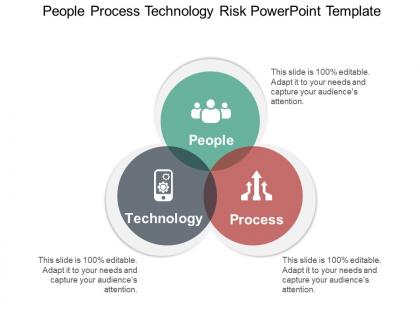
We help you focus on organization’s culture and understand the risk analysis by presenting to you our People Process Technology Risk PowerPoint Template slides. Our representation here focuses on the Venn diagram showing people process and technology images and how the combination of either of the 2 or the combination of all the 3 is required for organizational culture transformation and process improvement which ultimately results in a more effective and sustainable change effort. You can download this model PowerPoint graphic to showcase series of risks involved and how with the optimum usage of the 3 P’s can help to deliver a product, service or some other organizational goal. Our presentation graphic allows the top management to study the risks with respect to people process and technology and how to strategically plan to have the optimum results. So, address your thoughts using out PPT and gain momentum in your work. Avoid courting controversy with our People Process Technology Risk Powerpoint Template. They discourage dubious argument.
People who downloaded this PowerPoint presentation also viewed the following :
People process technology risk powerpoint template with all 5 slides:
Handle irrational fears with our People Process Technology Risk Powerpoint Template. Enable folks to intelligently assess their apprehensions.



FAQs for People process technology
The key components of the People Process Technology framework for risk management include skilled personnel with risk expertise, standardized risk assessment processes, comprehensive monitoring systems, automated detection tools, and integrated reporting mechanisms. These components work together by enhancing risk identification, streamlining compliance workflows, and enabling real-time threat response, with many financial institutions finding that this strategic combination ultimately delivers improved operational resilience and competitive advantage.
Interpersonal dynamics significantly influence risk management through communication patterns, trust levels, decision-making hierarchies, and collaborative problem-solving approaches that shape how organizations identify and respond to threats. Strong team relationships enhance information sharing, enable faster escalation of concerns, and promote proactive risk mitigation, while poor dynamics can create blind spots, ultimately delivering more resilient organizational defenses.
Common technological risks include cybersecurity threats, data breaches, system failures, outdated infrastructure, and integration challenges. These vulnerabilities significantly impact organizations across sectors, with financial institutions facing fraud risks, healthcare organizations managing patient data security, and retail companies protecting customer information, ultimately threatening operational efficiency, regulatory compliance, and competitive advantage in an increasingly digital landscape.
Employee training enhances risk management effectiveness by developing risk awareness, improving incident reporting protocols, ensuring regulatory compliance, and fostering proactive risk identification across all organizational levels. Through comprehensive training programs, organizations streamline response times, minimize human error, and create risk-conscious cultures, with many financial services and healthcare institutions finding that well-trained employees significantly reduce operational vulnerabilities while enhancing overall organizational resilience.
Organizational processes intersect with technology by creating interdependencies where system failures, data breaches, and automation errors can cascade across multiple business functions simultaneously. These intersections generate complex risk scenarios, especially in banking and healthcare, where process automation and digital workflows can amplify operational vulnerabilities while also enabling faster detection and response capabilities.
Organizations should track employee training completion rates, incident response times, system uptime percentages, compliance audit scores, and risk mitigation effectiveness across all three domains. These metrics enable comprehensive risk assessment by measuring human preparedness, operational efficiency, and technological resilience, with many institutions finding that integrated monitoring ultimately delivers enhanced organizational security and competitive advantage.
Organizations can ensure inclusive risk management by establishing diverse risk committees, conducting stakeholder mapping exercises, implementing multi-channel feedback mechanisms, and creating cross-functional assessment teams. This approach enables comprehensive risk identification across different business units, customer segments, and operational areas, with many companies finding that diverse perspectives reveal blind spots and enhance strategic decision-making capabilities.
Communication serves as the foundational risk mitigation strategy during technology implementation by ensuring stakeholder alignment, managing expectations, establishing clear protocols, and facilitating rapid issue resolution. Through structured communication frameworks, organizations streamline change management, minimize user resistance, and accelerate adoption timelines, with many finding that transparent, consistent messaging ultimately delivers smoother transitions and enhanced project success rates.
Businesses can leverage technology to streamline risk assessment through automated data collection, predictive analytics, real-time monitoring systems, AI-powered threat detection, and integrated reporting platforms. These technologies enable organizations to identify vulnerabilities faster, reduce manual errors, and enhance decision-making accuracy, with many financial institutions and healthcare providers finding that automated risk frameworks deliver significantly improved compliance outcomes and operational efficiency.
Frameworks for integrating people and processes into technological risk assessments include NIST Cybersecurity Framework, ISO 27001, COSO Enterprise Risk Management, FAIR quantitative analysis, and Human Factors Risk Assessment methodologies. These frameworks streamline risk evaluation by combining technical vulnerabilities with human behavior patterns and operational workflows, enabling organizations across financial services, healthcare, and manufacturing to deliver more comprehensive threat assessments and ultimately enhance their strategic risk management capabilities.
Regulatory changes significantly reshape the People Process Technology risk landscape by requiring updated compliance frameworks, revised operational procedures, and enhanced technological controls. These changes often demand workforce retraining, process modifications, and system upgrades, with many organizations finding that proactive regulatory alignment ultimately delivers competitive advantage and operational resilience.
Companies can align their workforce with evolving risk management through comprehensive training programs, cross-functional collaboration frameworks, technology integration workshops, and continuous communication strategies. These approaches enable organizations to build risk-aware cultures by enhancing employee understanding, streamlining processes across departments, and leveraging digital tools, ultimately delivering improved compliance and operational resilience.
Organizational culture significantly influences risk management through established values, communication patterns, and decision-making processes that shape how teams identify, assess, and respond to potential threats. Companies with open, collaborative cultures typically encourage proactive risk reporting and cross-functional coordination, while hierarchical organizations may experience delayed escalation, ultimately affecting operational resilience and strategic outcomes.
Best practices include establishing cross-functional risk committees, implementing shared dashboards and communication platforms, creating standardized risk reporting protocols, and conducting regular joint training sessions. These collaborative approaches enhance organizational resilience by breaking down silos, accelerating threat response times, and ensuring comprehensive risk visibility, with many enterprises finding that integrated teams deliver significantly faster incident resolution and more effective risk mitigation strategies.
Organizations can adapt their risk management strategies by implementing continuous monitoring systems, establishing cross-functional risk committees, and adopting agile assessment methodologies that evolve with emerging technologies. Through real-time analytics and collaborative frameworks, companies in sectors like financial services and healthcare streamline risk identification, enhance response times, and maintain regulatory compliance, ultimately delivering competitive advantage in an increasingly dynamic technological landscape.
-
Perfect template with attractive color combination.
-
Great product with effective design. Helped a lot in our corporate presentations. Easy to edit and stunning visuals.