

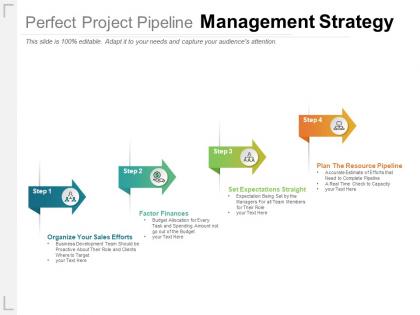
Perfect project pipeline management strategy




Try Before you Buy Download Free Sample Product
 Impress Your
 Audience
 100%
100% Editable
 Save Hours
 of Time


Broadcast your firm beliefs on our Perfect Project Pipeline Management Strategy. They ensure there is no distortion.
People who downloaded this PowerPoint presentation also viewed the following :
Perfect project pipeline management strategy with all 5 slides:
Get to the gist with our Perfect Project Pipeline Management Strategy. Keep your focus firmly on core essentials.




FAQs for Perfect project
Project pipeline management involves initiation, planning, execution, monitoring, and closure stages, with continuous evaluation and prioritization throughout the process. These stages streamline resource allocation, enhance project visibility, and optimize workflow efficiency, with many organizations finding that systematic pipeline management ultimately delivers faster project completion, better strategic alignment, and improved competitive advantage.
Effective project pipeline management enhances resource allocation by providing comprehensive visibility into project timelines, resource requirements, and capacity constraints across the organization. This strategic approach enables managers to optimize workforce deployment, minimize bottlenecks, and balance workloads more efficiently, with many organizations finding that streamlined pipeline oversight reduces project delays by up to 30%.
Key metrics for evaluating project pipeline success include throughput rate, cycle time, resource utilization, quality scores, and conversion rates from initiation to completion. These metrics enable organizations to streamline bottlenecks, optimize resource allocation, and enhance delivery predictability, with many project-driven companies finding that balanced scorecards ultimately deliver improved profitability and competitive advantage.
Project pipeline management aligns with organizational strategy by prioritizing projects based on strategic objectives, resource capacity, and expected ROI while ensuring optimal allocation across initiatives. Through strategic scoring frameworks and portfolio balancing, organizations streamline decision-making, eliminate redundant efforts, and accelerate high-impact projects, ultimately delivering measurable progress toward long-term goals and competitive advantage.
**INPUT**: What tools and software are recommended for effective project pipeline management? **OUTPUT**: Effective project pipeline management tools include Microsoft Project, Asana, Trello, Monday.com, and Smartsheet, each offering unique scheduling, tracking, and collaboration capabilities. These platforms streamline resource allocation, automate progress reporting, and enhance team communication across departments, with many organizations finding that integrated dashboards ultimately deliver improved project visibility and faster delivery timelines. [Word count: 56 words]
Risk management integrates into project pipeline processes through systematic risk identification, assessment protocols, and mitigation planning at each pipeline stage. By embedding risk evaluation frameworks within project gateways, organizations streamline decision-making, enhance resource allocation, and minimize project failures, with many companies finding that proactive risk integration ultimately delivers better project outcomes and competitive advantage.
Stakeholder communication serves as the foundation of effective project pipeline management, ensuring alignment on priorities, resource allocation, timelines, and strategic objectives across all organizational levels. Through regular updates, transparent reporting, and collaborative decision-making processes, project managers maintain stakeholder engagement, minimize conflicts, and secure continued support, ultimately delivering smoother project execution and enhanced organizational buy-in.
Organizations prioritize pipeline projects effectively through strategic alignment assessments, resource availability analysis, ROI calculations, risk evaluations, and stakeholder impact reviews. Through systematic scoring frameworks, companies streamline decision-making by weighing business value against implementation complexity, ultimately delivering optimized resource allocation and enhanced project outcomes across departments.
Common pipeline management challenges include resource conflicts, unclear prioritization criteria, inadequate forecasting, communication gaps, and bottleneck identification across multiple concurrent projects. These obstacles can be overcome by implementing standardized evaluation frameworks, establishing clear resource allocation protocols, and utilizing integrated project management tools, with many organizations finding that centralized visibility and data-driven decision making ultimately streamline workflows and enhance project delivery outcomes.
Pipeline management varies significantly across industries due to distinct project characteristics, regulatory requirements, and stakeholder needs. IT pipelines emphasize agile methodologies, continuous integration, and rapid iteration cycles, while construction focuses on sequential phases, regulatory compliance, and resource-intensive scheduling, with manufacturing pipelines prioritizing quality gates and supply chain coordination, ultimately requiring industry-specific tools and approaches.
Best practices for continuous improvement in project pipeline management include regular performance reviews, stakeholder feedback collection, data-driven decision making, process standardization, and cross-functional collaboration. These approaches streamline operations by identifying bottlenecks early, enhancing resource allocation, and accelerating project delivery timelines, with many organizations finding that systematic reviews and automated tracking ultimately deliver greater operational efficiency and competitive advantage.
Project pipeline management facilitates agile execution by enabling continuous workflow visibility, dynamic resource allocation, and rapid priority adjustments across multiple project phases. Through automated tracking and real-time dashboards, organizations streamline sprint planning, minimize bottlenecks, and accelerate delivery cycles, with many software development and consulting firms finding that pipeline visibility ultimately enhances team collaboration and project outcomes.
Feedback loops enable continuous pipeline improvement by identifying bottlenecks, measuring performance metrics, capturing stakeholder insights, and validating project outcomes against strategic objectives. Through regular feedback collection, organizations streamline resource allocation, enhance decision-making processes, and accelerate project delivery timelines, with many finding that systematic feedback integration ultimately delivers improved operational efficiency and competitive advantage.
Data analytics enhances project pipeline decision-making by providing real-time visibility into resource allocation, identifying bottlenecks before they impact timelines, and predicting project outcomes through historical performance patterns. Through advanced analytics dashboards, organizations streamline portfolio prioritization, optimize team utilization, and accelerate delivery cycles, with many finding that data-driven insights reduce project risks while improving strategic alignment.
Accurate project timeline forecasting techniques include critical path method analysis, earned value management, Monte Carlo simulations, historical data analysis, and three-point estimation using optimistic, pessimistic, and realistic scenarios. These methodologies enhance project predictability by identifying potential bottlenecks, resource constraints, and risk factors, with many organizations finding that combining multiple forecasting approaches delivers significantly improved timeline accuracy and better stakeholder confidence.
No Reviews