

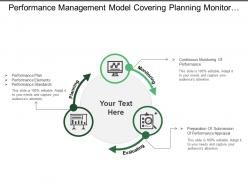
Performance management model covering planning monitoring and evaluating





Try Before you Buy Download Free Sample Product
 Impress Your
 Audience
 100%
100% Editable
 Save Hours
 of Time


Be assured of avoiding failure with our performance management model covering planning monitoring and evaluating. It is a good insurance.
People who downloaded this PowerPoint presentation also viewed the following :
Performance management model covering planning monitoring and evaluating with all 5 slides:
Most people miss the most important fact in a presentation which is the fact that the audience is sizing YOU the presenter. This they do physically and from the look of your performance management model covering planning monitoring and evaluating.



FAQs for Performance management model covering planning
Key components of an effective Performance Management Model include goal setting, continuous feedback, performance reviews, development planning, and recognition systems. These elements work together by aligning individual objectives with organizational strategy, providing regular coaching opportunities, and identifying growth areas, ultimately delivering improved employee engagement and business outcomes across all organizational levels.
Organizations align performance management with strategic goals by cascading objectives from corporate strategy to individual roles, establishing clear KPIs that directly measure strategic progress, and integrating goal-setting with regular performance reviews. Through strategic alignment frameworks, companies in sectors like retail and manufacturing streamline accountability, enhance resource allocation, and accelerate decision-making, ultimately delivering improved operational efficiency and competitive advantage.
Employee feedback serves as a critical component for identifying performance gaps, recognizing achievements, setting realistic goals, and fostering continuous improvement within organizations. Through regular feedback mechanisms, managers can enhance employee engagement, accelerate skill development, and align individual contributions with strategic objectives, ultimately delivering improved productivity and stronger organizational performance.
Technology enhances performance management systems by automating evaluations, providing real-time feedback platforms, and delivering advanced analytics for data-driven insights. Through AI-powered assessment tools and integrated dashboards, organizations streamline review processes, identify performance trends more accurately, and enable continuous coaching, ultimately delivering faster decision-making and improved employee development outcomes.
Common challenges include employee resistance to change, inadequate manager training, misaligned goals with business objectives, insufficient technology infrastructure, and lack of consistent communication throughout the organization. These implementation hurdles often stem from poor change management strategies, with many organizations finding that gradual rollouts, comprehensive training programs, and clear stakeholder buy-in ultimately deliver smoother transitions and higher adoption rates.
Remote performance management emphasizes outcome-based metrics, digital collaboration tools, and structured check-ins, while in-office settings rely more on observational feedback, spontaneous interactions, and physical presence indicators. Organizations increasingly find that remote environments require clearer goal-setting frameworks, enhanced communication protocols, and technology-driven tracking systems, ultimately delivering more measurable results and objective performance assessments.
Performance metrics should include goal achievement rates, quality of work output, collaboration effectiveness, skill development progress, and customer satisfaction scores. These comprehensive indicators enable organizations to assess both quantitative results and qualitative contributions, with many companies finding that balanced scorecards combining productivity measures with behavioral assessments deliver more accurate evaluations and strategic workforce insights.
Organizations foster continuous feedback cultures by implementing regular check-ins, peer feedback systems, real-time performance tracking tools, and manager training programs that emphasize ongoing dialogue over annual reviews. Through these structured approaches, companies like tech startups and financial services firms create transparent communication channels, enhance employee engagement, and accelerate professional development, ultimately delivering improved performance outcomes and stronger organizational alignment.
Goal-setting establishes clear expectations, creates measurable benchmarks, and aligns individual contributions with organizational objectives, providing employees direction and purpose while enabling managers to track progress effectively. Through structured goal frameworks, organizations streamline performance evaluations, enhance employee engagement, and drive strategic outcomes, with many companies finding that well-defined goals increase productivity and accountability significantly.
Performance management systems can be tailored for diverse teams by incorporating flexible goal-setting frameworks, culturally sensitive feedback mechanisms, multiple evaluation methods, and individualized development pathways. Organizations across sectors like technology and healthcare increasingly customize approaches by recognizing different communication styles, cultural backgrounds, and work preferences, ultimately delivering more equitable assessments and enhanced team performance.
Leadership style significantly influences performance management effectiveness by shaping communication approaches, feedback delivery methods, goal-setting processes, and employee development strategies. Transformational leaders often achieve higher engagement through collaborative goal-setting and continuous coaching, while directive leaders excel in structured environments requiring clear metrics, with many organizations finding that adaptive leadership styles ultimately deliver better performance outcomes and stronger employee retention.
Organizations ensure fairness in performance evaluations through standardized criteria, regular calibration sessions, multiple reviewer perspectives, clear documentation processes, and consistent timing across all departments. These approaches minimize bias by establishing objective benchmarks, providing structured feedback mechanisms, and creating transparent review processes, ultimately delivering equitable assessments that enhance employee trust and organizational credibility.
Managers need training in goal setting, feedback delivery, performance evaluation techniques, coaching skills, and conflict resolution to effectively implement performance management models. Through structured programs covering communication strategies and data analysis, organizations streamline manager development, enhance employee engagement, and deliver consistent performance outcomes, with many companies finding that well-trained managers significantly improve overall team productivity and retention rates.
Performance management contributes to employee engagement and retention by establishing clear expectations, providing regular feedback, recognizing achievements, and creating development opportunities that align individual goals with organizational objectives. Through structured performance conversations and career planning, organizations enhance employee satisfaction, reduce turnover costs, and build stronger talent pipelines, with many companies finding that consistent performance dialogue ultimately delivers improved productivity and competitive advantage.
Performance review best practices in hybrid environments include establishing consistent communication protocols, utilizing digital collaboration tools, setting clear remote work expectations, scheduling regular one-on-ones, and focusing on outcome-based metrics rather than hours worked. These approaches streamline evaluation processes by enhancing transparency, improving manager-employee connections, and delivering fair assessments across distributed teams, with many organizations finding that structured hybrid reviews ultimately boost employee engagement and retention.
-
Design layout is very impressive.
-
Amazing product with appealing content and design.