

Phishing Assessment And Cyber Security Training




Try Before you Buy Download Free Sample Product
 Impress Your
Audience
 100%
Editable
 Save Hours
of Time


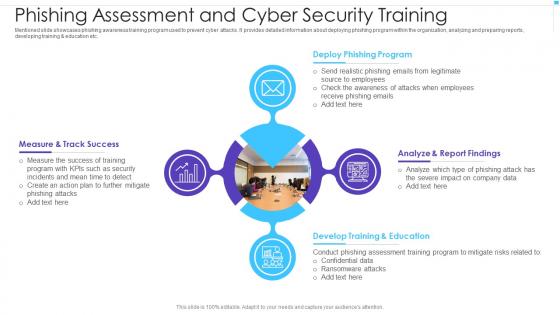
Mentioned slide showcases phishing awareness training program used to prevent cyber attacks. It provides detailed information about deploying phishing program within the organization, analyzing and preparing reports, developing training and education etc.
People who downloaded this PowerPoint presentation also viewed the following :
Phishing Assessment And Cyber Security Training with all 6 slides:
Use our Phishing Assessment And Cyber Security Training to effectively help you save your valuable time. They are readymade to fit into any presentation structure.






FAQs for Phishing Assessment And
The most common phishing attacks today include email phishing, spear phishing, whaling, smishing (SMS), vishing (voice), and clone phishing. These sophisticated methods target organizations by exploiting human psychology, mimicking trusted communications, and leveraging social engineering tactics, with many financial institutions and healthcare organizations finding that comprehensive employee training and multi-layered security protocols significantly reduce successful breach attempts.
Individuals can identify phishing emails through suspicious sender addresses, urgent language demanding immediate action, generic greetings, grammatical errors, and unexpected attachments or links. These warning signs help users recognize fraudulent attempts targeting personal information, with many organizations finding that employee training on email verification, hovering over links before clicking, and reporting suspicious messages significantly reduces security breaches and enhances overall cybersecurity.
Social engineering techniques form the psychological foundation of phishing scams, manipulating human emotions like urgency, fear, trust, and curiosity to bypass rational decision-making. These tactics exploit cognitive biases through fake urgent notices, impersonated authority figures, and fabricated crises, with cybercriminals increasingly combining technical deception with behavioral psychology to maximize success rates across organizations.
Phishing has evolved through sophisticated social engineering, AI-generated content, mobile-targeted attacks, deepfake technology, and multi-channel approaches across email, SMS, and social platforms. These advanced techniques enable cybercriminals to create highly personalized, convincing campaigns that bypass traditional security measures, with many organizations finding that comprehensive employee training and AI-powered detection systems provide the most effective defense against these increasingly sophisticated threats.
Companies facing phishing attacks encounter legal implications including regulatory fines, compliance violations, customer lawsuits, breach notification requirements, and potential criminal liability for negligence. These consequences vary by industry and jurisdiction, with financial services, healthcare, and retail sectors facing stricter penalties, ultimately emphasizing the critical importance of robust cybersecurity frameworks and incident response protocols.
Organizations can implement comprehensive phishing education through regular security awareness training, simulated phishing exercises, interactive workshops, email security guidelines, and incident reporting protocols. These preventive measures enhance employee vigilance by teaching threat recognition, establishing clear response procedures, and creating security-conscious workplace culture, with many companies finding that consistent training programs significantly reduce successful phishing attacks and strengthen overall cybersecurity posture.
Multifactor authentication significantly reduces phishing risks by requiring additional verification steps beyond passwords, including biometric scans, mobile codes, and hardware tokens. Even when cybercriminals steal login credentials through phishing attacks, they cannot access accounts without these secondary authentication factors, with many financial institutions and healthcare organizations finding this approach delivers enhanced security and substantially minimizes unauthorized access incidents.
Notable phishing attacks include the 2016 Democratic National Committee breach, Target's 2013 data compromise, and Anthem's healthcare records incident affecting millions. These attacks demonstrate how sophisticated social engineering can bypass traditional security measures, resulting in stolen credentials, financial losses exceeding billions collectively, and lasting reputational damage that continues impacting organizational trust and operational costs.
Phishing attacks targeting individuals typically focus on personal credentials, banking information, and social media accounts through generic mass emails. Corporate phishing employs sophisticated spear-phishing techniques, targeting specific employees with company-relevant content, business email compromise schemes, and advanced persistent threats, ultimately seeking intellectual property, financial systems access, and broader network infiltration for strategic advantage.
Phishing detection tools include email security gateways, anti-phishing software, URL analysis platforms, DNS filtering solutions, and AI-powered threat intelligence systems. These technologies enhance cybersecurity by analyzing suspicious patterns, blocking malicious links, and filtering deceptive communications, with many organizations finding that strategic combinations ultimately deliver faster threat response and significantly reduced security incidents.
Businesses can recover from phishing attacks through immediate incident response, system isolation, credential resets, security audits, and stakeholder communication. Organizations typically engage cybersecurity experts to assess damage, implement enhanced monitoring, and strengthen employee training programs, while financial institutions and healthcare providers often find that transparent communication with customers and regulatory compliance accelerate recovery and restore trust.
URL spoofing is critical to phishing success because it creates seemingly legitimate web addresses that deceive users into entering sensitive information on fraudulent sites. Through domain masquerading, character substitution, and subdomain manipulation, cybercriminals effectively mimic trusted brands like banks and retail platforms, with many organizations finding that employee training and URL verification tools significantly reduce successful attacks.
Emerging phishing trends include AI-generated deepfake communications, sophisticated social engineering through social media reconnaissance, mobile-focused attacks targeting banking apps, and supply chain compromises through trusted vendor impersonation. These evolving tactics exploit remote work vulnerabilities, cloud service dependencies, and increased digital transaction volumes, with cybercriminals leveraging automation and personalization to bypass traditional security measures, ultimately requiring organizations to adopt more dynamic, behavior-based detection systems.
Users can effectively report suspected phishing by forwarding suspicious emails to the Anti-Phishing Working Group at [email protected], notifying their IT departments, and using built-in reporting features in email platforms like Outlook and Gmail. Many organizations streamline this process through dedicated security teams and automated reporting tools, ultimately enhancing collective cybersecurity defenses and enabling faster threat response across industries.
Psychological factors that make individuals susceptible to phishing include urgency manipulation, authority deception, social proof exploitation, fear-based messaging, and trust hijacking through familiar branding. These tactics leverage cognitive biases by creating artificial time pressure, impersonating legitimate institutions, and exploiting emotional vulnerabilities, with many organizations finding that employee awareness training significantly reduces susceptibility rates.
-
SlideTeam is a great place for PPT templates. They have many templates on a single topic. It has made my life a lot easier.
-
Requested a complete pitch deck. Delivered immediately and with high quality well researched content.