

Pitch deck slide competitive analysis template 4 scatter chart radar chart ppt samples





Try Before you Buy Download Free Sample Product
 Impress Your
Audience
 100%
Editable
 Save Hours
of Time


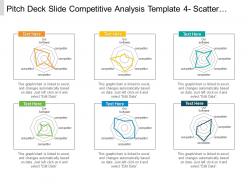
Introducing Pitch Deck Slide Competitive Analysis Template 4 Scatter Chart Radar Chart PPT Samples. With the help of a PowerPoint presentation slide highlight the factors that help to identify the strategies of your competitors. You can elaborate on the numerous key points that determine the activities of the third party using our PPT template. Use this PowerPoint presentation slide to focus on the events of your current and potential opponent. There are numerous steps such as extensive distribution, customer focus, economies of scale, and product innovation which you can mention with the assistance of our PPT slide. The PowerPoint presentation template enables you to brief about the features that increase your reputation in the market. Using this PPT slide, you can showcase the methods that help to implement, analyze, monitor, and develop new technologies that degrade the performance level of your rival. Therefore, download our PowerPoint presentation template and estimate your future competitive threats.
People who downloaded this PowerPoint presentation also viewed the following :
Pitch deck slide competitive analysis template 4 scatter chart radar chart ppt samples with all 5 slides:
Create stunning presentations with our Pitch Deck Slide Competitive Analysis Template 4 Scatter Chart Radar Chart Ppt Samples to make a mark in your career world. The exclusive quality and of our products will global character empower you in conveying your exceptional vision.


FAQs for Pitch deck slide competitive analysis template 4 scatter chart radar
Key metrics should include market share percentages, pricing strategies, product feature comparisons, customer satisfaction scores, and brand recognition levels. These metrics enable organizations to identify competitive gaps, benchmark performance against industry leaders, and develop strategic positioning advantages, with many businesses finding that comprehensive analysis across these areas ultimately delivers clearer market insights and enhanced competitive differentiation.
A competitive analysis template helps identify product gaps by systematically comparing features, pricing, target markets, and value propositions across competitors, revealing unmet customer needs and market opportunities. Through structured evaluation, businesses can pinpoint areas where competitors excel, discover underserved segments, and strategically position new offerings, ultimately enabling more targeted product development and enhanced competitive advantage.
Visual elements that enhance competitive analysis presentations include interactive charts, competitor comparison matrices, SWOT analysis diagrams, market positioning maps, and branded infographics. These elements streamline complex data interpretation by transforming dense spreadsheets into digestible visuals, enabling clearer strategic insights, and ultimately delivering more persuasive presentations that drive faster decision-making and stakeholder buy-in.
Competitive analysis should be updated quarterly for comprehensive reviews, with monthly monitoring of key competitors and immediate updates for significant market changes, product launches, or strategic shifts. A standardized template facilitates this process by streamlining data collection, ensuring consistent metrics tracking, and enabling quick comparison updates, ultimately delivering faster insights and more agile strategic responses.
Reliable data sources for competitive analysis templates include company websites, annual reports, industry publications, customer reviews, social media analytics, and market research databases like IBISWorld or Statista. These sources enable businesses to gather comprehensive competitor intelligence on pricing strategies, product features, and market positioning, with many organizations finding that combining multiple data streams delivers more accurate insights and stronger competitive advantages.
SWOT analysis enhances competitive analysis templates by systematically evaluating each competitor's strengths, weaknesses, opportunities, and threats alongside market positioning data. This strategic combination enables businesses to identify competitive gaps, benchmark capabilities, and uncover market opportunities more effectively, with many organizations finding that integrated SWOT frameworks streamline strategic planning and deliver clearer competitive advantages.
Customer feedback enriches competitive analysis templates by providing real-world insights into competitor strengths, weaknesses, pricing effectiveness, and service quality gaps that internal research might miss. Through customer surveys, reviews, and direct feedback, organizations uncover competitive positioning opportunities, identify unmet market needs, and validate strategic assumptions, ultimately delivering more accurate competitive intelligence and enhanced market differentiation strategies.
You can tailor a competitive analysis template by identifying industry-specific metrics, regulatory requirements, customer behaviors, and competitive factors unique to your sector. For example, healthcare organizations focus on compliance and patient outcomes, while retail companies emphasize customer acquisition costs, seasonal trends, and omnichannel strategies, ultimately delivering more relevant insights for strategic decision-making.
Common pitfalls include relying on outdated data, focusing solely on direct competitors while ignoring emerging threats, overemphasizing features without analyzing customer value propositions, and failing to update analysis regularly. These oversights can lead to strategic blind spots, with many organizations finding that successful competitive analysis requires continuous monitoring, broader market perspective, and actionable insights rather than static comparisons, ultimately delivering more informed decision-making.
Competitive analysis significantly impacts marketing strategy by revealing market positioning opportunities, identifying competitor weaknesses, uncovering pricing strategies, and highlighting differentiation points. The template should emphasize competitor messaging approaches, target audience overlaps, content strategies, and promotional tactics, with many organizations finding that systematic competitive intelligence enables more strategic campaign development, better resource allocation, and ultimately stronger market positioning against rivals.
Tools for enhancing competitive analysis templates include SEMrush, Ahrefs, SimilarWeb, Sprout Social, and Google Analytics, alongside specialized platforms like Kompyte and Crayon. These technologies streamline data collection, automate competitor monitoring, and deliver real-time insights across marketing channels, with many organizations finding that integrated analytics ultimately enhance strategic decision-making and competitive positioning.
Visual representation methods include SWOT matrices, radar charts, competitive positioning maps, strength-weakness grids, and comparison tables with color-coded performance indicators. These visualization tools streamline competitor assessment by highlighting performance gaps, market positioning, and strategic opportunities, with many organizations finding that visual competitive analysis accelerates decision-making and strategic planning processes.
Best practices for sharing competitive analysis findings include creating executive summaries with key insights, using visual dashboards for quick comprehension, organizing data by competitor strengths and weaknesses, highlighting actionable recommendations, and scheduling regular review sessions. These templates enhance team collaboration by streamlining information flow, enabling faster strategic decisions, and ensuring consistent communication across departments, with many organizations finding that structured sharing ultimately delivers improved market positioning and competitive advantage.
Competitor pricing strategies can be effectively compared through price range matrices, value proposition mapping, pricing model comparisons, and competitive positioning charts within templates. These visual frameworks enable businesses to analyze pricing tiers, identify market gaps, and assess value-versus-cost positioning across competitors, ultimately delivering strategic insights for optimal pricing decisions and competitive advantage.
**INPUT**: What additional elements, like market trends or consumer behavior, should be considered when creating a comprehensive competitive analysis? **OUTPUT**: Comprehensive competitive analysis should incorporate market trends, consumer behavior patterns, pricing strategies, digital presence evaluation, customer satisfaction metrics, and regulatory changes affecting the industry. These elements enhance strategic decision-making by revealing competitor vulnerabilities, emerging opportunities, and shifting customer preferences, with many organizations finding that integrating behavioral data with trend analysis delivers deeper market insights and sustainable competitive advantage.
-
Nice and innovative design.
-
Wonderful templates design to use in business meetings.