

Plan To Conduct Understudy Training For Junior Employees Formulating On Job Training Program





Try Before you Buy Download Free Sample Product
 Impress Your
Audience
 100%
Editable
 Save Hours
of Time


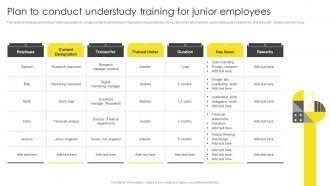
This slide showcases plan that can help organization to conduct understudy training for high performing employees. Its key elements are employee, current designation, trained for, trained under, duration and key focus.
People who downloaded this PowerPoint presentation also viewed the following :
Plan To Conduct Understudy Training For Junior Employees Formulating On Job Training Program with all 6 slides:
Use our Plan To Conduct Understudy Training For Junior Employees Formulating On Job Training Program to effectively help you save your valuable time. They are readymade to fit into any presentation structure.





FAQs for Plan To Conduct Understudy Training For Junior Employees Formulating On
Okay so you basically want them to be rock-solid backups who can jump in without missing a beat. Get them to nail all the blocking, lines, and character work - like they ARE the main actor. I always think of it as being the backup QB but with better costumes lol. Give them real rehearsal time on stage, not just watching from the wings. They need to understand WHY choices were made, not just memorize the moves. Do one-on-ones regularly. And seriously, don't wait until tech week to see if they're actually ready - that's just asking for disaster.
Look for the people who are naturally curious about stuff outside their job and already crush it in their current role. High performers who get restless? Gold mine - they'll eat up the challenge. Notice who asks smart questions in meetings or jumps on cross-team projects without being asked. Check your performance reviews too for anyone who's mentioned wanting to grow or shows leadership vibes. Honestly, I'd just start casual conversations about where they see themselves going. Then make a quick grid - interest vs ability. You'll figure out your winners pretty fast that way.
Honestly, quick memorization and blocking are everything when they call you up last minute. Work on character motivations too - I can't tell you how many understudies I've watched who know every line but completely miss what drives their character. Super frustrating to watch. Don't just run scenes with the leads either, practice with other understudies since cast changes happen constantly. Smooth transitions between scenes will save your butt. And here's the thing - being adaptable beats being perfect every time. Set up regular run-throughs so you're actually performance-ready, not just stumbling through rehearsals.
Honestly, it's all about risk tolerance and timing. Theater understudies get like one rehearsal because the show literally must go on - kinda brutal if you ask me. Corporate handoffs are way more chill though, you'll usually get weeks of shadowing. Healthcare goes nuts with simulation training since, you know, people could die. Airlines do something similar with their backup pilots. Oh and definitely ask about shadowing opportunities early on - most managers actually appreciate when you're proactive about it instead of waiting until someone quits unexpectedly.
Dude, mentorship is huge for understudies. You can't just throw someone into rehearsals and expect them to figure it out. Pairing them with experienced performers gives them real feedback and emotional support - plus all that behind-the-scenes knowledge you don't get otherwise. Going on last minute is scary as hell (I mean, imagine getting that call). Having a mentor who's actually been through it becomes like their safety net. They'll build confidence way faster. Oh and don't leave the pairings to chance - make them official. Random mentoring barely works.
Video recording is honestly a game-changer for blocking and choreography - understudies can watch scenes whenever they need to. VR stuff is cool for immersive rehearsals too, though I haven't tried it myself. Basic shared Google docs for notes work surprisingly well. There are apps for scheduling rehearsals and annotating scripts that help track everything. Digital voice coaching lets understudies practice independently, and video calls work great for remote director sessions. Don't go overboard though - pick like 2-3 tools that actually make sense for how you work instead of trying every flashy new thing.
Honestly, I'd focus on two main things: how fast people can jump in when needed and whether stuff actually runs smoothly when they do. Check confidence levels during handoffs - that's huge. Get feedback from everyone involved, both the person being covered and their team. Knowledge assessments work too, though they feel kinda awkward and school-ish. But really, the proof is in actual absences - minimal chaos and productivity stays decent. Oh, and track this stuff regularly or you won't catch training gaps. I'd start simple with a basic scorecard hitting these points, then tweak based on what you're seeing. The patterns usually show up pretty quick.
Honestly, the trick is making it feel like actual growth instead of just piling on more work. Set up mentorship pairs so people can shadow different roles. Those lunch and learns work surprisingly well - keeps things relaxed but regular. Don't give them busy work though, that's the worst. Give understudies real projects where they can actually take on more responsibility over time. Track the cross-training and tie it to reviews or promotions. People need to see there's a payoff. Oh, and celebrate when someone steps up to a challenge - that stuff matters more than you'd think.
Honestly, the two biggest headaches are gonna be time and pushback from your team. People get paranoid they're training their own replacements - which I totally get, that's scary stuff. Finding time for training when everyone's already swamped? Good luck with that. Be upfront about how this actually helps their careers grow. Don't call it "replacement prep" - frame it as skill building instead. Try scheduling during your slower weeks if you have any. Maybe throw in some incentives too? Start with just your most critical roles first. Once people see it's not about firing anyone, the resistance usually dies down.
You're basically building your own backup system by training people who already get how things work. Having someone shadow key roles means they're learning the real stuff - the daily chaos, office politics, all of it. Way better than hiring someone cold who has to figure everything out from scratch. You can also see who actually handles stress well versus who just interviews nicely. Honestly, the relief of not panicking when someone quits unexpectedly? Priceless. I'd start by figuring out which positions would screw you over most if they went empty, then get understudies shadowing those roles ASAP.
First thing - figure out what they actually need to know, then chunk it into stuff they can handle. I'd do a mix of them shadowing you and some actual sit-down training time. The shadowing is honestly where they'll learn the most useful stuff. Don't just focus on the technical parts either - they need to see how you make decisions and deal with team drama. Set up regular check-ins and maybe some fake scenarios where they can mess up without consequences. Oh, and give them real exposure before they're thrown into the deep end!
Real-time coaching during rehearsals works best - catch them in the moment with quick fixes. Then do deeper one-on-ones afterward when they can actually think straight. Video reviews are gold, though some actors absolutely hate seeing themselves on camera (honestly can't blame them). Make your notes super specific instead of just saying "that was good" or whatever. I'd create a basic form covering blocking, character stuff, and technical notes so you don't forget anything important. Weekly check-ins minimum, but don't make it feel like homework. The whole point is helping them nail it when it counts.
Honestly, cross-department training is a game changer for your understudies. They get to work with the actual people they'd deal with during real incidents instead of just learning in a vacuum. You know how a database crash suddenly becomes everyone's problem? They'll see that firsthand - how it hits customer support, messes with dev deployments, the whole chain reaction. Other teams catch blind spots you'd never think of too since they use your systems totally differently. I've watched this approach uncover so many weird edge cases that would've blindsided us otherwise. Set up some regular shadowing sessions between departments. Works way better than keeping everyone siloed.
Honestly, soft skills are everything for understudy work - probably more than the technical side. Communication is key since you're constantly asking questions and need to soak up feedback fast. Being adaptable matters too because you're juggling multiple roles with barely any rehearsal time. Watch and learn without getting in anyone's way (emotional intelligence basically). Oh, and confidence - because when they call your number, you can't freeze up. My biggest tip? Really listen during those shadowing sessions. Don't just nod along. And seriously, ask questions when you're confused - better than screwing up later.
Definitely get your key person to write down step-by-step guides for everything important. But here's the thing - documentation alone won't cut it. Your understudy needs to actually DO the work while the expert's right there, not just watch. I'd say run through at least two complete cycles where the new person handles everything (with backup still around for questions, obviously). Oh, and don't skip the "why" stuff - all those unwritten rules and relationships matter way more than you'd think. Regular check-ins help too since people forget things fast.
-
I took a chance with SlideTeam. I never looked back. Great products and great service.
-
One word for SlideTeam–Versatile!