Planning For Disaster Recovery Testing Disaster Recovery Implementation Plan
Try Before you Buy Download Free Sample Product
Audience
Editable
of Time
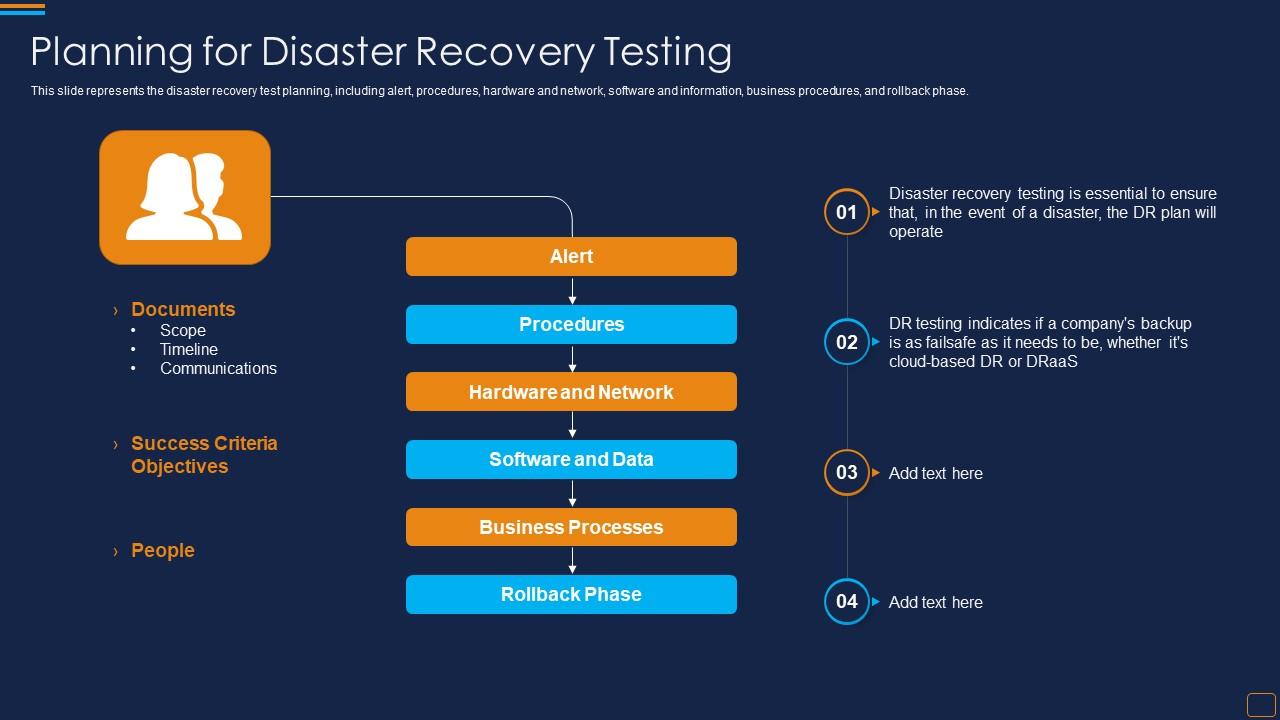
This slide represents the disaster recovery test planning, including alert, procedures, hardware and network, software and information, business procedures, and rollback phase.
People who downloaded this PowerPoint presentation also viewed the following :
Planning For Disaster Recovery Testing Disaster Recovery Implementation Plan with all 6 slides:
Use our Planning For Disaster Recovery Testing Disaster Recovery Implementation Plan to effectively help you save your valuable time. They are readymade to fit into any presentation structure.
FAQs for Planning For Disaster Recovery Testing Disaster
Key components of an effective disaster recovery plan include risk assessment and business impact analysis, data backup and recovery procedures, communication protocols, alternative operational sites, and regular testing schedules. These elements work together by identifying critical vulnerabilities, ensuring data protection, maintaining stakeholder coordination, and providing operational continuity, with many organizations finding that comprehensive planning significantly reduces downtime and enhances business resilience.
Businesses can assess vulnerabilities by conducting comprehensive risk assessments, analyzing critical systems and dependencies, evaluating potential threats like natural disasters and cyberattacks, and identifying single points of failure across operations. Through vulnerability mapping and business impact analysis, organizations streamline their recovery strategies, prioritize resource allocation, and enhance operational resilience, ultimately delivering faster recovery times and competitive advantage during disruptions.
Risk assessment serves as the foundation of disaster recovery planning by identifying potential threats, evaluating their likelihood and impact, prioritizing critical business functions, and determining resource allocation needs. Through comprehensive risk analysis, organizations systematically map vulnerabilities across their operations, infrastructure, and data systems, ultimately enabling targeted recovery strategies that minimize downtime and protect essential services during actual disaster scenarios.
**INPUT**: How often should disaster recovery plans be tested and updated? **OUTPUT**: Disaster recovery plans should be tested quarterly and updated annually, with additional reviews following major infrastructure changes, security incidents, or business expansions. Many organizations enhance their resilience by conducting tabletop exercises, partial failovers, and full system tests throughout the year, ultimately ensuring operational continuity and minimizing downtime during actual emergencies.
Technologies that enhance disaster recovery include cloud computing, automated backup systems, virtualization, real-time data replication, and artificial intelligence-powered monitoring tools. These solutions streamline recovery processes by enabling rapid data restoration, minimizing downtime, and providing predictive analytics for threat detection, with many organizations finding that strategic technology integration delivers faster recovery times and significantly reduced operational disruptions.
Different industries approach disaster recovery planning based on their specific regulatory requirements, operational criticality, and customer dependencies. Financial services prioritize real-time data replication and instant failover capabilities, healthcare focuses on patient safety and medical record accessibility, while manufacturing emphasizes supply chain continuity and production system restoration, with each sector increasingly recognizing that tailored recovery strategies deliver competitive advantage and regulatory compliance.
Legal and compliance considerations for disaster recovery include data protection regulations, industry-specific compliance requirements, regulatory reporting obligations, audit trail maintenance, and breach notification protocols. These frameworks ensure organizations maintain regulatory adherence during disruptions, with sectors like healthcare and financial services finding that proactive compliance planning minimizes legal exposure while accelerating recovery operations.
Employee training improves disaster recovery effectiveness by ensuring staff understand their specific roles, can execute procedures under pressure, and respond quickly during actual emergencies. Through regular simulations and hands-on practice, organizations streamline communication, minimize confusion, and reduce recovery times, with many companies finding that well-trained teams deliver significantly faster restoration of critical operations.
Common disaster recovery mistakes include inadequate testing procedures, outdated documentation, insufficient backup frequency, poor communication protocols, and unrealistic recovery time objectives. Many organizations, particularly in financial services and healthcare, find that overlooking these fundamentals ultimately compromises business continuity, with regular testing and strategic updates delivering enhanced operational resilience and competitive advantage.
Cloud solutions optimize disaster recovery by enabling automated backups, geographically distributed data storage, rapid system restoration, and scalable infrastructure provisioning. These technologies streamline recovery processes through instant data replication, remote accessibility, and flexible resource allocation, with many organizations finding that cloud-based approaches significantly reduce downtime, minimize operational disruptions, and deliver faster business continuity at lower costs.
Organizations should track Recovery Time Objective (RTO), Recovery Point Objective (RPO), system availability percentages, data integrity rates, and staff response times during incidents. These metrics enable businesses to evaluate operational resilience, minimize downtime costs, and ensure regulatory compliance, with many financial institutions and healthcare organizations finding that regular measurement ultimately delivers faster recovery capabilities and enhanced business continuity.
Communication serves as the backbone of disaster recovery efforts by coordinating response teams, disseminating critical information to stakeholders, and maintaining operational continuity during disruptions. Through integrated communication platforms and protocols, organizations streamline incident response, minimize downtime, and ensure seamless coordination between departments, ultimately delivering faster recovery times and enhanced business resilience.
A well-structured disaster recovery plan significantly reduces downtime, minimizes financial losses, and maintains customer trust during unexpected disruptions like cyberattacks, natural disasters, or system failures. These comprehensive plans enable organizations to restore critical operations within hours rather than days, with many financial institutions and healthcare systems finding that strategic recovery frameworks deliver competitive advantages while ensuring regulatory compliance and stakeholder confidence.
Organizations ensure data integrity during disaster recovery through regular data backups, checksums and validation protocols, redundant storage systems, and comprehensive testing procedures. These methods enable businesses to verify data accuracy, minimize corruption risks, and maintain operational continuity, with many financial institutions and healthcare organizations finding that automated validation processes significantly reduce recovery time while preserving critical information assets.
A dedicated disaster recovery team ensures coordinated response during crises, maintains specialized expertise in recovery procedures, establishes clear communication protocols, and provides continuous plan updates and testing. These teams streamline recovery operations by reducing response times, minimizing downtime costs, and enabling faster business resumption, with many organizations finding that dedicated teams deliver significantly better outcomes than ad-hoc crisis management approaches.
-
Easy to edit slides with easy to understand instructions.
-
Excellent template with unique design.