

Porters Five Forces Analysis For Agriculture Industry Crop Farming Business Plan BP SS





Try Before you Buy Download Free Sample Product
 Impress Your
Audience
 100%
Editable
 Save Hours
of Time


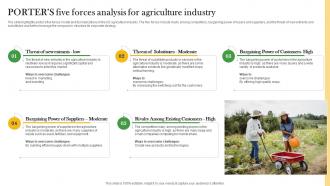
The slide highlights porters five forces model and its implications in the US agriculture industry. The five forces include rivalry among competitors, bargaining power of buyers and suppliers, and the threat of new entrants and substitutes and further leverage the company to structure its corporate strategy.
People who downloaded this PowerPoint presentation also viewed the following :
Porters Five Forces Analysis For Agriculture Industry Crop Farming Business Plan BP SS with all 9 slides:
Use our Porters Five Forces Analysis For Agriculture Industry Crop Farming Business Plan BP SS to effectively help you save your valuable time. They are readymade to fit into any presentation structure.








FAQs for Porters Five Forces Analysis For Agriculture Industry Crop Farming Business
Porter's Five Forces framework comprises competitive rivalry among existing firms, threat of new entrants, bargaining power of suppliers, bargaining power of buyers, and threat of substitute products or services. These interconnected forces help organizations assess industry attractiveness and competitive positioning by analyzing market dynamics, entry barriers, and stakeholder influence, ultimately enabling strategic decision-making for sustainable competitive advantage.
Businesses assess industry rivalry by analyzing competitor concentration, market growth rates, product differentiation levels, switching costs, and exit barriers within their sector. This comprehensive evaluation enables companies to identify competitive pressures in industries like telecommunications or retail, ultimately developing strategic positioning that enhances market share and operational efficiency.
Supplier power influences pricing strategies by controlling input costs, availability, and quality standards, forcing companies to adjust margins, seek alternative sources, or pass costs to consumers. Industries like automotive and electronics often find that concentrated supplier bases limit negotiating flexibility, while diversified sourcing enables more competitive pricing strategies and operational resilience.
Strong buyer power compels companies to enhance product differentiation and accelerate innovation by demanding better value, unique features, and competitive pricing. This pressure drives organizations to invest in research and development, create distinctive offerings, and continuously improve their products, with many businesses in sectors like technology and automotive finding that sustained innovation becomes their primary competitive advantage.
The threat of new entrants forces established companies to strengthen their competitive moats through cost leadership, differentiation, brand building, and strategic partnerships to maintain market position. This competitive pressure drives innovation, operational efficiency, and customer loyalty initiatives across industries like retail, technology, and financial services, ultimately delivering enhanced value propositions and sustainable competitive advantages.
Companies can defend against substitutes by enhancing product differentiation, building strong customer loyalty programs, continuously innovating features, and reducing switching costs through integrated services or long-term contracts. Strategic approaches like improving quality while maintaining competitive pricing, creating unique value propositions, and fostering deeper customer relationships enable businesses to maintain market position, with many organizations finding that combining multiple defensive strategies ultimately delivers sustained competitive advantage and reduced vulnerability to substitute threats.
Businesses should gather competitor financial data, market share statistics, supplier pricing structures, customer switching costs, regulatory barriers, and substitute product performance metrics. This comprehensive data collection enables organizations to accurately assess competitive intensity, supplier power, buyer leverage, and threat levels across banking, retail, and manufacturing sectors, ultimately delivering strategic insights for sustainable competitive advantage.
Industry growth rate significantly influences competitive dynamics by determining resource availability, market expansion opportunities, and rivalry intensity among existing players. In high-growth sectors like renewable energy or biotechnology, companies often focus on capturing market share rather than competing aggressively on price, while slow-growth industries intensify competition as firms fight for limited customers, ultimately affecting profitability and strategic positioning across all market participants.
Porter's Five Forces effectively applies to non-traditional industries by analyzing competitive dynamics, supplier relationships, customer bargaining power, substitution threats, and entry barriers across any market structure. Tech startups benefit from examining platform dependencies and network effects, while social enterprises can assess funding competition and stakeholder influence, ultimately delivering strategic insights that enhance positioning and sustainable competitive advantage.
The Five Forces model struggles in rapidly evolving markets where technological disruption, emerging business models, and shifting consumer behaviors outpace traditional competitive analysis. While Porter's framework excels at assessing established industry structures, it may underestimate the impact of digital transformation, platform economies, and ecosystem partnerships that increasingly blur traditional industry boundaries, requiring more dynamic strategic approaches.
Porter's Five Forces framework informs strategic planning by systematically evaluating competitive intensity, supplier power, buyer power, substitution threats, and entry barriers across the business landscape. This comprehensive analysis enables organizations to identify market opportunities, assess competitive positioning, and develop differentiation strategies, with many firms finding that regular Five Forces assessments ultimately deliver stronger market positioning and more resilient competitive advantages.
Global factors significantly influence local Five Forces by introducing international competitors, alternative suppliers, substitute products from abroad, and changing customer expectations shaped by global standards. Multinational corporations can intensify competitive rivalry, while global supply chains affect supplier power, international trade agreements influence substitute availability, and cross-border digital platforms alter customer bargaining dynamics, ultimately requiring local businesses to adapt strategies for increasingly interconnected market conditions.
Companies should monitor technological disruptions, regulatory changes, evolving customer preferences, supply chain shifts, and emerging business models that could reshape competitive dynamics. Digital transformation in sectors like retail and banking, sustainability requirements affecting manufacturing, and platform economies creating new market entrants demonstrate how external trends can strengthen or weaken competitive forces, ultimately requiring strategic repositioning for sustained advantage.
Businesses can use Porter's Five Forces to identify strategic partnerships by analyzing supplier power, buyer power, competitive rivalry, substitution threats, and entry barriers to pinpoint collaboration opportunities. Through this framework, companies in sectors like retail, manufacturing, and financial services can form supplier alliances, customer partnerships, or competitor collaborations, ultimately reducing competitive pressures while enhancing market positioning and operational efficiency.
Common pitfalls include treating the analysis as static rather than dynamic, oversimplifying complex competitive relationships, focusing too heavily on current threats while ignoring emerging ones, and failing to weight forces appropriately for specific industry contexts. Many organizations find that successful interpretation requires regular reassessment, cross-functional perspective integration, and balancing quantitative data with qualitative market insights to drive strategic decision-making.
-
Very well designed and informative templates.
-
Been using SlideTeam for some time now…can’t imagine why I wasted all that time in front of the screen trying to make the perfect presentation.