

Porters Five Forces Analysis For Auto Repair Shop Business Plan BP SS





Try Before you Buy Download Free Sample Product
 Impress Your
Audience
 100%
Editable
 Save Hours
of Time


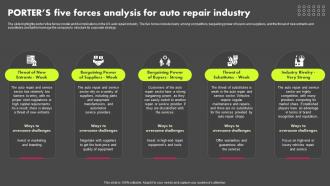
The slide highlights porters five forces model and its implications in the US auto repair industry. The five forces include rivalry among competitors, bargaining power of buyers and suppliers, and the threat of new entrants and substitutes and further leverage the company to structure its corporate strategy.
People who downloaded this PowerPoint presentation also viewed the following :
Porters Five Forces Analysis For Auto Repair Shop Business Plan BP SS with all 9 slides:
Use our Porters Five Forces Analysis For Auto Repair Shop Business Plan BP SS to effectively help you save your valuable time. They are readymade to fit into any presentation structure.








FAQs for Porters Five Forces Analysis For Auto Repair Shop Business
Porter's Five Forces model includes competitive rivalry, supplier power, buyer power, threat of substitutes, and threat of new entrants. These forces collectively determine industry profitability by evaluating market dynamics, bargaining relationships, and competitive pressures, with companies like Amazon and Apple strategically positioning themselves to minimize threats while maximizing their competitive advantages across multiple sectors.
Companies can effectively analyze new entrant threats by evaluating barriers to entry, capital requirements, economies of scale, brand loyalty, and regulatory constraints within their industry. Through Porter's framework, organizations examine switching costs, distribution access, and competitive retaliation potential, with many businesses finding that higher barriers significantly reduce threat levels, ultimately delivering strategic insights for competitive positioning and market protection.
Supplier power directly influences pricing strategy by affecting input costs, negotiation leverage, and margin flexibility, with companies facing limited supplier options often experiencing reduced profitability through higher procurement expenses. Industries like semiconductors and pharmaceuticals demonstrate this impact, where dominant suppliers can dictate terms, forcing businesses to either absorb costs or pass them to customers, ultimately reshaping competitive positioning and strategic resource allocation.
Firms can leverage substitute threats by accelerating innovation, diversifying product portfolios, strengthening customer relationships, and creating switching costs through superior value propositions. Companies like Apple with smartphones and Netflix with streaming services transformed substitute threats into competitive advantages by continuously enhancing features, building ecosystem lock-in, and delivering exceptional customer experiences that competitors struggle to replicate.
Buyer power significantly influences companies to enhance product quality, customize offerings, improve customer service experiences, and maintain competitive pricing strategies to retain market share. In industries like telecommunications and retail banking, strong buyer power drives organizations to streamline service delivery, expand product portfolios, and invest in customer relationship management, ultimately delivering differentiated experiences that build loyalty and sustainable competitive advantage.
Understanding competitive rivalry intensity reveals market gaps, underserved segments, and differentiation opportunities where businesses can establish unique positioning. When rivalry is fierce, companies often discover blue ocean strategies, niche markets, or innovative service models that competitors overlook, ultimately enabling strategic expansion into less contested spaces while delivering superior customer value.
The Five Forces model benefits startups by identifying market entry barriers, competitive intensity, and supplier dynamics before launching, while established companies leverage it for strategic pivots, market expansion decisions, and competitive positioning assessments. Startups in emerging tech sectors often find it reveals untapped opportunities and potential threats, whereas established firms use it to evaluate acquisition targets, defend market share, and optimize resource allocation in increasingly competitive landscapes.
Digital transformation fundamentally reshapes Porter's Five Forces by lowering entry barriers through cloud technologies and digital platforms, intensifying competitive rivalry via data-driven insights, and shifting supplier-buyer power dynamics through enhanced transparency and direct-to-consumer channels. These changes enable organizations to streamline operations, enhance customer experiences, and create new competitive advantages, with many industries finding that digital capabilities ultimately determine market positioning and strategic success.
Companies can mitigate supplier power through diversification strategies, vertical integration, long-term partnerships, and developing alternative sourcing channels, while addressing buyer power requires differentiation, loyalty programs, and value-added services. Manufacturing firms increasingly use multi-supplier networks and strategic alliances to reduce dependency, while retailers enhance customer experiences through personalization and exclusive offerings, ultimately delivering greater operational flexibility and sustained competitive advantage.
Porter's Five Forces enables businesses to evaluate market entry by analyzing competitive rivalry, supplier power, buyer power, threat of substitutes, and barriers to entry within target industries. This strategic framework helps organizations identify market gaps, assess profitability potential, and develop competitive positioning strategies, with many companies finding that thorough Five Forces analysis significantly reduces entry risks while maximizing strategic advantage.
The Five Forces model adapts to global markets by incorporating cultural preferences, regulatory frameworks, local competitive dynamics, and region-specific barriers to entry across different economies. While core competitive principles remain consistent, companies must adjust their analysis to account for varying government policies, cultural business practices, and market structures, with many multinational organizations finding that localized Five Forces assessments deliver more accurate strategic insights and competitive positioning.
**INPUT**: Can you provide examples of industries where the threat of substitutes has dramatically altered competitive landscapes? **OUTPUT**: Industries dramatically reshaped by substitute threats include traditional taxi services facing rideshare platforms, physical retail confronting e-commerce, cable television challenged by streaming services, and banking disrupted by fintech solutions. These substitutes streamline customer experiences, reduce costs, and enhance accessibility, with many established companies finding that strategic adaptation through digital transformation ultimately delivers competitive advantage in increasingly dynamic markets. [Word count: 60 words]
Technology significantly reshapes Porter's Five Forces by reducing barriers to entry through cloud computing and digital platforms, intensifying competitive rivalry via data analytics and automation, and shifting supplier power as companies leverage multiple digital vendors. These advancements enable organizations to streamline operations, enhance customer experiences, and access global markets more efficiently, with many businesses finding that strategic technology adoption ultimately delivers competitive advantages and improved market positioning.
Five Forces analysis complements SWOT and PESTEL by providing industry-specific competitive dynamics that enhance internal strengths/weaknesses assessment and external macro-environmental factors. While SWOT identifies organizational capabilities and PESTEL examines broad market conditions, Five Forces delivers granular competitor intelligence, supplier leverage, and customer power insights, with many strategic teams finding that this combination enables comprehensive market positioning and competitive advantage planning.
Firms can apply Porter's Five Forces to evaluate target companies by analyzing supplier power, buyer power, competitive rivalry, threat of substitutes, and barriers to entry within the target's industry. This strategic framework enables acquirers to assess market positioning, identify potential synergies, and evaluate long-term competitive advantages, ultimately delivering more informed M&A decisions and enhanced post-merger integration success.
-
Awesome presentation, really professional and easy to edit.
-
The design is clean-cut, modern, and sleek, keeping the users' needs in mind. The multiple uses make this product worth every penny!