

Ports Industry Report Powerpoint Presentation Slides IR





Try Before you Buy Download Free Sample Product
 Impress Your
Audience
 100%
Editable
 Save Hours
of Time


Check out our professionally designed Ports Industry Report PowerPoint presentation. Global port market was valued at USD 165.69 Bn in 2024 and expected to reach USD 223.94 Bn by 2029 at a CAGR of 6.27 percent. Our readily-available and professionally designed ports industry report PPT provides you with detailed stats on ports products and services. It also includes ports market insights, market trends, key restraints, industry laws and regulations etc. covering lucrative growth opportunities. In addition, this Cargo Shipment Industry Report PPT module covers section for PESTEL analysis, SWOT analysis, risk assessment, COVID-19 and its impact. Furthermore, Porters framework, and competitive landscape are some of the essential topics covered in the industry report. Download our 100 percent editable and customizable ports services industry report template, which is also compatible with Google Slides.
People who downloaded this PowerPoint presentation also viewed the following :
Content of this Powerpoint Presentation
Slide 1: This slide introduces Ports Industry Report. State your company name and begin.
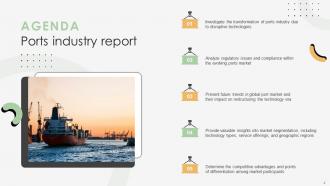
Slide 2: This slide states Agenda of the presentation.
Slide 3: This slide shows Table of Content for the presentation.
Slide 4: This slide highlights title for topics that are to be covered next in the template.
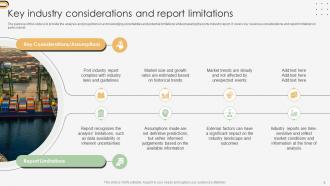
Slide 5: The purpose of this slide is to provide the analysis and projections in acknowledging uncertainties and potential limitations while preparing the ports industry report. It covers key business considerations and report limitations in ports market.
Slide 6: The slide portrays the research objectives overview of the ports industry report. It includes market research objectives and technological objectives to know the future of port industry.
Slide 7: This slide highlights title for topics that are to be covered next in the template.
Slide 8: The slide outlines the overview of the port industry. The purpose of this slide is to understand market growth, future forecast of global market. It includes detailed market analysis, different sectors covered, future forecast analysis and differentiation made on the basis of technological updates.
Slide 9: The slide covers the segmentation analysis in the port industry. It includes attributes related to technology, distribution channel, customer segmentation, products and services, geographical analysis, and key market player profile.
Slide 10: This slide highlights title for topics that are to be covered next in the template.
Slide 11: The slide examines the attributes on the basis of technology in the port industry. The purpose of this slide is to make readers aware about the tech updates in smart
Slide 12: The slide examines the attributes on the basis of technology in the regional port industry. The purpose of this slide is to make readers aware about the regional smart port insights.
Slide 13: The slide examines the attributes on the basis of technology used in the port industry. The purpose of this slide is to make readers aware about the big data analytics market in the port sector.
Slide 14: The slide examines the attributes on the basis of technology in the port industry. The purpose of this slide is to make readers aware about the integrated marine automation system market.
Slide 15: The slide examines the attributes on the basis of marine digitization technology in the port industry. The purpose of this slide is to make readers aware about the tech updates available in the marine digitization sector.
Slide 16: This slide highlights title for topics that are to be covered next in the template.
Slide 17: The slide examines the attributes on the basis of marine ports in the industry report. The purpose of this slide is to cover information related to major and minor ports during year 2022 to 2030.
Slide 18: The slide examines the attributes on the basis of commercial vessels in port industry. The purpose of this slide is to aware about overall market, increase in impact and segment wise valuation etc.
Slide 19: The slide examines the attributes on the basis of cargo handling in port industry report. The purpose of this slide is to cover key market insights and major players in the market.
Slide 20: The slide examines the attributes on the basis of equipment handling vehicle market in port industry report. The purpose of this slide is to aware about overall market size, increase in market impact and segment wise distribution.
Slide 21: The purpose of this slide is to aware about the different distribution channels available in the port and it’s coverage. The slide includes information related to storage and warehouse market system, growth drivers and challenges faced.
Slide 22: The purpose of this slide is to aware about the different products and services available in the ports industry. It includes overall locomotive statistics, market consolidation and key drivers.
Slide 23: The purpose of this slide is to aware about the different regional level insights in the maritime market. It includes information related to maritime market for APAC and North America region.
Slide 24: The purpose of this slide is to aware about the different regional level insights in the marine vessels. It includes information related to Marine vessel market related to MENA region.
Slide 25: This slide highlights title for topics that are to be covered next in the template.
Slide 26: The slide determines the attributes on the basis of major trends in the ports market. The purpose of this slide is to aware about the different areas where ports is reshaping the market. It capture the information related to upcoming trends offered in the industry.
Slide 27: The slide provides an insight on the market restraints existing in the ports market. The purpose of this slide is to aware about the different areas of ports which are impacted. It capture the information related to short comings faced in the industry.
Slide 28: This slide highlights title for topics that are to be covered next in the template.
Slide 29: The purpose of this slide is to provide a glimpse of significant participants of the industry to gain insight into their founder, location and business description. This slide helps the companies to implement new business strategies to compete successfully in the market.
Slide 30: The slide represents a detailed overview of competitive landscape. The purpose of this slide is to help stakeholders in understanding the competitive environment that aids in making informed strategic decision. The key players list include major ports companies.
Slide 31: This slide highlights title for topics that are to be covered next in the template.
Slide 32: The slide provides a diagrammatic representation of positioning and evaluation of various ports organizations based on their completeness of vision and the ability to execute. The matrix includes challengers, visionaries, leaders and niche players.
Slide 33: This slide highlights title for topics that are to be covered next in the template.
Slide 34: This slide highlights title for topics that are to be covered next in the template.
Slide 35: This slide highlights title for topics that are to be covered next in the template.
Slide 36: This slide highlights title for topics that are to be covered next in the template.
Slide 37: This slide highlights title for topics that are to be covered next in the template.
Slide 38: The purpose of this slide is to provide a brief insights related to seaports entry barriers. It covers understanding of global market, diversification of products and services offered, and emerging middle class expansion.
Slide 39: This slide highlights title for topics that are to be covered next in the template.
Slide 40: This slide shows Industry laws and regulations in global ports.
Slide 41: This slide highlights title for topics that are to be covered next in the template.
Slide 42: This slide highlights market stability, consumer protection and foster innovation while mitigating risks. It includes environment stability, health and safety, and quality education.
Slide 43: This slide highlights title for topics that are to be covered next in the template.
Slide 44: The purpose of this slide is to ensure market impact at the time of coved-19 situations to understand the demand and growth of market. It includes increased demand, e-commerce segment, supply chain disruptions, innovation in product segment.
Slide 45: This slide highlights title for topics that are to be covered next in the template.
Slide 46: This slide highlights the potential risks associated with the global ports industry. This slide comprises the major concerns such as economic, geopolitical, technological, manufacturing, pandemic, environmental, safety, and information security threats.
Slide 47: This slide highlights title for topics that are to be covered next in the template.
Slide 48: The purpose of this slide is to cover different prospects related to growth of the industry. It covers port terminal investment, public private partnerships, investment opportunities and innovation in port expansion.
Slide 49: The purpose of this slide is to cover recent development in the ports industry. It covers digital and technological transformation, sustainable and climate concerns, product development innovation, and data-driven decision making.
Slide 50: The purpose of this slide is to provide a brief insights related to the ports market and its growth. It covers opportunity protection, macro and geopolitical insights related to the insurers, and demand for cyber security ports and services analysis.
Slide 51: This slide highlights title for topics that are to be covered next in the template.
Slide 52: The purpose of this slide is to provide a brief insights on how the ports and services market is going related to its growth. It covers understanding of global market, diversification of products and services offered, and emerging middle class expansion.
Slide 53: The purpose of this slide is to provide a brief insights on how the ports and services market is going related to its growth. It covers understanding of global market, diversification of products and services offered, and emerging middle class expansion.
Slide 54: This slide highlights title for topics that are to be covered next in the template.
Slide 55: This slide displays Key abbreviations used in ports report.
Slide 56: This slide contains all the icons used in this presentation.
Slide 57: This slide is titled as Additional Slides for moving forward.
Slide 58: This slide shows Challenges for small terminal operators entrants in the ports industry.
Slide 59: This slide presents Emerging issues impacting port and maritime shipping.
Slide 60: This slide displays Key potential benefits of port digitalization.
Slide 61: This slide contains Puzzle with related icons and text.
Slide 62: This slide depicts Venn diagram with text boxes.
Slide 63: This is a Timeline slide. Show data related to time intervals here.
Slide 64: This slide shows Post It Notes. Post your important notes here.
Slide 65: This is a Thank You slide with address, contact numbers and email address.
Ports Industry Report Powerpoint Presentation Slides IR with all 73 slides:
Use our Ports Industry Report Powerpoint Presentation Slides IR to effectively help you save your valuable time. They are readymade to fit into any presentation structure.

















FAQs for Ports Industry Report Powerpoint
Emerging trends shaping the global ports industry include automation technologies, digital twin systems, green energy initiatives, AI-powered logistics optimization, and blockchain-based supply chain transparency. These innovations streamline cargo handling, enhance operational efficiency, and reduce environmental impact, with major ports like Rotterdam and Singapore finding that strategic technology adoption delivers faster processing times, lower costs, and significant competitive advantages.
Automation technology transforms port operations through autonomous cranes, AI-powered traffic management, robotic container handling, predictive maintenance systems, and integrated logistics platforms. These technologies streamline cargo processing, reduce human error, and optimize resource allocation, with major ports like Rotterdam and Singapore achieving 30% faster turnaround times, significantly lower operational costs, and enhanced competitive positioning.
Green initiatives serve as fundamental drivers of port sustainability through renewable energy adoption, emission reduction technologies, electrification of equipment, waste management optimization, and water conservation systems. These environmental programs enable ports to significantly reduce operational costs, comply with increasingly stringent regulations, and attract eco-conscious shipping partners, while many major ports finding that sustainability investments ultimately deliver competitive advantages and improved community relations.
Supply chain disruptions are reshaping port logistics through increased cargo backlogs, vessel scheduling delays, equipment shortages, and labor constraints, forcing ports to adopt more flexible operational strategies. These challenges have accelerated automation investments and digital tracking systems, with many ports finding that real-time visibility and predictive analytics enable better resource allocation, ultimately delivering improved resilience and competitive advantage.
Port authorities face challenges including rising sea levels threatening infrastructure, extreme weather disrupting operations, regulatory compliance costs, aging equipment vulnerabilities, and supply chain adaptation requirements. These climate pressures present both operational risks and strategic opportunities, with many ports finding that investing in resilient infrastructure, automated systems, and sustainable technologies ultimately delivers competitive advantages, operational continuity, and enhanced stakeholder confidence in an increasingly volatile environment.
Ports can enhance cybersecurity through network segmentation, multi-factor authentication, real-time monitoring systems, regular security audits, and employee training programs. These measures streamline protection by isolating critical systems, detecting threats early, and ensuring compliance standards, with many maritime facilities finding that integrated cybersecurity frameworks ultimately deliver operational continuity and competitive advantage in increasingly digitized shipping environments.
E-commerce growth significantly increases container volumes, accelerates demand for faster turnaround times, and drives automation investments across global ports. Major shipping hubs like Los Angeles, Rotterdam, and Singapore are expanding warehouse capacity, implementing AI-driven logistics systems, and enhancing last-mile connectivity, ultimately delivering shorter delivery windows and improved supply chain efficiency for retailers.
Ports can improve efficiency through automation technologies, predictive analytics, integrated logistics systems, optimized berth scheduling, and real-time cargo tracking capabilities. These strategies streamline operations by reducing manual processes, enhancing vessel coordination, and minimizing idle time, with many major ports finding that strategic technology integration delivers faster turnaround times and improved competitive positioning.
Geopolitical factors significantly influence port development through trade agreements, sanctions, territorial disputes, and diplomatic relationships that reshape cargo flows and investment priorities. Strategic ports like Singapore and Dubai have leveraged political stability to become major hubs, while conflicts can redirect trade routes entirely, with many shipping companies increasingly diversifying port partnerships to minimize geopolitical risks and maintain operational continuity.
Smart port technologies and digitalization deliver enhanced operational efficiency, reduced vessel turnaround times, improved cargo tracking, automated logistics processes, and optimized resource allocation. Through IoT sensors, AI analytics, and blockchain systems, ports streamline container handling, minimize delays, and enhance supply chain transparency, with many facilities finding that these innovations ultimately reduce operational costs while delivering faster, more reliable shipping services.
Collaboration between ports and shipping companies optimizes logistics by enabling synchronized scheduling, real-time data sharing, and integrated planning systems that reduce vessel waiting times and streamline cargo handling. This strategic partnership allows ports and carriers to coordinate berth availability, optimize container movements, and enhance supply chain visibility, ultimately delivering faster turnaround times and reduced operational costs.
Public-private partnerships, government bonds, development bank financing, and revenue-backed securities represent the most effective funding models for port infrastructure projects. These approaches enable ports to leverage private sector efficiency while maintaining public oversight, with many major ports finding that blended financing structures deliver reduced public burden, accelerated project timelines, and enhanced operational capabilities.
Port communities can engage local stakeholders through collaborative planning committees, environmental impact assessments, workforce development programs, community investment initiatives, and transparent communication channels. These engagement strategies enable ports to address local concerns while building partnerships with businesses, residents, and government entities, ultimately delivering sustainable growth, enhanced community relations, and shared economic benefits across the region.
Megaships are driving significant port infrastructure transformations through deeper berths, stronger cranes, expanded storage areas, and enhanced intermodal connections to handle larger cargo volumes efficiently. These vessels enable greater economies of scale while challenging ports to invest in advanced automation, wider channels, and strategic redesigns, ultimately delivering improved operational efficiency and competitive positioning in increasingly demanding global shipping networks.
Maritime Autonomous Surface Ships present both operational transformation opportunities and infrastructure adaptation challenges for ports, requiring upgraded digital systems, automated cargo handling, enhanced cybersecurity protocols, and redesigned terminal layouts. These technological advances streamline port operations by reducing human error, accelerating vessel turnaround times, and optimizing berth allocation, ultimately delivering significant cost reductions and competitive advantages for forward-thinking port authorities.
-
I discovered this website through a google search, the services matched my needs perfectly and the pricing was very reasonable. I was thrilled with the product and the customer service. I will definitely use their slides again for my presentations and recommend them to other colleagues.
-
Their designing team is so expert in making tailored templates. They craft the exact thing I have in my mind…..really happy.