

Positive effects of technology on health ppt powerpoint presentation model pictures





Try Before you Buy Download Free Sample Product
 Impress Your
Audience
 100%
Editable
 Save Hours
of Time


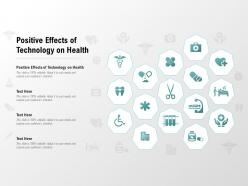
The following is a completely editable Medical Powerpoint Template Slide that discusses the topic Positive Effects Of Technology On Health. It is designed for medical professionals to discuss Positive Effects Of Technology On Health and can be completely customized to suit their needs. Add more items to this list and include this in your deck to impress your audience.
People who downloaded this PowerPoint presentation also viewed the following :
Positive effects of technology on health ppt powerpoint presentation model pictures with all 2 slides:
Give your audience a fulfilling experience. They will find our Positive Effects Of Technology On Health Ppt Powerpoint Presentation Model Pictures elevating.

FAQs for Positive effects of technology on health ppt powerpoint
Innovative health monitoring tools include wearable fitness trackers, continuous glucose monitors, smart blood pressure cuffs, remote patient monitoring systems, and AI-powered diagnostic apps. These technologies streamline healthcare delivery by enabling real-time data collection, early disease detection, and personalized treatment plans, with many healthcare institutions finding that remote monitoring reduces costs while enhancing patient outcomes.
Telemedicine has dramatically expanded healthcare access for remote populations by eliminating geographical barriers, reducing travel costs, and enabling real-time consultations with specialists. Through video conferencing and mobile health platforms, rural communities can receive timely diagnoses, chronic disease management, and emergency consultations, with many remote hospitals finding that telemedicine delivers faster care delivery and improved patient outcomes.
Wearable technology has revolutionized personal fitness through continuous heart rate monitoring, sleep tracking, step counting, calorie measurement, and real-time health alerts. These devices enhance wellness by providing personalized insights, automated goal setting, and behavioral nudges, with many healthcare providers and fitness enthusiasts finding that consistent data tracking ultimately delivers improved health outcomes and preventive care strategies.
Health apps enhance patient engagement by providing personalized reminders, real-time progress tracking, educational resources, and interactive features that make treatment management more accessible and user-friendly. Through gamification, peer support networks, and direct communication with healthcare providers, patients in chronic care, rehabilitation, and medication management find significantly improved adherence rates, while healthcare organizations ultimately deliver better outcomes and reduced readmission costs.
Artificial intelligence enhances early disease detection through medical imaging analysis, pattern recognition in patient data, predictive modeling, and automated screening processes. AI algorithms can identify subtle anomalies in X-rays, MRIs, and CT scans that human practitioners might miss, while analyzing electronic health records to flag at-risk patients, ultimately enabling faster interventions and improved outcomes.
Technology enhances mental health support by providing accessible therapy sessions, AI-powered mood tracking, peer support communities, and 24/7 crisis intervention resources through online platforms. These digital solutions streamline care delivery by reducing geographical barriers, lowering costs, and enabling continuous monitoring, with many healthcare systems finding that virtual counseling increases patient engagement while delivering faster, more personalized treatment outcomes.
Electronic health records enhance patient care continuity by providing instant access to comprehensive medical histories, medication lists, test results, allergies, and treatment plans across all healthcare providers. Through seamless information sharing, hospitals, specialists, and primary care physicians can coordinate more effectively, reduce duplicate testing, and minimize medication errors, while patients experience faster diagnoses and more personalized treatment outcomes.
Drones revolutionize healthcare delivery in underserved areas by transporting medical supplies, delivering medications, and enabling rapid emergency response across difficult terrain. These unmanned systems streamline logistics by bypassing infrastructure limitations, reducing delivery times, and minimizing costs, with rural hospitals and remote clinics finding that drone networks ultimately enhance patient outcomes and expand access to critical care services.
Remote monitoring significantly transforms chronic disease management by enabling continuous patient tracking, real-time data collection, automated alert systems, and seamless healthcare provider communication. Through wearable devices and mobile health platforms, patients with diabetes, heart conditions, and hypertension experience improved medication adherence, faster intervention responses, and reduced hospital readmissions, while healthcare systems deliver more personalized care and enhanced operational efficiency.
Virtual reality accelerates rehabilitation by creating immersive environments for physical therapy, cognitive training, and pain management, enabling precise movement tracking and real-time feedback. Through VR simulations, hospitals and rehabilitation centers deliver personalized stroke recovery programs, phobia treatments, and motor skill exercises, ultimately reducing recovery times while enhancing patient engagement and therapeutic outcomes.
Ethical considerations in AI patient care include data privacy protection, algorithmic bias prevention, informed consent protocols, transparency in decision-making processes, and maintaining human oversight. These frameworks ensure responsible implementation by safeguarding patient rights, promoting equitable treatment across diverse populations, and preserving the physician-patient relationship, with many healthcare institutions finding that robust ethical guidelines ultimately enhance both care quality and patient trust.
Social media has revolutionized health awareness by enabling real-time information sharing, peer support networks, direct healthcare provider communication, and widespread health campaign reach. Through platforms like Facebook and Twitter, patients connect with support communities, healthcare organizations disseminate preventive care guidance, and public health agencies rapidly address emerging health concerns, ultimately democratizing health information access and empowering informed healthcare decisions.
Teletherapy advancements include AI-powered chatbots, mobile therapy apps, virtual reality exposure therapy, real-time mood tracking, and secure video platforms with integrated scheduling. These technologies streamline mental health delivery by reducing wait times, lowering costs, and eliminating geographical barriers, with many healthcare systems finding that patients access care more consistently, ultimately enhancing treatment outcomes and expanding therapeutic reach.
Technology facilitates better communication between patients and healthcare providers through telemedicine platforms, secure messaging systems, patient portals, and mobile health applications. These digital tools enable real-time consultations, instant access to medical records, appointment scheduling, and continuous monitoring, with hospitals and clinics finding that patients experience improved care coordination, faster response times, and enhanced treatment outcomes.
Over-reliance on health technology for self-diagnosis can lead to misinterpretation of symptoms, delayed professional medical care, increased anxiety from inaccurate readings, and false sense of security from incomplete assessments. While these tools enhance health monitoring and accessibility, healthcare providers increasingly emphasize using them as complementary resources rather than replacements for professional diagnosis, ultimately ensuring better patient outcomes through balanced technological integration.
No Reviews