

Predictive Modeling Methodologies Lifecycle Of Predictive Analytics Model




Try Before you Buy Download Free Sample Product
 Impress Your
 Audience
 100%
100% Editable
 Save Hours
 of Time


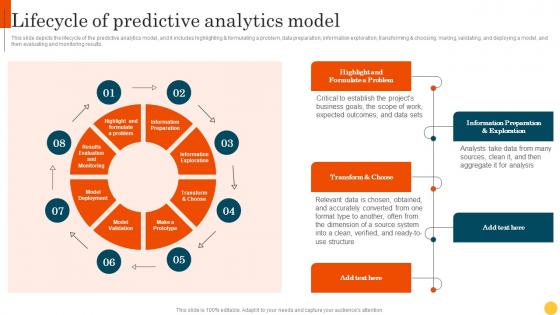
This slide depicts the lifecycle of the predictive analytics model, and it includes highlighting and formulating a problem, data preparation, information exploration, transforming and choosing, making, validating, and deploying a model, and then evaluating and monitoring results.
People who downloaded this PowerPoint presentation also viewed the following :
Predictive Modeling Methodologies Lifecycle Of Predictive Analytics Model with all 6 slides:
Use our Predictive Modeling Methodologies Lifecycle Of Predictive Analytics Model to effectively help you save your valuable time. They are readymade to fit into any presentation structure.





FAQs for Predictive Modeling Methodologies Lifecycle Of
The predictive modeling lifecycle includes data collection and preparation, exploratory data analysis, feature engineering, model selection and training, validation and testing, and deployment with monitoring. These stages work together by ensuring data quality, identifying meaningful patterns, optimizing model performance, and maintaining accuracy over time, ultimately delivering actionable insights and competitive advantage for organizations across industries.
Data preprocessing significantly impacts predictive model effectiveness by improving data quality, reducing noise, and ensuring feature relevance through cleaning, normalization, and transformation techniques. Poor preprocessing can lead to biased models and inaccurate predictions, while thorough preprocessing enhances model accuracy, reduces training time, and delivers more reliable insights for strategic business decisions.
Feature selection techniques include filter methods, wrapper methods, embedded methods, univariate selection, and recursive feature elimination. These approaches streamline model performance by removing irrelevant variables, reducing overfitting, and enhancing computational efficiency, with many data science teams finding that strategic feature selection ultimately delivers faster model training and improved predictive accuracy across diverse business applications.
Data quality assessment involves evaluating completeness, accuracy, consistency, timeliness, and relevance through statistical profiling, outlier detection, and validation checks. Organizations implement automated data quality frameworks that identify missing values, detect anomalies, and verify source reliability, with many financial services and healthcare institutions finding that robust assessment processes ultimately reduce model errors by 40-60%.
Common predictive modeling algorithms include linear regression, decision trees, random forests, support vector machines, and neural networks, each offering distinct approaches to pattern recognition and prediction accuracy. Linear regression excels in straightforward relationships, while decision trees provide interpretability, random forests enhance accuracy through ensemble methods, and neural networks handle complex, non-linear patterns, with financial services and healthcare organizations increasingly leveraging multiple algorithms to optimize forecasting precision and business outcomes.
Missing data can be effectively handled through imputation techniques like mean/median substitution, regression imputation, multiple imputation, and advanced methods like K-nearest neighbors or machine learning algorithms. These approaches enable organizations to maintain dataset integrity while preserving statistical relationships, with many financial services and healthcare institutions finding that strategic imputation delivers more accurate predictions and robust model performance than simply excluding incomplete records.
Ensuring model generalization involves cross-validation techniques, train-validation-test splits, regularization methods, and feature engineering that avoids overfitting to training data. These approaches enable organizations across healthcare, finance, and retail to deploy models that maintain accuracy in real-world scenarios, ultimately delivering reliable predictions and sustainable competitive advantage.
Model evaluation plays a critical role by assessing predictive accuracy, validating performance against real-world data, identifying potential biases, and ensuring models meet business requirements before deployment. Through rigorous testing methodologies, organizations can minimize prediction errors, enhance decision-making confidence, and optimize resource allocation, with many financial services and retail companies finding that thorough evaluation ultimately delivers competitive advantage and operational efficiency.
Domain knowledge integration occurs through feature engineering, model selection, constraint setting, validation design, and expert-guided interpretation of results. Financial institutions leverage credit risk expertise to enhance loan default models, while healthcare organizations incorporate clinical knowledge into diagnostic algorithms, ultimately delivering more accurate predictions and actionable insights.
Overfitting mitigation strategies include cross-validation, regularization techniques, feature selection, early stopping, and ensemble methods. These approaches enhance model generalization by preventing excessive complexity, reducing irrelevant variables, and balancing bias-variance tradeoffs, with many organizations finding that strategic combination of multiple techniques ultimately delivers more robust predictive performance and reliable business insights.
**INPUT**: How do we determine the appropriate metrics for evaluating a predictive model's performance? **OUTPUT**: Determining appropriate evaluation metrics depends on your business objectives, data characteristics, model type, and stakeholder requirements, with classification models using accuracy and precision while regression models emphasize RMSE and MAE. Organizations across finance, healthcare, and retail increasingly align metrics with strategic outcomes, ensuring models deliver measurable value through improved decision-making and operational efficiency.
Model deployment transforms predictive models from development concepts into operational business tools, enabling real-time decision-making, automated processes, and measurable value creation. Best practices include establishing robust monitoring systems, implementing version control, ensuring scalable infrastructure, and maintaining continuous performance validation, with many organizations finding that proper deployment strategies deliver faster insights, reduced operational costs, and sustained competitive advantage across their operations.
Ensuring predictive model relevance requires continuous monitoring, regular retraining with fresh data, performance validation against changing business conditions, and systematic feedback loops. Organizations across industries like banking and retail implement automated model refresh schedules, A/B testing frameworks, and drift detection systems, ultimately maintaining accuracy while adapting to evolving market dynamics and customer behaviors.
Ethical considerations in predictive modeling include data privacy protection, algorithmic bias prevention, transparency in decision-making processes, informed consent for data usage, and fairness across demographic groups. These principles help organizations build trustworthy models while ensuring compliance with regulations, with many financial services and healthcare institutions finding that ethical frameworks ultimately enhance customer trust and reduce regulatory risks.
Ensemble methods enhance predictive model performance by combining multiple algorithms to reduce overfitting, improve accuracy, and increase robustness across diverse datasets. Through techniques like bagging, boosting, and stacking, organizations in healthcare, finance, and retail achieve more reliable predictions, minimize individual model weaknesses, and ultimately deliver superior forecasting capabilities that drive strategic decision-making and competitive advantage.
-
SlideTeam offers so many variations of designs and topics. It’s unbelievable! Easy to create such stunning presentations now.
-
My team has been relying on SlideTeam’s professional PPT designs for a while now. It has greatly sped up quality work at my organization. So thanks!