

Presentation Stage In Sales Process Training Ppt




Try Before you Buy Download Free Sample Product
 Impress Your
 Audience
 100%
100% Editable
 Save Hours
 of Time


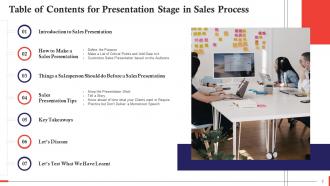
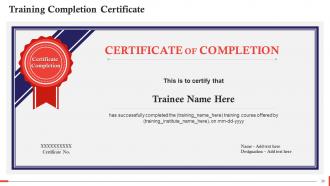
This training module on Presentation Stage in Sales Process in depth covers How to Make a Sales Presentation Define the Purpose, Make a List of Critical Points and Add Data to it, Customize Sales Presentation based on the Audience, Things a Salesperson Should do Before a Sales Presentation, and Tips for Effective Sales Presentation Keep the Presentation Short, Tell a Story, Know ahead of time what your Clients want or Require, Practice but Dont Deliver a Memorized Speech. It also includes Key Takeaways and Discussion Questions related to the topic to make the coaching session more interactive. The deck has PPT slides on About Us, Vision, Mission, Goal, 30-60-90 Days Plan, Timeline, Roadmap, Training Completion Certificate, and Energizer Activities. It also includes a Client Proposal and Assessment Form for training evaluation.
People who downloaded this PowerPoint presentation also viewed the following :
Content of this Powerpoint Presentation
Slide 3
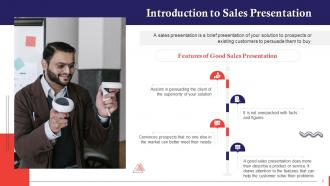
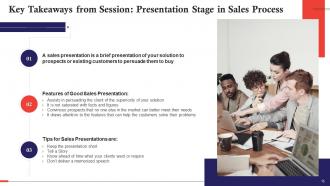
This slide contains information about a sales presentation. It highlights that a sales presentation is a brief presentation of your solution to prospects or current customers to persuade them to purchase. It also mentions the characteristics of a good sales presentation.
Slide 4
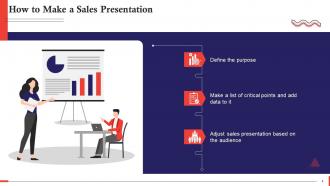
This slide depicts how to make a sales presentation. It highlights that while preparing a sales presentation, a salesperson must define the purpose, make a list of critical points and add data to it, and adjust the sales presentation based on the audience.
Slide 5
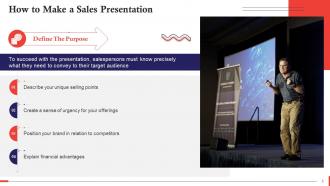
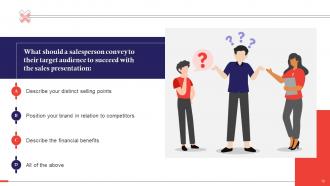
This slide provides information about defining the purpose in sales presentation. It mentions that to succeed with the presentation, salespersons must know precisely what they need to convey to their target audience.
Slide 6
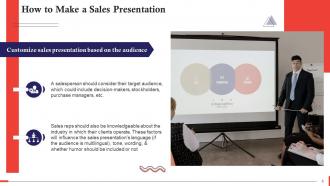
This slide depicts the importance of adjusting sales presentation based on the audience. It highlights that a salesperson should consider their target audience, which could include decision-makers, stockholders, purchase managers, etc. It also mentions that sales reps should also be knowledgeable about the industry in which their clients operate.
Slide 7
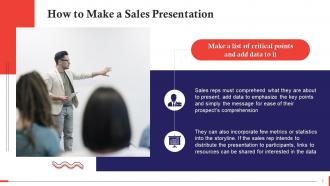
This slide discusses making a list of critical points and adding data to it in a sales presentation. It highlights that sales reps must comprehend what they are about to present, add data to emphasize the key points and simply the message for ease of their prospect’s comprehension. It also mentions that they can also incorporate few metrics or statistics into the storyline.
Slide 8
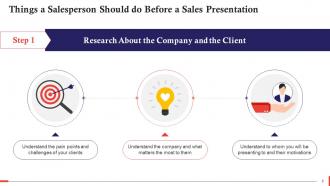
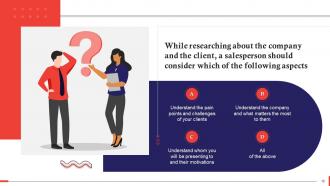
This slide contains information about researching the company and the client before a sales presentation. It highlights that while researching the client and the company, a salesperson should understand their pain points and challenges, what is most important to them, and to whom will they be presenting and their motivations.
Slide 9
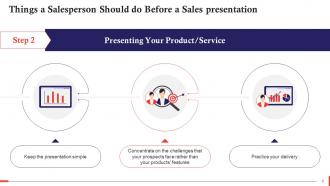
This slide discusses the importance of presenting your product/service to the prospect while giving a sales presentation. It highlights the importance of keeping the presentation simple and concise, focusing on the challenges your prospects face rather than your products’ features, and practicing the delivery.
Slide 10
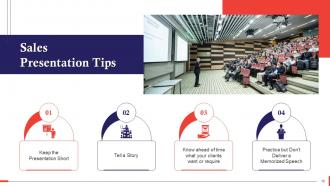
This slide lists the tips for better sales presentation. The tips are: Keep the presentation short, tell a story, know ahead of time what your clients want or require, and practice but don’t deliver a memorized speech.
Slide 11
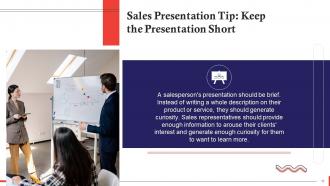
This slide discusses about keeping the presentation short as sales presentation tip. It highlights that a salesperson's presentation should be brief. Instead of writing a whole description on their product or service, they should generate curiosity.
Slide 12
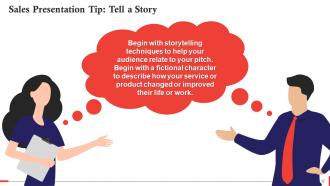
This slide depicts the significance of telling a story during a sales presentation. It highlights the importance of starting with storytelling techniques to help your audience relate to your pitch. It also states that you should start with a fictional character and describe how your service or product changed or improved their life or work.
Slide 13
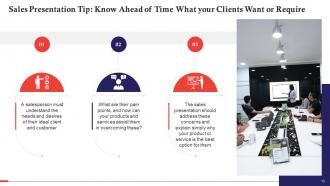
This slide depicts how a salesperson must anticipate what their clients want or require. It highlights the importance of a salesperson understanding their ideal client's and customer's needs and desires. It also states that the sales presentation should address these concerns and clearly explain why your product or service is the best choice for them.
Slide 14
This slide explains why a salesperson should practice rather than give a memorized speech during a sales presentation. It emphasizes the importance of preparation in delivering an effective sales presentation. However, many people misinterpret this and attempt to memorize everything they intend to say during the presentation.
Slide 31 to 46
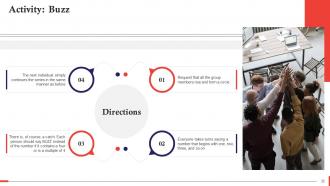
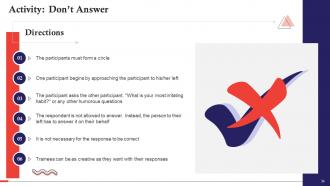
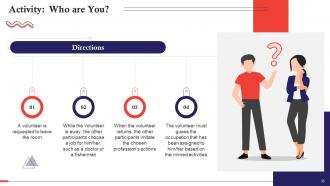
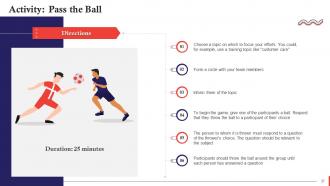
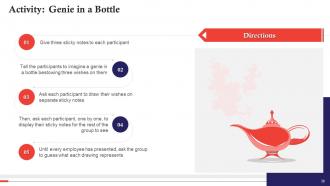
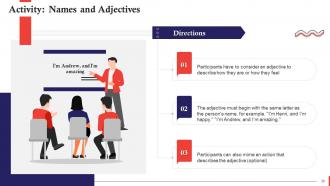
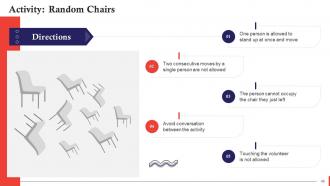
These slides contain energizer activities to engage the audience of the training session.
Slide 47 to 74
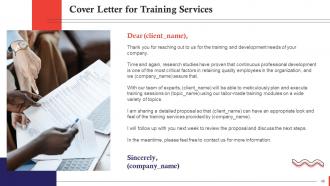
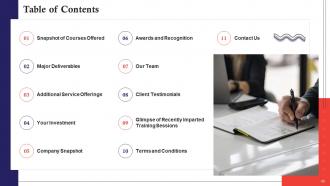
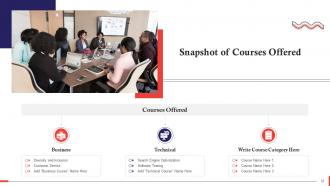
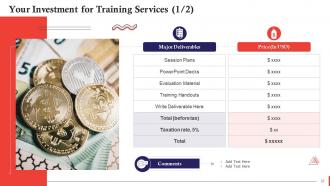
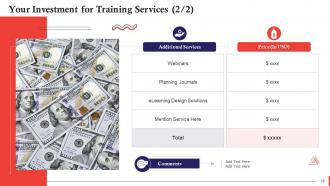
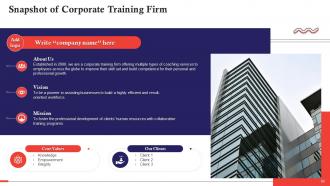
These slides contain a training proposal covering what the company providing corporate training can accomplish for the client.
Slide 75 to 77
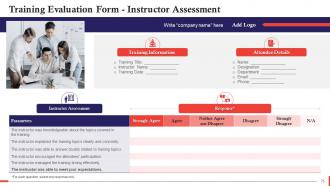
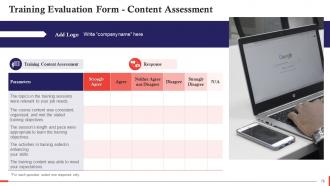
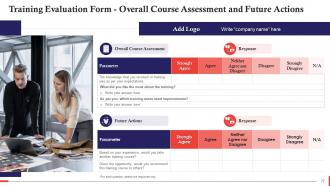
These slides include a training evaluation form for instructor, content and course assessment.
Presentation Stage In Sales Process Training Ppt with all 82 slides:
Use our Presentation Stage In Sales Process Training Ppt to effectively help you save your valuable time. They are readymade to fit into any presentation structure.






















FAQs for Presentation Stage In Sales
Key components include product knowledge mastery, customer relationship building techniques, objection handling strategies, closing methodologies, and performance tracking systems. These elements work together by equipping sales teams with comprehensive skills, building confidence through structured learning, and enabling consistent results across organizations, with many companies finding that well-trained salespeople deliver significantly higher conversion rates and customer satisfaction.
Role-playing enhances sales training by creating realistic practice environments, building confidence through repetition, and developing critical thinking skills for handling objections. Through simulated customer interactions, sales teams can refine their communication techniques, practice closing strategies, and receive immediate feedback, with many organizations finding that experiential learning significantly improves conversion rates and accelerates skill development.
Sales training success metrics include conversion rates, average deal size, sales cycle length, quota attainment, and customer retention rates. These measurements enable organizations to track behavioral changes, revenue impact, and skill development across teams, with many companies finding that combining leading indicators like activity metrics with lagging indicators like closed deals ultimately delivers comprehensive insights into training ROI and competitive advantage.
Sales training can be tailored through visual presentations and infographics, hands-on role-playing exercises, auditory discussions and podcasts, kinesthetic simulations, and personalized digital modules. This multi-modal approach enables organizations to enhance knowledge retention, accelerate skill development, and improve sales performance across diverse teams, with many companies finding that customized training ultimately delivers higher conversion rates and stronger customer relationships.
Technology revolutionizes modern sales training through CRM integration, virtual reality simulations, AI-powered coaching platforms, mobile learning apps, and data analytics dashboards. These tools enable organizations to deliver personalized training experiences, track performance metrics in real-time, and simulate customer interactions, with sales teams ultimately achieving faster onboarding, improved conversion rates, and enhanced customer relationships.
Organizations ensure ongoing sales development through regular coaching sessions, peer-to-peer learning programs, performance analytics reviews, refresher workshops, and mentorship initiatives. These approaches deliver continuous skill enhancement by reinforcing training concepts, addressing evolving market challenges, and adapting to new customer behaviors, with many companies finding that sustained development programs ultimately increase revenue performance and retention rates.
Common sales training challenges include inconsistent messaging across teams, lack of practical application opportunities, insufficient follow-up reinforcement, resistance to new methodologies, and difficulty measuring training effectiveness. These obstacles can be overcome by implementing standardized training modules, incorporating role-playing scenarios, establishing ongoing coaching programs, and utilizing interactive presentation tools, with many organizations finding that combining digital learning platforms with hands-on practice significantly improves retention and sales performance.
Companies integrate product knowledge by incorporating detailed specifications, competitive comparisons, customer use cases, pricing structures, and technical features into comprehensive training modules. Through interactive workshops, role-playing scenarios, and hands-on demonstrations, sales teams develop deeper expertise that enables more consultative conversations, addresses customer objections effectively, and ultimately drives higher conversion rates and customer satisfaction across diverse market segments.
Trainers can foster engagement through interactive role-playing scenarios, real-time case study analysis, gamification elements, peer collaboration exercises, and multimedia presentations. These techniques enhance learning retention by simulating actual sales environments, encouraging active participation, and creating competitive dynamics, with many organizations finding that interactive approaches deliver improved performance outcomes and stronger skill application in the field.
Real-time feedback is crucial in sales training because it enables immediate course correction, accelerates skill development, and prevents bad habits from becoming ingrained. Through interactive coaching platforms and AI-powered assessment tools, sales teams can refine their techniques during practice sessions, ultimately delivering improved conversion rates and stronger customer relationships across organizations.
Company culture significantly impacts sales training effectiveness by shaping employee engagement, knowledge retention, and skill application in real-world scenarios. Organizations with collaborative, learning-focused cultures see higher training completion rates, better peer mentoring, and more consistent implementation of new techniques, while supportive environments enable continuous improvement and ultimately deliver stronger sales performance and customer relationships.
Sales training programs align with business objectives by mapping learning outcomes to specific revenue goals, customer satisfaction metrics, and market expansion targets. Through strategic curriculum design, organizations enhance deal closure rates, improve customer retention, and accelerate pipeline velocity, with many companies finding that objective-aligned training delivers measurable ROI and competitive advantage.
Effective remote sales training strategies include virtual role-playing sessions, interactive video modules, gamified learning platforms, peer-to-peer mentoring programs, and regular one-on-one coaching calls. These approaches enhance engagement by incorporating real-time feedback, collaborative learning experiences, and performance tracking tools, with many organizations finding that structured virtual training delivers improved sales outcomes and stronger team cohesion.
Diversity and inclusion training enhances sales effectiveness by improving cultural competency, expanding market reach, and strengthening customer relationships across diverse demographics. Through inclusive communication techniques and bias awareness, sales teams deliver more personalized experiences, access broader customer segments, and build stronger trust, ultimately driving revenue growth and competitive advantage in increasingly diverse markets.
Best practices for creating a sales training manual include defining clear learning objectives, incorporating real-world scenarios and case studies, structuring content progressively from basics to advanced techniques, and integrating interactive elements like role-playing exercises. These comprehensive guides enhance sales team performance by standardizing processes, accelerating onboarding, and providing ongoing reference materials, with many organizations finding that well-designed manuals significantly improve conversion rates and reduce training time.
-
Excellent work done on template design and graphics.
-
Awesomely designed templates, Easy to understand.