

Price proposal contract offer labour direct costs estimate




Try Before you Buy Download Free Sample Product
 Impress Your
 Audience
 100%
100% Editable
 Save Hours
 of Time


Create a feast for everyone's eyes with our Price Proposal Contract Offer Labour Direct Costs Estimate. It helps garnish your good ideas.
People who downloaded this PowerPoint presentation also viewed the following :
Content of this Powerpoint Presentation
Description:
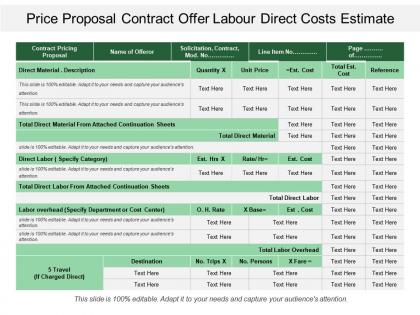
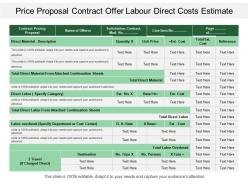
The image is of a PowerPoint slide titled "Price Proposal Contract Offer Labour Direct Costs Estimate." It features a template designed to detail the costs associated with a project or contract proposal, broken down into various categories. The sections include:
1. Contract Pricing Proposal: A heading for entering the proposal details.
2. Direct Material. Description: A section for detailing materials with placeholders for quantity, unit price, estimated cost, total estimated cost, and reference.
3. Total Direct Material From Attached Continuation Sheets: A summary line for material costs from detailed sheets.
4. Direct Labor (Specify Category): A section for labor costs with placeholders for estimated hours, rate per hour, and estimated cost.
5. Total Direct Labor From Attached Continuation Sheets: A summary line for total direct labor costs.
6. Labor Overhead (Specify Department or Cost Center)": A section for overhead costs associated with labor, including overhead rate and base for the calculation of estimated cost.
7. Total Labor Overhead: A summary line for total labor overhead.
8. Travel (If Charged Direct): A section detailing direct travel costs with placeholders for the destination, number of trips, number of persons, fare, and total estimated cost.
Each section has "Text Here" placeholders indicating where specific information should be entered. This slide is a comprehensive tool for compiling and presenting cost estimates in contract proposals.
Use Cases:
Such a cost estimation template is valuable across a wide range of industries:
1. Construction:
Use: Bidding on construction projects.
Presenter: Estimator
Audience: Clients and Contractors
2. Consulting:
Use: Proposing consulting project fees.
Presenter: Management Consultant
Audience: Business Clients
3. Event Planning:
Use: Outlining event costs for clients.
Presenter: Event Planner
Audience: Clients and Vendors
4. Healthcare:
Use: Estimating costs for healthcare services.
Presenter: Healthcare Administrator
Audience: Insurance Providers
5. Manufacturing:
Use: Costing new manufacturing projects.
Presenter: Cost Analyst
Audience: Management and Investors
6. Information Technology:
Use: Pricing IT project development.
Presenter: IT Project Manager
Audience: Clients and Stakeholders
7. Research and Development:
Use: Funding proposals for R&D projects.
Presenter: Research Coordinator
Audience: Grant Committees and Investors
Price proposal contract offer labour direct costs estimate with all 5 slides:
Be alto centric with our Price Proposal Contract Offer Labour Direct Costs Estimate. Focus your thoughts on benefiting them.


FAQs for Price proposal contract offer labour
Key components for project cost estimation include labor expenses, materials and equipment, overhead costs, contingency reserves, and external vendor fees. These elements work together to create comprehensive budgets, with many organizations finding that accurate upfront estimation in sectors like construction, software development, and manufacturing ultimately delivers better resource allocation, minimized overruns, and enhanced project profitability.
Fixed costs remain constant regardless of production volume, while variable costs fluctuate with activity levels, creating different budgeting challenges and opportunities. Organizations across manufacturing, retail, and service sectors find that accurately categorizing these costs enables better forecasting, resource allocation, and pricing strategies, ultimately delivering more precise financial planning and improved profit margins.
Historical data and past project costs serve as foundational benchmarks for accurate cost estimation, providing insights into resource requirements, timeline patterns, labor costs, material expenses, and potential risk factors. These records enable organizations to identify cost trends, validate assumptions, and refine estimation models, with many project managers finding that comprehensive historical analysis significantly reduces estimation errors and enhances budget accuracy.
Software tools enhance cost estimation accuracy by automating calculations, integrating real-time data, eliminating human error, and providing predictive analytics based on historical patterns. These technologies streamline project planning through automated resource allocation, scenario modeling, and continuous tracking, with many construction firms and manufacturing organizations finding that digital estimation delivers faster quotes, reduced overruns, and improved competitive positioning.
Common pitfalls include underestimating overhead costs, failing to account for scope creep, neglecting contingency buffers, overlooking indirect expenses, and using outdated pricing data. Small businesses often struggle with these challenges due to limited resources and experience, but implementing structured estimation processes, regular cost reviews, and buffer planning ultimately delivers more accurate budgets and improved financial control.
External factors significantly influence cost estimations by affecting material prices, labor costs, resource availability, and project timelines. Market volatility, inflation rates, and supply chain disruptions can shift project budgets by 10-30%, with construction, manufacturing, and technology sectors finding that dynamic pricing models and contingency planning help maintain accuracy while delivering competitive project outcomes.
Ensuring stakeholder buy-in on cost estimates involves transparent communication, collaborative validation, detailed documentation, and regular progress updates throughout the project lifecycle. By presenting clear assumptions, involving stakeholders in estimate development, and providing historical data comparisons, organizations streamline approval processes, minimize scope disputes, and ultimately deliver enhanced project success rates with stronger stakeholder alignment.
Contingency planning should be integrated by establishing risk-based buffers typically ranging 5-20% of total costs, conducting scenario analysis for potential overruns, and creating phased funding approaches that allow for adjustments. Organizations across sectors like construction, IT, and manufacturing increasingly build these strategic reserves into their estimation frameworks, enabling better resource allocation, reduced project failures, and enhanced stakeholder confidence when unexpected costs emerge.
Cost estimation refinement techniques include bottom-up estimating, three-point estimation, parametric modeling, analogous estimating, and earned value management. These methods enhance accuracy by incorporating actual project data, stakeholder feedback, and market conditions throughout the lifecycle, with many project managers finding that regular estimate updates using multiple techniques delivers improved budget control and stakeholder confidence.
Industries approach cost estimation through sector-specific methodologies, with construction using detailed breakdowns and contingencies, manufacturing employing activity-based costing, software development leveraging agile estimation techniques, and healthcare focusing on patient outcome metrics. These varied approaches demonstrate that effective cost estimation requires industry-tailored frameworks, real-time data integration, and stakeholder collaboration, ultimately delivering more accurate budgets and competitive advantage.
A Work Breakdown Structure (WBS) is fundamental to accurate cost estimation because it decomposes complex projects into manageable, definable work packages that can be individually costed and tracked. This systematic approach enables project managers to identify all cost components, allocate resources more precisely, and minimize budget overruns, with many organizations finding that detailed WBS implementation improves cost accuracy by significantly reducing unforeseen expenses.
Collaboration among team members improves cost estimation accuracy by combining diverse expertise, cross-validating assumptions, and identifying potential overlooked expenses through multiple perspectives. When project managers, engineers, procurement specialists, and finance teams collaborate, they create comprehensive estimates that account for technical complexities, market variables, and operational realities, ultimately delivering more reliable budgets and reducing costly project overruns.
Parametric estimating offers superior accuracy, speed, and consistency compared to analogous or bottom-up methods, utilizing statistical relationships and historical data to generate reliable cost projections. This approach streamlines project planning across construction, software development, and manufacturing sectors, while enabling faster bid responses, reduced estimation time, and improved resource allocation, ultimately delivering competitive advantage through data-driven decision making.
Cost estimation significantly impacts project timelines by determining resource availability, scheduling constraints, and milestone planning, while influencing team size, equipment procurement, and budget allocation decisions. Accurate estimates enable organizations to streamline workflows, minimize delays, and optimize resource distribution, with many companies finding that precise cost forecasting ultimately delivers faster project completion and enhanced operational efficiency.
Cost estimation serves as a foundation for risk management by identifying potential budget overruns, resource shortages, and financial vulnerabilities before they occur. Through accurate cost projections, organizations can develop contingency plans, allocate reserve funds, and implement mitigation strategies, with many construction firms and manufacturing companies finding that precise estimation reduces project risks by 30-40%.
-
Unique design & color.
-
Informative presentations that are easily editable.