

Pricing And Revenue Optimization Bcg Matrix To Evaluate Market Pricing Strategy




Try Before you Buy Download Free Sample Product
 Impress Your
 Audience
 100%
100% Editable
 Save Hours
 of Time


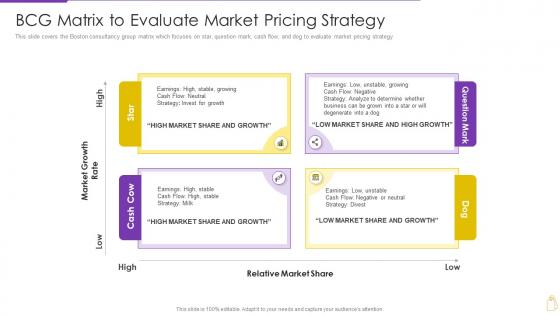
This slide covers the Boston consultancy group matrix which focuses on star, question mark, cash flow, and dog to evaluate market pricing strategy.
People who downloaded this PowerPoint presentation also viewed the following :
Pricing And Revenue Optimization Bcg Matrix To Evaluate Market Pricing Strategy with all 6 slides:
Use our Pricing And Revenue Optimization Bcg Matrix To Evaluate Market Pricing Strategy to effectively help you save your valuable time. They are readymade to fit into any presentation structure.





FAQs for Pricing And Revenue Optimization Bcg Matrix To Evaluate
**INPUT**: What factors should be considered when determining the pricing of presentation templates? **OUTPUT**: Pricing presentation templates requires considering production complexity, target market segments, competitive landscape, design quality, and licensing terms. These factors work together by balancing development costs with market demand, customization levels, and brand positioning, with many template providers finding that strategic pricing based on professional value and industry-specific applications ultimately delivers sustainable revenue growth.
Market demand significantly influences pricing strategy by determining price elasticity, competitive positioning, and customer willingness to pay for presentation templates. High demand periods, such as back-to-school or corporate planning seasons, enable premium pricing, while saturated markets require competitive adjustments, with many digital product companies finding that dynamic pricing based on demand patterns ultimately delivers optimized revenue and market penetration.
Subscription-based pricing for presentation templates offers predictable revenue streams, lower customer acquisition costs, continuous content updates, and enhanced customer retention through ongoing value delivery. While this model requires significant upfront content investment and may deter price-sensitive users, many template businesses find that subscriptions ultimately deliver higher lifetime customer value and sustainable competitive advantage.
Psychological pricing for presentation templates leverages anchoring, decoy effects, and charm pricing to influence purchasing decisions. By positioning premium templates at higher anchor prices, offering three-tiered bundles where the middle option appears most valuable, and using prices like $19.99 instead of $20, businesses can increase conversion rates and average order values.
Competitor pricing informs your presentation template strategy by revealing market positioning opportunities, identifying pricing gaps, understanding value perception benchmarks, and highlighting differentiation possibilities. Through competitive analysis, businesses can strategically position their templates above, below, or alongside competitors while emphasizing unique features, ultimately enabling more informed pricing decisions that balance competitiveness with profitability and market positioning goals.
Perceived value significantly influences digital download pricing by determining what customers willingly pay based on design quality, professional appeal, time-saving benefits, and brand credibility. High-quality presentation templates command premium prices when buyers recognize their ability to enhance business communications, streamline workflow processes, and deliver polished results, with many professionals finding that investing in superior templates ultimately provides competitive advantage through improved presentations.
Customer segmentation for pricing involves analyzing demographics, purchasing behavior, price sensitivity, usage patterns, and geographic factors to identify distinct user groups with varying value perceptions. Companies like Netflix and Adobe successfully implement tiered pricing based on customer segments, with streaming services offering basic and premium tiers while software companies provide student, professional, and enterprise pricing, ultimately maximizing revenue across diverse customer needs.
Customer loyalty significantly influences pricing strategy through retention-focused discounts, tiered membership programs, bulk purchase incentives, and exclusive early access deals for presentation templates. Loyal buyers typically demonstrate higher price tolerance and purchase frequency, enabling businesses to implement strategic loyalty pricing that balances competitive rates with premium value propositions, ultimately increasing customer lifetime value while maintaining sustainable profit margins.
Bundling multiple presentation templates enhances sales by increasing perceived value, encouraging higher transaction volumes, and reducing customer acquisition costs per purchase. This strategy enables businesses to offer premium packages at competitive price points while streamlining inventory management, with many design companies finding that bundled offerings boost average order values and foster long-term customer relationships.
Pricing significantly lower than competitors can accelerate market penetration and customer acquisition, while potentially signaling lower perceived value or quality concerns. This strategy enables rapid user base growth, competitive differentiation, and market share capture, with many presentation template providers finding that aggressive introductory pricing, combined with superior design quality, ultimately delivers customer loyalty and sustainable revenue growth through volume scaling.
Seasonal promotions can strategically drive template sales by aligning discounts with business cycles, holiday campaigns, budget periods, and industry-specific seasons when presentation demand peaks. Companies leverage back-to-school promotions for educational templates, year-end discounts for corporate planning decks, and holiday bundles for marketing presentations, ultimately boosting revenue while clearing inventory and attracting price-sensitive customers during traditionally slower periods.
Key metrics include customer acquisition cost, lifetime value, conversion rates, price elasticity, churn rates, and revenue per user. These indicators help organizations optimize their digital pricing by revealing customer behavior patterns, market responsiveness, and profitability trends, with many companies finding that regular analysis enables strategic adjustments that enhance competitive positioning.
Customer feedback leverages pricing strategy refinement through usage analytics, satisfaction surveys, feature preference analysis, willingness-to-pay studies, and competitive positioning insights. By analyzing customer responses across enterprise clients, creative agencies, and educational institutions, businesses can optimize price points, bundle offerings, and tier structures, ultimately delivering better value alignment while maximizing revenue potential and market competitiveness.
Branding plays a pivotal role in premium presentation template pricing by establishing perceived value, market positioning, and customer willingness to pay higher prices. Strong branding enables companies to command premium rates through reputation, quality assurance, and brand trust, with many design agencies and corporate clients finding that recognized brands justify significantly higher template investments over generic alternatives.
Incorporating value-added services like customization into presentation template pricing involves tiered structures, premium add-ons, bundled packages, subscription upgrades, and consultation fees. These pricing models enable businesses to capture additional revenue while delivering personalized experiences, with many design companies finding that customization services command 40-60% higher margins than standard templates.
-
Commendable slides with attractive designs. Extremely pleased with the fact that they are easy to modify. Great work!
-
Unique design & color.