

Prioritize Cyber Security Risk With Severity Matrix Cyber Risk Assessment




Try Before you Buy Download Free Sample Product
 Impress Your
Audience
 100%
Editable
 Save Hours
of Time


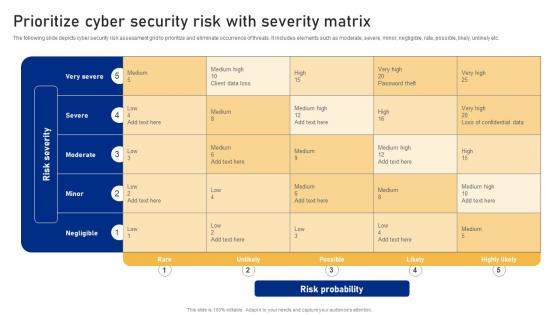
The following slide depicts cyber security risk assessment grid to prioritize and eliminate occurrence of threats. It includes elements such as moderate, severe, minor, negligible, rate, possible, likely, unlikely etc.
People who downloaded this PowerPoint presentation also viewed the following :
Prioritize Cyber Security Risk With Severity Matrix Cyber Risk Assessment with all 9 slides:
Use our Prioritize Cyber Security Risk With Severity Matrix Cyber Risk Assessment to effectively help you save your valuable time. They are readymade to fit into any presentation structure.









FAQs for Prioritize Cyber Security Risk With Severity Matrix
A comprehensive cyber security risk assessment should include asset inventory and classification, threat identification and analysis, vulnerability scanning and penetration testing, risk evaluation and prioritization, and mitigation strategy development. These components work together by mapping digital assets, identifying potential attack vectors, and quantifying business impact, with many organizations finding that this systematic approach streamlines security investments while enhancing operational resilience.
Organizations identify critical assets by conducting comprehensive asset inventories, analyzing business impact dependencies, evaluating data sensitivity levels, assessing regulatory compliance requirements, and mapping operational dependencies. Through systematic classification frameworks, companies prioritize assets based on revenue impact, customer data exposure, and operational continuity, with many financial institutions and healthcare organizations finding that this structured approach enables targeted security investments and significantly reduces overall risk exposure.
Threat modeling systematically identifies potential attack vectors, vulnerabilities, and threat actors targeting specific systems, enabling organizations to prioritize security investments and defensive strategies more effectively. This proactive approach enhances risk assessments by providing detailed attack scenarios and impact analysis, with financial institutions and healthcare organizations finding that structured threat modeling significantly improves their security posture and regulatory compliance.
Organizations can effectively assess IT infrastructure vulnerability through comprehensive security audits, penetration testing, vulnerability scanning, network monitoring, and risk analysis frameworks like NIST or ISO 27001. These methodologies enable systematic identification of weaknesses across systems, applications, and processes, with many financial institutions and healthcare organizations finding that regular assessments significantly reduce breach risks while enhancing overall security posture.
Common cybersecurity risk assessment methodologies include NIST Cybersecurity Framework, ISO 27001, OCTAVE, FAIR, and COBIT. These frameworks streamline risk identification, analysis, and mitigation by establishing standardized processes, enabling consistent vulnerability evaluation, and providing measurable security metrics, with many organizations finding that structured approaches ultimately deliver enhanced threat visibility and strategic security investments.
Regulatory requirements significantly shape risk assessment processes by mandating specific security standards, compliance frameworks, and reporting protocols tailored to each industry's unique vulnerabilities. Financial services must comply with PCI DSS and SOX requirements, healthcare organizations follow HIPAA guidelines, while manufacturing sectors adhere to NIST frameworks, with many organizations finding that these structured approaches ultimately streamline their security posture and reduce operational risks.
Cybersecurity risk assessment effectiveness metrics include risk reduction percentages, incident response times, vulnerability remediation rates, compliance scores, and cost-benefit analysis outcomes. These measurements enable organizations to track security posture improvements, demonstrate ROI to stakeholders, and optimize resource allocation, with many financial institutions and healthcare providers finding that quantified assessments ultimately deliver enhanced protection and regulatory confidence.
Small businesses can conduct cost-effective cyber security risk assessments using free online tools, employee-led security audits, and streamlined vulnerability scans that identify critical weaknesses without requiring dedicated IT staff. Many small organizations find that combining basic penetration testing tools with structured checklists and vendor assessments delivers comprehensive protection insights, ultimately enabling targeted security investments that maximize protection while minimizing costs.
Ongoing risk assessment requires regular vulnerability scanning, threat intelligence monitoring, security metrics analysis, incident response evaluation, and compliance audits. Organizations should establish quarterly assessments, continuous monitoring systems, and feedback loops that incorporate lessons from security events, with many financial institutions and healthcare providers finding that automated tools combined with expert analysis significantly enhance their ability to adapt to emerging threats.
Organizations can involve stakeholders through cross-functional workshops, regular communication updates, collaborative risk identification sessions, and shared responsibility frameworks that assign specific roles to different departments. This inclusive approach ensures comprehensive risk coverage while building organizational commitment, with many companies finding that stakeholder engagement leads to more accurate threat identification, faster incident response, and stronger security culture across all business units.
Automation tools include vulnerability scanners, security information and event management (SIEM) systems, penetration testing platforms, compliance monitoring software, and AI-powered threat detection systems. These technologies streamline risk identification by continuously monitoring network traffic, automatically scanning for vulnerabilities, and generating real-time threat intelligence reports, ultimately enabling organizations to maintain comprehensive security oversight while reducing manual assessment time and improving response accuracy.
Organizations quantify cyber risks through risk scoring methodologies, probability assessments, asset valuations, threat modeling, and impact calculations that translate potential breaches into dollar amounts. Financial services and healthcare institutions increasingly use these frameworks to evaluate costs of data loss, system downtime, and regulatory penalties against security investments, ultimately enabling strategic budget allocation and demonstrating ROI for cybersecurity initiatives.
Threat intelligence enhances risk assessment by providing real-time data on emerging threats, attack patterns, vulnerability exploits, and threat actor behaviors. Through comprehensive intelligence feeds, organizations can prioritize risks more effectively, anticipate potential attacks, and strengthen defensive strategies, with many financial institutions and healthcare providers finding that intelligence-driven assessments deliver more accurate risk profiles.
Cybersecurity risk assessments should evolve through continuous threat intelligence monitoring, regular framework updates, and adaptive methodologies that incorporate emerging attack vectors and technologies. Organizations must establish dynamic evaluation processes that reassess vulnerabilities quarterly, integrate AI-driven threat detection capabilities, and update security protocols, with many enterprises finding that agile assessment approaches deliver enhanced protection and competitive advantage.
Organizations face challenges including rapidly evolving threat landscapes, resource constraints, data silos across departments, lack of skilled cybersecurity personnel, and difficulty quantifying emerging risks. These obstacles often result in outdated assessments that miss critical vulnerabilities, with many enterprises finding that automated tools and cross-functional collaboration help streamline updates while maintaining comprehensive coverage.
-
A perfect platform for all your presentation needs. Unlimited products at an affordable price.
-
SlideTeam makes creating presentations easy. Unlimited products, premium quality designs and affordable.