


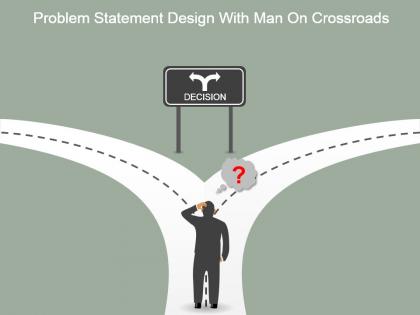
Problem statement design with man on crossroads powerpoint images




Try Before you Buy Download Free Sample Product
 Impress Your
 Audience
 100%
100% Editable
 Save Hours
 of Time


Form ideas with our Problem Statement Design With Man On Crossroads Powerpoint Images. They offer you excellent cues.
People who downloaded this PowerPoint presentation also viewed the following :
Problem statement design with man on crossroads powerpoint images with all 6 slides:
Your ascent will be beyond imagination due to our Problem Statement Design With Man On Crossroads Powerpoint Images. You will go to giddy heights.

FAQs for Problem statement design with man on
Key factors include clarifying your core values, assessing long-term implications, evaluating available resources, considering stakeholder impact, and analyzing potential risks versus rewards. These considerations enable individuals and organizations to make strategic choices by aligning decisions with personal goals, professional objectives, and operational capabilities, ultimately delivering greater clarity and confidence in navigating complex transitions.
Effective crossroads evaluation involves systematic analysis through impact assessment, stakeholder consultation, risk evaluation, timeline consideration, and resource requirement analysis. These approaches streamline decision-making by clarifying potential outcomes, identifying implementation challenges, and aligning choices with strategic objectives, with many organizations finding that structured comparison frameworks ultimately deliver greater confidence and measurable results.
Intuition plays a crucial role in crossroads decisions by processing subconscious patterns, past experiences, and emotional intelligence that analytical thinking might miss. While data-driven analysis provides the foundation, many executives find that combining intuitive insights with strategic evaluation enables faster decision-making, especially in ambiguous situations, ultimately delivering competitive advantage when time-sensitive opportunities arise.
Visual aids enhance pivotal decision-making by clarifying complex data, highlighting key trade-offs, and enabling stakeholders to quickly grasp critical relationships between options, timelines, and potential outcomes. Through decision trees, comparison matrices, and scenario mapping, organizations streamline collaborative analysis, reduce cognitive overload, and accelerate consensus-building, with many leadership teams finding that visual frameworks ultimately deliver faster, more confident strategic choices.
Decision-making frameworks like SWOT analysis help clarify crossroads options by systematically evaluating strengths, weaknesses, opportunities, and threats, providing structured comparison of alternatives, and reducing emotional bias through objective assessment criteria. These frameworks enable organizations to visualize trade-offs, prioritize resources strategically, and identify potential risks before implementation, with many businesses finding that structured approaches ultimately deliver more confident decisions and better long-term outcomes.
Past experiences inform crossroads decisions by providing valuable pattern recognition, highlighting potential consequences of similar choices, and revealing personal values that emerge under pressure. Through reflection on previous outcomes, decision-makers can identify what worked, what didn't, and why, while many organizations find that documenting past decision frameworks creates strategic advantages when facing future pivotal moments.
Strategies to mitigate decision fatigue include prioritizing high-impact decisions, establishing clear decision criteria, delegating routine choices, batching similar decisions together, and implementing systematic evaluation frameworks. These approaches streamline cognitive load by reducing unnecessary deliberation, enabling leaders in sectors like healthcare and finance to maintain strategic focus while ultimately delivering faster decision-making processes and improved organizational efficiency.
Group dynamics significantly influence critical decision-making through diverse perspectives, collective expertise, collaborative problem-solving, and shared accountability mechanisms. While teams can enhance analysis and reduce individual bias, they may also face challenges like groupthink or prolonged consensus-building, with many organizations finding that structured facilitation and clear decision frameworks ultimately deliver more comprehensive outcomes and stronger stakeholder buy-in.
Common psychological biases affecting crossroads decision making include confirmation bias, anchoring bias, loss aversion, overconfidence bias, and availability heuristic. These cognitive patterns can significantly impact strategic choices by limiting perspective, skewing risk assessment, and creating blind spots, with many organizations finding that structured decision frameworks and diverse input help mitigate these biases while enhancing outcomes.
Ensuring alignment involves conducting honest self-reflection to identify core values, assessing each option against long-term personal and professional goals, and considering potential consequences on relationships, career trajectory, and overall life satisfaction. Many individuals find that creating a structured evaluation framework, seeking guidance from trusted mentors, and visualizing future scenarios ultimately delivers clarity and confidence in major life transitions.
Critical junction decisions require comprehensive market analysis, financial projections, competitive intelligence, stakeholder feedback, and risk assessments to ensure informed choices. Organizations should gather customer data, operational metrics, and industry benchmarks, while consulting internal teams and external advisors, ultimately enabling strategic decisions that minimize uncertainty and maximize competitive advantage in an increasingly complex business landscape.
Storytelling techniques communicate crossroads decisions through narrative structure, character development, conflict resolution, emotional arcs, and clear outcome visualization. These approaches enable leaders to present complex choices as relatable journeys, helping stakeholders understand decision rationale and consequences, while organizations across industries find that story-driven communication enhances buy-in and strategic alignment.
Decision visualization tools include decision trees, scenario planning software, Monte Carlo simulations, predictive analytics platforms, and interactive dashboards that map potential outcomes across multiple variables. These technologies enable organizations to model complex scenarios by analyzing risk probabilities, financial projections, and strategic implications, with many financial services and manufacturing companies finding that visual modeling significantly enhances decision confidence and stakeholder alignment.
Feedback from trusted peers or mentors provides objective perspectives, identifies blind spots, and offers experienced insights that help evaluate crossroads options more comprehensively. Through candid discussions and strategic questioning, these advisors help decision-makers weigh risks against opportunities, challenge assumptions, and ultimately gain confidence in their chosen direction while minimizing potential oversights.
Methods to manage decision-making anxiety include structured frameworks like decision matrices, scenario planning, stakeholder consultation, mindfulness practices, and phased implementation approaches. These techniques help organizations and leaders navigate uncertainty by breaking complex choices into manageable components, gathering diverse perspectives, and creating contingency plans, ultimately delivering greater confidence and strategic clarity during critical business crossroads.
-
Informative presentations that are easily editable.
-
Easily Editable.