

Process Automation Implementation To Improve Organization Performance Complete Deck




Try Before you Buy Download Free Sample Product
 Impress Your
 Audience
 100%
100% Editable
 Save Hours
 of Time


Grab our competently designed Process automation implementation to improve organization performance to enhance operational efficiency via an automation template that determines, analyzes, and improves the organizations current industry processes. This helps in optimization and meeting new quality standards. Workflow improvement is a continuous practice and should always be followed up with the estimation of tangible areas of improvement. When executed successfully, it can result in the enhancement of product quality, customer satisfaction, increased productivity, etc. Our Process automation deck covers recent automation tools, process improvement techniques, and an execution timeline. It further showcases the areas of workflow automation and incorporates automation implementation strategies. At last, our Business workflow automation module exhibits implementation guidelines and dashboards to measure business performance after implementation. Download this 100 percentage editable presentation and get access to our highly researched and skillfully designed product
People who downloaded this PowerPoint presentation also viewed the following :
Content of this Powerpoint Presentation
Slide 1: This slide displays the title Process Automation Implementation to Improve Organization Performance.
Slide 2: This slide displays the title Agenda.
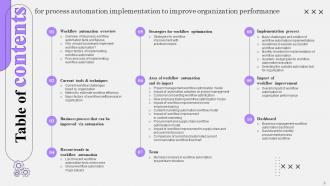
Slide 3: This slide exhibit table of content.
Slide 4: This slide showcase table of content that is to be discuss further.
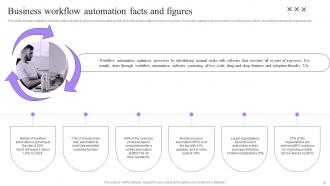
Slide 5: This slide includes statistics and information related to recent and estimated growth of workflow automation in upcoming years.
Slide 6: This slide illustrated the requirement of workflow automation in any organization.
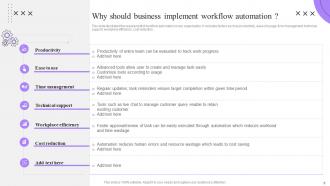
Slide 7: This slide showcases the major reasons of implementing workflow automation.
Slide 8: This slide showcases the merits and demerits of implementing workflow automation in organization.
Slide 9: This slide showcase table of content that is to be discuss further.
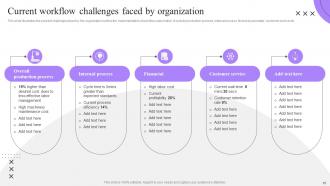
Slide 10: This slide illustrates the present challenges faced by the organization before the implementation of workflow automation.
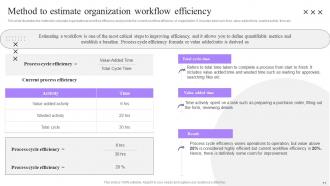
Slide 11: This slide illustrates the method to calculate organizational workflow efficiency and provide the current workflow efficiency of organization.
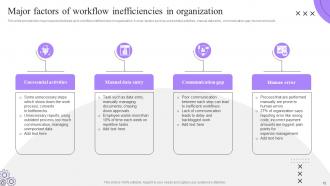
Slide 12: This slide provides the major reasons that lead up to workflow inefficiencies in organization.
Slide 13: This slide showcase table of content that is to be discuss further.
Slide 14: This slide covers all the aspects of an organization workflows that can be improvised by implementing automation.
Slide 15: This slide showcase table of content that is to be discuss further.
Slide 16: This slide includes the trending workflow automation tools for industries such as healthcare, IT, finance, marketing, human resources etc.
Slide 17: This slide includes the trending workflow automation tools for industries such as healthcare, IT, finance, marketing, human resources etc.
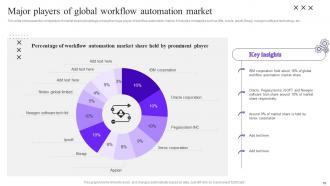
Slide 18: This slide showcases the comparison of market share percentage among the major player of workflow automation market.
Slide 19: This slide showcase table of content that is to be discuss further.
Slide 20: This slide showcase the tactics to enhance organization performance by improving workflow with practical examples.
Slide 21: This slide showcase table of content that is to be discuss further.
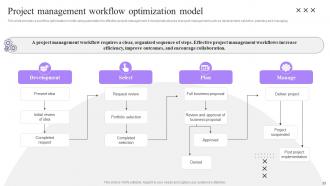
Slide 22: This slide provides a workflow optimization model using automation for effective project management.
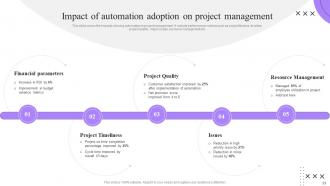
Slide 23: This slide covers the impacts of using automation in project management.
Slide 24: This slide provides a workflow optimization model via using automation for new staff training.
Slide 25: This slide includes impact of implementing automation in new employee training program.
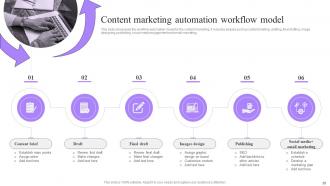
Slide 26: This slide showcases the workflow automation model for the content marketing.
Slide 27: This slide includes overall impact of implementing content marketing workflow automation.
Slide 28: This slide showcase the workflow optimization model via automation for procurement process.
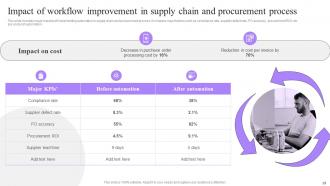
Slide 29: This slide includes major impacts of implementing automation in supply chain and procurement process.
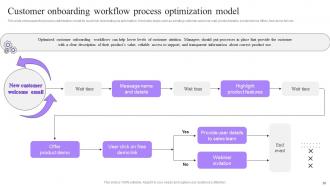
Slide 30: This slide showcases the process optimization model for customer onboarding via automation.
Slide 31: This slide compares the customer communication workflow model before and after automation.
Slide 32: This slide showcase table of content that is to be discuss further.
Slide 33: This slide provide information about the workflow automation project team.
Slide 34: This slide showcase table of content that is to be discuss further.
Slide 35: This slide showcases the challenges and solution of executing business workflow automation along with its implementation approach.
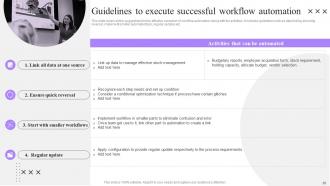
Slide 36: This slide covers all the suggestions for the effective execution of workflow automation along with the activities.
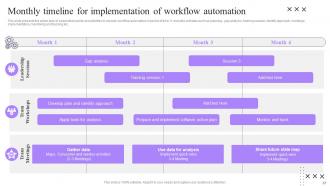
Slide 37: This slide presents the action plan of sequential events and activities to execute workflow automation in period of time.
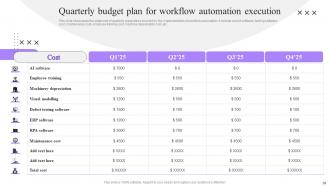
Slide 38: This slide showcases the statement of quarterly expenditure incurred by the implementation of workflow automation.
Slide 39: This slide showcases the method of choosing appropriate workflow automation tool on the basis of factors.
Slide 40: This slide showcase table of content that is to be discuss further.
Slide 41: This slide showcases the overall impact of workflow automation on business performance.
Slide 42: This slide showcase table of content that is to be discuss further.
Slide 43: This slide presents the graphical representation of business management dashboard via workflow automation software.
Slide 44: This slide presents a dashboard for monthly procurement activities in an organization.
Slide 45: This is the icons slide.
Slide 46: This slide presents title for additional slides.
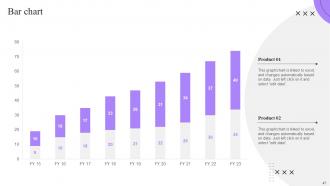
Slide 47: This slide displays yearly bar chart for different products.
Slide 48: This slide exhibits ideas generated.
Slide 49: This slide depicts posts for past experiences of clients.
Slide 50: This slide exhibits yearly timeline of company.
Slide 51: This slide diplay Our goal.
Slide 52: This slide shows puzzle for displaying elements of company.
Slide 53: This slide display Venn.
Slide 54: This slide display Roadmap.
Slide 55: This is thank you slide & contains contact details of company like office address, phone no., etc.
Process Automation Implementation To Improve Organization Performance Complete Deck with all 60 slides:
Use our Process Automation Implementation To Improve Organization Performance Complete Deck to effectively help you save your valuable time. They are readymade to fit into any presentation structure.


























FAQs for Process Automation Implementation To Improve Organization
Process automation delivers significant benefits including reduced operational costs, enhanced accuracy, and improved employee productivity, ultimately streamlining workflows. While initial implementation can present challenges and opportunities, organizations across industries—like banks and hospitals—are finding that automating tasks such as invoice processing and data entry enables faster services and better customer experiences.
Process automation enhances productivity and efficiency in everyday tasks by streamlining repetitive workflows, minimizing manual errors, and accelerating task completion. Through robotic process automation and intelligent automation, organizations across industries—including banks, hospitals, and retail—are automating data entry, invoice processing, and customer interactions. This ultimately delivers significant cost reduction and improved customer experiences, with many institutions finding that automation frees employees for higher-value strategic initiatives.
Process automation contributes to cost savings for organizations by streamlining workflows, minimizing errors, and reducing manual labor requirements. These technologies enhance operational efficiency through robotic process automation, intelligent document processing, and workflow orchestration, with many financial services and healthcare institutions finding that automation delivers significant reductions in processing times and labor costs. Ultimately delivering improved resource allocation and a strengthened competitive advantage in an increasingly digital landscape.
Process automation adoption presents both challenges and opportunities, including initial investment costs, integration with legacy systems, and the need for skilled personnel. While streamlining workflows and reducing errors, it also requires careful planning, data security considerations, and change management across organizations. With many financial services and healthcare institutions finding that successful implementation hinges on clearly defined goals and employee training, ultimately delivering increased operational efficiency and a competitive advantage.
Process automation enhances security and compliance by minimizing manual intervention, enforcing standardized workflows, and enabling detailed audit trails. These technologies streamline access controls, data encryption, and version management, with many financial services institutions finding that automated systems significantly reduce the risk of human error and fraud. Ultimately delivering enhanced data protection and regulatory adherence.
Artificial intelligence significantly enhances process automation by enabling intelligent data processing, predictive decision-making, and adaptive workflows. These technologies streamline operations by automating complex tasks, minimizing errors, and accelerating cycle times, with many financial services institutions finding that AI-powered automation delivers substantial cost reductions and improved customer experiences. Ultimately, AI enables organizations to achieve greater operational efficiency and competitive advantage in an increasingly dynamic landscape.
Process automation suitability is assessed by evaluating tasks for repetitiveness, rule-based structures, and high transaction volumes, alongside potential for error reduction and cost savings. While identifying these processes, it also requires considering integration complexities and potential impacts on existing workflows, with many financial services and healthcare institutions finding that claims processing and data entry are ideal starting points. These technologies streamline operations by minimizing manual intervention, accelerating turnaround times, and ultimately delivering significant operational efficiency and a competitive advantage.
Process automation integration necessitates careful planning, robust data mapping, and phased implementation, alongside thorough testing and employee training. These technologies streamline workflows by minimizing manual tasks, enhancing data accuracy, and accelerating response times, with many financial services institutions finding that seamless integration delivers significant operational efficiency and reduced costs.
Process automation enhances customer experience and satisfaction by streamlining interactions, personalizing services, and accelerating response times through robotic process automation, intelligent chatbots, and workflow optimization. While initial implementation presents both challenges and opportunities, organizations—like banks and hospitals—are finding that automated processes deliver faster resolutions, reduced errors, and ultimately, increased customer loyalty and advocacy.
Process automation success requires organizations to track several key metrics, including cost reduction, error rate, processing time, and employee satisfaction. These technologies streamline workflows by minimizing manual intervention, accelerating task completion, and enhancing data accuracy, with many financial services institutions finding that automation delivers significant operational efficiency. Ultimately, consistent monitoring enables optimized resource allocation and a demonstrable return on investment.
Process automation significantly reshapes workforce dynamics by streamlining repetitive tasks, enhancing employee focus on strategic initiatives, and fostering skill development. While concerns around job displacement exist, it also creates opportunities for roles centered around automation management, data analysis, and process optimization, with many organizations finding that reskilling programs deliver a more agile and efficient workforce. Ultimately delivering increased productivity and improved employee experiences in an increasingly competitive landscape.
Process automation and digital transformation intersect by streamlining workflows, enhancing data accessibility, and fostering innovation across organizations. These technologies converge through robotic process automation, artificial intelligence, and machine learning, ultimately delivering operational efficiency and improved customer experiences. With many institutions finding that integrated approaches accelerate digital maturity, enabling strategic combination of resources and faster services.
Process automation is gaining traction across banking, healthcare, retail, and manufacturing, driven by needs for efficiency and scalability. These industries leverage robotic process automation (RPA) by streamlining repetitive tasks, minimizing errors, and accelerating workflows. With many organizations finding that automation enhances customer experiences and reduces operational costs, ultimately delivering a competitive advantage and improved resource allocation.
Process automation empowers small businesses by streamlining workflows through robotic process automation (RPA), business process management (BPM), and low-code platforms. While initial setup requires investment, these technologies reduce manual tasks, minimize errors, and accelerate operations for organizations, with many finding that focused automation of key areas like invoice processing and customer onboarding delivers significant cost savings and enhanced customer experiences.
Process automation trends include robotic process automation (RPA), artificial intelligence (AI), machine learning (ML), intelligent document processing, and hyperautomation. These technologies streamline workflows by automating repetitive tasks, enhancing decision-making, and improving data accuracy, with many financial services and healthcare institutions finding that strategic combination delivers significant operational efficiency and competitive advantage.
-
Definitely a time saver! Predesigned and easy-to-use templates just helped me put together an amazing presentation.
-
SlideTeam never fails to surprise me with its amazing PPT designs. Thanks team for providing me with your constant support!