


Process Evaluation Checklist For Kaizen Gemba Walk Training Ppt




Try Before you Buy Download Free Sample Product
 Impress Your
 Audience
 100%
100% Editable
 Save Hours
 of Time


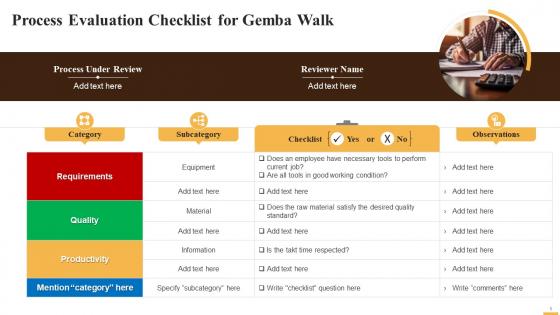
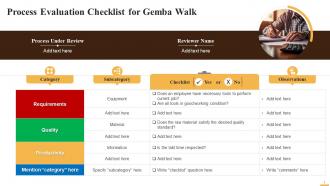
This slide presents a process evaluation checklist that the reviewer can use during the Gemba Walk. The major constituents of the checklist are process under review, category, subcategory, questions, and observations.
People who downloaded this PowerPoint presentation also viewed the following :
Process Evaluation Checklist For Kaizen Gemba Walk Training Ppt with all 20 slides:
Use our Process Evaluation Checklist For Kaizen Gemba Walk Training Ppt to effectively help you save your valuable time. They are readymade to fit into any presentation structure.










FAQs for Process Evaluation Checklist For Kaizen Gemba
The primary purpose of a Gemba Walk in Kaizen is to observe actual work processes at their source, enabling leaders to identify inefficiencies, understand real operational challenges, and discover improvement opportunities through direct engagement with frontline employees. This practice enhances decision-making by connecting management with ground-level realities, while fostering continuous improvement culture and delivering more effective solutions.
Gemba walks directly influence continuous improvement by identifying waste, inefficiencies, and process gaps through firsthand observation, enabling leaders to understand actual versus perceived operations. This real-time assessment approach helps manufacturing plants, healthcare facilities, and service organizations prioritize improvement projects based on observable data, ultimately streamlining workflows and enhancing operational efficiency across departments.
Key factors include process flow efficiency, waste identification, safety compliance, quality standards adherence, and employee engagement levels. These evaluation criteria enable managers to systematically assess operational effectiveness by observing actual work conditions, documenting improvement opportunities, and gathering frontline insights, ultimately delivering enhanced productivity and streamlined operations across manufacturing and service environments.
Employee engagement significantly influences Gemba Walk outcomes by ensuring authentic observations, accurate problem identification, and sustainable improvement implementation. Engaged employees willingly share operational challenges, provide honest feedback about processes, and actively participate in solution development, while disengaged staff may conceal issues or resist changes, ultimately determining whether organizations achieve meaningful operational improvements and lasting cultural transformation.
Data collected during Gemba walks should include cycle times, quality metrics, waste indicators, resource utilization rates, and employee feedback on process bottlenecks. These measurements enable organizations to identify inefficiencies, streamline workflows, and enhance operational performance, with many manufacturing and service companies finding that systematic data collection ultimately delivers significant cost reductions and improved productivity.
Gemba Walks help identify waste reduction areas by enabling managers to observe actual work processes, spot bottlenecks, inefficient workflows, and resource misallocation directly on the shop floor. Through real-time observation, organizations can uncover hidden inefficiencies like excessive inventory, unnecessary motion, and process delays, ultimately streamlining operations and enhancing productivity across manufacturing, healthcare, and service environments.
Methods to encourage open dialogue during Gemba Walks include creating psychological safety through non-judgmental questioning, implementing structured observation periods with collaborative discussion sessions, and using visual management tools to facilitate conversation around process improvements. These approaches enhance communication by establishing trust between leadership and frontline workers, promoting knowledge sharing across departments, and ultimately delivering more accurate problem identification and sustainable solutions, with many organizations finding that regular dialogue-focused walks significantly improve employee engagement and operational efficiency.
Ensuring stakeholder inclusion in Gemba Walks requires strategic planning that encompasses frontline workers, supervisors, quality managers, safety personnel, and cross-functional team representatives from operations, maintenance, and support departments. Through structured invitation processes and rotating participation schedules, organizations streamline communication, enhance diverse perspectives, and ultimately deliver comprehensive process insights, with many manufacturing and healthcare facilities finding that broader stakeholder engagement accelerates sustainable improvement outcomes.
Leadership drives Gemba Walk success by actively participating in floor-level observations, demonstrating commitment to continuous improvement, and fostering open dialogue with frontline employees. Through authentic engagement and follow-through on identified opportunities, leaders create psychological safety that encourages honest feedback, ultimately strengthening organizational culture while delivering measurable operational improvements and enhanced employee engagement.
Visual management tools can be integrated into Gemba Walk evaluation checklists through digital dashboards, color-coded status indicators, real-time data displays, visual workflow maps, and standardized documentation templates. These tools streamline the evaluation process by enabling immediate problem identification, facilitating clear communication between teams, and creating visual documentation of improvement opportunities, ultimately delivering faster decision-making and enhanced continuous improvement tracking across manufacturing and operational environments.
Follow-up actions after a Gemba Walk include documenting observations, prioritizing improvement opportunities, assigning responsible team members, establishing timelines, and scheduling progress reviews. These systematic steps streamline implementation by creating accountability, enabling continuous monitoring, and fostering collaborative problem-solving, with many manufacturing organizations finding that structured follow-up processes ultimately deliver measurable operational improvements and sustained cultural change.
Gemba Walk effectiveness can be measured through key performance indicators like defect reduction rates, cycle time improvements, employee engagement scores, and implementation rates of identified improvements. Organizations track these metrics monthly or quarterly, with many manufacturing and healthcare facilities finding that consistent measurement delivers 15-30% operational efficiency gains and enhanced continuous improvement cultures.
Common pitfalls include rushing through observations, focusing solely on problems without understanding processes, interrupting workflows, making immediate judgments, and neglecting employee input during evaluations. These missteps undermine the core purpose of Gemba walks, with many organizations finding that successful implementations require patience, active listening, and collaborative engagement, ultimately delivering deeper process insights and stronger employee relationships.
Technology enhances Gemba Walks through mobile apps for real-time data collection, digital checklists for standardized evaluations, IoT sensors for continuous monitoring, and analytics platforms for trend identification. These tools streamline documentation, enable immediate issue tracking, and provide data-driven insights, with many manufacturing organizations finding that digital integration accelerates improvement cycles while maintaining the human-centered observation approach.
Cultural context significantly influences Gemba Walk effectiveness by shaping communication styles, hierarchy respect, feedback acceptance, and problem-solving approaches across different organizational environments. While Japanese cultures naturally embrace continuous improvement and respectful observation, Western organizations often require adapted approaches that balance direct feedback with collaborative engagement, ultimately delivering enhanced operational insights when culturally aligned.
-
Very well designed and informative templates.
-
SlideTeam is the best in the business. Their templates are engaging and customizable. You can rely on them.