


Process Flow Of Service Desk Management Using Help Desk Management Advanced Support Services




Try Before you Buy Download Free Sample Product
 Impress Your
Audience
 100%
Editable
 Save Hours
of Time


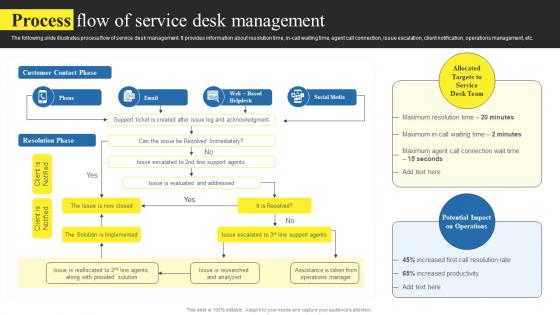
The following slide illustrates process flow of service desk management. It provides information about resolution time, in-call waiting time, agent call connection, issue escalation, client notification, operations management, etc.
People who downloaded this PowerPoint presentation also viewed the following :
Process Flow Of Service Desk Management Using Help Desk Management Advanced Support Services with all 6 slides:
Use our Process Flow Of Service Desk Management Using Help Desk Management Advanced Support Services to effectively help you save your valuable time. They are readymade to fit into any presentation structure.






FAQs for Process Flow Of Service Desk Management Using Help Desk Management
Key service desk metrics include first call resolution rate, average response time, customer satisfaction scores, ticket volume trends, and agent productivity levels. These measurements streamline operations by identifying bottlenecks, enhancing resource allocation, and improving service quality, with many IT organizations finding that comprehensive metric tracking ultimately delivers faster issue resolution and significantly higher user satisfaction rates.
AI and automation enhance service desk operations by streamlining ticket routing, automating routine tasks, and providing intelligent chatbots for instant customer support. These technologies enable faster response times, reduce operational costs, and improve service quality, with many organizations finding that automated systems handle 60-70% of standard inquiries, ultimately freeing human agents for complex problem-solving.
Customer feedback plays a crucial role in identifying service gaps, measuring satisfaction levels, prioritizing improvement areas, and validating resolution effectiveness. Through systematic feedback collection, service desk teams can enhance response times, streamline processes, and deliver more personalized support experiences, with many organizations finding that regular feedback loops ultimately drive higher first-call resolution rates and customer loyalty.
Service desks balance user satisfaction with operational efficiency by implementing tiered support structures, automated ticket routing, self-service portals, and proactive monitoring systems. These approaches streamline resolution processes while maintaining personalized service, with many organizations finding that strategic automation reduces response times, optimizes resource allocation, and ultimately delivers improved user experiences alongside cost-effective operations.
**INPUT**: What are the best practices for incident categorization and prioritization? **OUTPUT**: Best practices for incident categorization and prioritization include establishing clear severity levels, implementing standardized classification schemes, defining business impact criteria, automating initial triage processes, and creating escalation matrices. These approaches streamline resolution workflows by ensuring critical issues receive immediate attention, resources are allocated efficiently, and service level agreements are consistently met, with many organizations finding that structured categorization reduces response times and enhances overall customer satisfaction. **Word count: 60 words**
Effective knowledge management improves service desk responses by centralizing solutions, reducing resolution times, and ensuring consistent information across all support channels. Through comprehensive knowledge bases, service desk teams can quickly access proven solutions, minimize escalations, and deliver standardized responses, with many organizations finding that structured knowledge systems enhance first-call resolution rates while reducing training requirements.
Effective service desk training strategies include role-based learning paths, hands-on simulations, mentorship programs, continuous certification tracks, and cross-functional knowledge sharing sessions. These approaches streamline staff development by combining theoretical knowledge with practical application, real-world troubleshooting scenarios, and ongoing skill enhancement, ultimately delivering faster issue resolution, improved customer satisfaction, and reduced training costs across growing support organizations.
ITIL framework transforms service desk management by establishing standardized processes for incident management, problem resolution, change control, and service level agreements, creating structured workflows that enhance consistency and accountability. Through ITIL's systematic approach, organizations streamline ticket prioritization, reduce resolution times, and improve customer satisfaction rates, with many IT departments finding that these standardized practices ultimately deliver measurable operational efficiency and enhanced service quality.
Multi-channel service desk support faces challenges including inconsistent customer experiences across channels, fragmented data silos, agent skill gaps, escalating operational costs, and complex integration requirements. These obstacles can significantly impact service quality and efficiency, with many organizations finding that strategic technology investments and unified communication platforms ultimately streamline operations while delivering enhanced customer satisfaction and competitive advantage.
Service desks integrate with ITSM tools through APIs, middleware platforms, and unified dashboards that connect incident management, asset databases, monitoring systems, and knowledge repositories. These integrations streamline workflows by automatically creating tickets from alerts, synchronizing asset information, and enabling seamless data flow between tools, ultimately delivering faster resolution times and enhanced operational efficiency across IT organizations.
Remote work transforms service desk operations by increasing ticket volumes, expanding security vulnerabilities, and requiring cloud-based support tools and virtual collaboration platforms. While these changes present challenges in troubleshooting hardware issues and maintaining team cohesion, they also enable global talent access and 24/7 coverage, with many organizations finding that strategic automation and self-service portals ultimately deliver enhanced operational efficiency.
Service desk teams foster collaboration by establishing cross-departmental communication protocols, implementing shared ticketing systems that provide visibility across teams, and creating regular interdepartmental meetings for issue resolution and knowledge sharing. These approaches streamline information flow, reduce duplicate efforts, and accelerate problem-solving, with many organizations finding that centralized service portals and collaborative workflows ultimately enhance operational efficiency and customer satisfaction.
Self-service portals deliver reduced ticket volumes, faster issue resolution, enhanced user satisfaction, improved resource allocation, and 24/7 accessibility for common requests. These systems streamline operations by automating password resets, software installations, and FAQ responses, with many organizations finding that users resolve 40-60% of issues independently, ultimately freeing IT staff for strategic initiatives.
Reporting and analytics drive continuous improvement by identifying performance trends, bottlenecks, and recurring issues through data analysis, predictive insights, and user feedback patterns. These tools enable service desks to optimize resource allocation, reduce resolution times, and enhance customer satisfaction, with many organizations finding that data-driven decisions ultimately deliver faster services and improved operational efficiency.
Service desks should consider adopting AI-powered chatbots, predictive analytics, augmented reality for remote assistance, blockchain for secure transactions, and IoT monitoring capabilities. These technologies streamline operations by automating routine tasks, predicting issues before they occur, and enabling faster resolution times, with many organizations finding that strategic technology integration ultimately delivers enhanced customer experiences and significant operational efficiency gains.
-
SlideTeam provides PPTs on every single topic. Their templates suit my job very well. I am very grateful!
-
Presentation Design is very nice, good work with the content as well.