

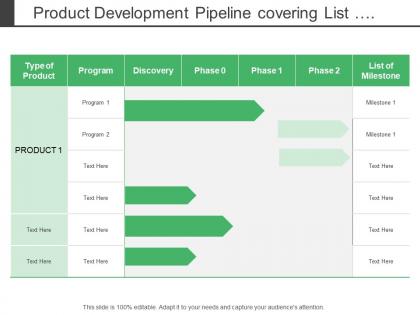
Product development pipeline covering list of milestone and program




Try Before you Buy Download Free Sample Product
 Impress Your
 Audience
 100%
100% Editable
 Save Hours
 of Time


Use our Product Development Pipeline Covering List Of Milestone And Program and and feel the difference. Right off they generate a surge of interest.
People who downloaded this PowerPoint presentation also viewed the following :
Product development pipeline covering list of milestone and program with all 5 slides:
Have ideas, will communicate. Our Product Development Pipeline Covering List Of Milestone And Program are the best go-between.
FAQs for Product development pipeline covering list of
So there's basically five stages you'll go through: discovery/research, ideation, design and prototyping, testing, then launch and iteration. First you figure out what users actually need and what the market wants. Then brainstorm solutions and build prototypes - honestly this part's the most fun. After that, test everything with real users to see if your ideas actually work. Finally launch and keep improving. Oh, and don't skip the validation step even when everyone's pushing you to ship faster. I learned that the hard way. Each stage needs clear goals so you know when you're done.
Dude, seriously - talk to your customers first before building anything. I learned this the hard way watching teams (including mine) build stuff nobody wanted. Surveys, competitor research, user interviews... whatever gets you actual data. At least 10 conversations minimum before touching any code. The insights you'll get are gold for prioritizing features and nailing your pricing. Pain points become super clear. Plus when your boss inevitably suggests some random feature they love, you've got real user feedback to back up your decisions. Skip this step and you're basically gambling with your time.
Honestly, prototyping is just a sanity check before you blow your budget on something nobody wants. Test your idea with actual users first - I can't tell you how many "genius" concepts fall flat when real people touch them. Better to fail on a $50 paper mockup than a $50k app, right? Start super simple with wireframes or sketches, then get fancier if it's working. The key thing is testing with your target audience, not just showing it to your coworkers who'll be nice about everything. You'll catch problems early and save yourself so much headache later.
Honestly, cross-functional teams are a game changer because they kill those stupid department silos. Everyone's in the loop from the start - designers, devs, marketing, product people. No more of that old-school handoff nightmare where design creates something impossible to build (we've all been there, right?). Communication stays open the whole time instead of people working in their little bubbles. You'll see way faster decisions and fewer "oh crap" moments when someone realizes a feature won't actually work. The key is figuring out who needs to be involved early and keeping everyone talking throughout.
Look, most teams go crazy tracking everything upfront - total mistake. Start simple. Discovery phase? Track interview completion and how well you're validating the actual problem. Development's all about sprint velocity and getting features done. Design stage is user feedback scores and iteration rounds. Launch time shifts to adoption rates and engagement stuff. After that, focus on retention and revenue impact - that's what actually matters. Honestly just pick 2-3 metrics per stage that'll change what you do next. You can always add more later once you're not drowning in data.
Honestly, just bake feedback into your dev process from the start instead of tacking it on later. I do quick 15-minute user chats at different stages - after wireframes, during prototyping, before big releases. Way better than long surveys most of the time (though those work too). Here's the thing though - make sure that feedback actually gets to whoever's making the calls, not just some random spreadsheet that nobody checks. Start with like 5-10 users and ask really specific stuff about what you're currently working on. Keep it focused.
Honestly, the worst thing you can do is skip talking to actual users - I've watched teams build entire features nobody wanted. Scope creep will murder your timeline too. Don't validate early enough? That's how you end up with months of work dying in the first user test (brutal but still better than launching to silence). Communication breakdowns between eng and design are another killer. My advice: prototype fast, test constantly, and set hard limits on what you're building. Oh and actually define your requirements upfront - sounds obvious but you'd be surprised how often people skip this step.
Don't wait until the end to think about what could go wrong - weave it into everything from day one. Make a simple list of risks (market changes, tech issues, budget problems) and get someone to own each one. Skip the massive documents - nobody reads those anyway. Pull in people from engineering and marketing so you're not missing obvious stuff. Honestly, the collaborative part is huge because you'll have blind spots you don't even know about. Set triggers for when to escalate and keep backup plans ready. Regular check-ins help, but keep them short and actionable.
Okay so for project stuff, Asana and Monday.com are solid for tracking milestones. Figma's amazing for design collab - honestly can't imagine working without it now. The real game-changer though? Getting these tools to actually talk to each other instead of living in silos. GitHub Actions handles CI/CD pretty well if you're doing dev work. Slack's obvious but organize your channels properly or it becomes chaos. Oh and don't sleep on analytics - Mixpanel or Amplitude will save you when you're trying to figure out what's actually working post-launch. Start with whatever's driving you crazy right now instead of overhauling everything.
Dude, agile is a game-changer because you're shipping actual working stuff every 1-2 weeks instead of waiting forever for some massive launch. Users give you feedback way faster, so if something sucks you can fix it quickly. Those daily check-ins? So much better than sitting through endless status meetings (seriously, who has time for that). Your team can actually adapt when the market shifts or requirements change - no more scrapping months of work. Oh, and start with 2-week cycles. Focus on finishing one thing properly instead of having a bunch of half-done features sitting around collecting dust.
So basically, customer personas are like your compass for deciding what to build next. Map each feature idea against your main personas - does this actually help Sarah the overworked marketing manager or Mike who's watching every penny? Way smarter than just building whatever the devs think is fun. Score features by how many personas benefit, how bad their pain points are, and whether it matches their actual goals. Honestly saves you from wasting months on stuff nobody wants. I learned this the hard way when we built this "amazing" dashboard feature that literally three people used.
Okay so think of a product roadmap as your GPS for development. You'll avoid that whole "wait, what are we even building?" chaos that derails teams constantly. It helps prioritize features and gives you solid answers when stakeholders bug you about timelines - which they will, trust me. Plus it forces you to spot dependencies early instead of discovering them at 2am before a deadline. My advice? Start with your big milestones and work backwards. Way more realistic than just guessing dates. Otherwise you're basically flying blind and hoping for the best.
Honestly, you'll save yourself so much headache if you test early and often. Real user feedback beats your assumptions every time - I can't tell you how many teams I've watched build entire features nobody wanted. Test rough prototypes with just a handful of users first. Each round shows you what's actually broken or confusing. Way easier to pivot when you haven't sunk months into development yet. Even super basic feedback is better than crossing your fingers at launch. The problems you catch now won't become expensive disasters later.
Look, branding can't just be an afterthought you tack on later. Start thinking about your brand voice and positioning right from the concept phase - seriously, it makes everything way less chaotic down the road. Your brand guidelines will actually drive design choices, which features you prioritize, even how you package things. I learned this the hard way on a project once. Define your brand pillars before diving too deep into development. Otherwise you'll end up doing expensive pivots when you realize nothing feels cohesive. Think of it as your North Star that keeps everything aligned with what customers expect from you.
Honestly, start with making sure people won't get roasted for trying something that bombs. Wild brainstorming works way better when nobody's judging the weird ideas. Set aside actual time for experiments - that Google 20% thing wasn't just PR fluff, it worked. Mix up your teams too. Engineers talking to marketers usually sparks something interesting. Oh, and this part's crucial - celebrate the failures that actually teach you stuff, not just obvious wins. Ask them what crazy idea they've been holding back on. You'll be surprised what people have been sitting on.
-
Commendable slides with attractive designs. Extremely pleased with the fact that they are easy to modify. Great work!
-
Excellent products for quick understanding.