

Product Distribution Strategy Powerpoint Presentation Slides




Try Before you Buy Download Free Sample Product
 Impress Your
 Audience
 100%
100% Editable
 Save Hours
 of Time


Deliver the right quality of product to your customers with the aid of our Product Distribution Strategy PowerPoint Presentation Slides. You can explain how to increase the value of your product by using the product planning PowerPoint graphic. Use product marketing plan PPT visual to identify the customer needs through market research. With the help of a distribution resource planning presentation template, you can create an impressive marketing report that also grabs the attention of your audience. Take the assistance of this professionally designed go-to-market plan PowerPoint layout to articulate the various marketing requirements. Employ the product marketing plan presentation slide to inspect the market dynamics, patterns, customers, and the current sales value. Talk about the marketing plan budget with the help of product distribution PPT visual and assign funding for the products accordingly. Therefore, download our ready-to-use distribution strategy PowerPoint template and grow your business effectively.
People who downloaded this PowerPoint presentation also viewed the following :
Content of this Powerpoint Presentation
Slide 1: This slide introduces Product Distribution Strategy. State Your Company Name and begin.
Slide 2: This slide shows Content of the presentation.
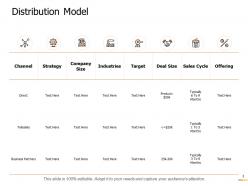
Slide 3: This slide shows Distribution Model describing channel, strategy, company size, industries, target, deal size, sales cycle and offering.
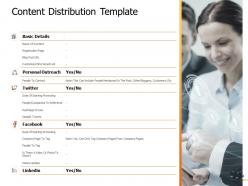
Slide 4: This slide presents Content Distribution Template describing basic details, personal outreach, twitter, facebook and linkedin.
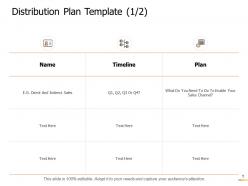
Slide 5: This slide displays Distribution Plan Template in tabular form with categories as Name, timeline and plan.
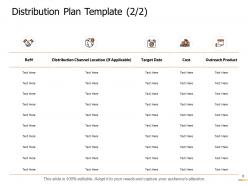
Slide 6: This is an optional slide for Distribution Plan Template.
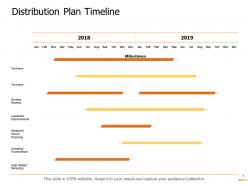
Slide 7: This slide showcases Distribution Plan Timeline. You can add or edit data as per requirements.
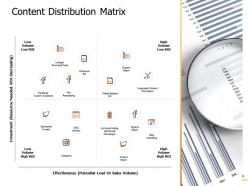
Slide 8: This slide shows Content Distribution Matrix with related imagery.
Slide 9: This slide presents Product Distribution Strategy Icons.
Slide 10: This slide is titled as Additional Slides for moving forward.
Slide 11: This is Our Mission slide with related imagery and text boxes.
Slide 12: This is Our Awesome Team slide with names and designation.
Slide 13: This is About Us slide to show company specifications etc.
Slide 14: This is a Financial slide. Show your finance related stuff here.
Slide 15: This slide is titled as Post It. Post your important notes here.
Slide 16: This is Our Goal slide. State your important goals here.
Slide 17: This is a Timeline slide to show information related with time period.
Slide 18: This is an Idea Generation slide to state a new idea or highlight information, specifications etc.
Slide 19: This is a Thank you slide with address, contact numbers and email address.
Product Distribution Strategy Powerpoint Presentation Slides with all 19 slides:
Use our Product Distribution Strategy Powerpoint Presentation Slides to effectively help you save your valuable time. They are readymade to fit into any presentation structure.







FAQs for Product Distribution Strategy
So you've got four main things to nail down: target market analysis, picking your channels, logistics, and partner relationships. First thing - actually ask your customers where they like to shop instead of guessing. Online? Physical stores? Through distributors? I swear, companies mess this up constantly by making assumptions. Map out your supply chain and inventory stuff next. Oh, and pricing gets tricky when you're selling through different channels - retailers might want different margins than your online store. Start with an audit of what you're doing now. Where are the biggest holes in reaching customers?
Look, channel selection is basically where your customers can actually buy your stuff - and it makes or breaks your sales. Pick the wrong spots? You're losing money. I always tell people to figure out where their ideal customers already shop for similar products first. Then focus on those channels instead of spreading yourself thin everywhere. Distribution gets crazy complicated if you don't keep tabs on it. You want channels that actually reach your people without competing against each other (learned that one the hard way). Map out your best customers' buying habits and start there.
Dude, your customers are literally calling the shots on distribution. They love online shopping? You'll need solid e-commerce and shipping networks. Want stuff immediately? Better get local stores or same-day delivery sorted. Price-sensitive customers might push you toward retailers, while convenience-obsessed ones want direct-to-consumer options. It's wild how much they control the whole strategy! Oh, and don't just guess what they want - actually survey them regularly. I learned that one the hard way when I assumed my customers cared about sustainability more than speed.
GPS tracking and route optimization software will slash your delivery costs - honestly, the time savings alone make it worth it. Warehouse automation speeds things up too, especially robotics for inventory management. Real-time analytics are clutch because you'll catch bottlenecks before they screw you over. Cloud platforms let you connect with suppliers way easier than the old systems (which, let's be real, were terrible). I'd pick whatever area is driving you crazy right now and start there. Don't try to fix everything at once.
So with direct distribution, you get way better control and margins but honestly? You're building everything from scratch - warehouses, sales people, all of it. Going indirect through retailers is the opposite - instant market access and they do the work, but your margins get crushed and you lose that customer connection. Most companies I know mix both approaches depending on what they're selling. I'd figure out your budget and goals first, then pick different channels for different types of customers. Makes way more sense than going all-in on one approach.
Look at your cost per sale first - that's huge. Then check delivery times and how happy customers actually are with each channel. Honestly, customer complaints are your best friend here because they'll show you exactly what's broken. Calculate how much you're spending to serve customers versus what you're making back. Don't forget inventory turnover and whether orders are going out correctly. Quick win? Grab last quarter's numbers and put all your channels side by side. I bet you'll see the problem spots right away - it's usually pretty obvious once you see it all laid out.
Track market penetration and channel coverage first - those show if you're actually reaching people. Then dive into cost per acquisition and revenue by channel since some channels are total time wasters despite looking busy. Customer satisfaction scores matter too because happy customers come back. Oh, and don't sleep on inventory turnover rates. Honestly, I'd just throw all this into a monthly dashboard so you can see what's trending and move your budget around. The whole point is figuring out where your money's actually working instead of just hoping for the best.
Honestly, going international completely changes your distribution game. Each region has different infrastructure, regulations, and what customers actually want. You'll probably need totally different partners in Asia vs Europe. Cultural stuff matters way more than you'd think - Germans and Brazilians don't shop the same way at all. Then there's e-commerce adoption rates, payment methods, local competition that's already locked down their networks. I learned this the hard way with a project last year. My take? Pick one market first, figure it out, then copy that approach to similar places.
Honestly, seasonal spikes mess with everything in your supply chain. You've got to get inventory positioned way ahead of time - like, way earlier than feels comfortable. Holiday rush is the obvious killer, but don't forget back-to-school and summer stuff too. The trick is setting up flexible contracts with your carriers so you're not paying for trucks you don't need in February. Warehouse space becomes gold during peak times. I'd start tracking your patterns right now and push for variable pricing deals. It's all about scaling up fast without getting burned on the back end.
Ugh, sustainability hits every part of your supply chain - packaging, shipping, warehouse energy, all of it. Yeah, it's a pain balancing costs with going green at first. But customers actually care about this stuff now, so you're kinda shooting yourself in the foot if you ignore it. Route optimization cuts fuel costs big time. Switch to eco-friendly packaging when you can. Find carriers who aren't just greenwashing their way through sustainability reports. Honestly, just audit what you're doing now and tackle the worst offenders first. Makes the whole thing less overwhelming.
Honestly, start with an audit of how different your regions actually are right now - that'll show you the biggest problems to fix first. Get standardized processes going for pricing, inventory, and quality stuff so everyone's doing things the same way. Cross-regional meetings are annoying to schedule (time zones suck) but you really need them for communication. Same performance metrics everywhere is huge - otherwise you can't even compare what's working. Document everything and train your regional managers properly on the standards. I know it sounds like a lot of boring process work, but consistency across regions makes such a difference once you get it locked down.
Don't rely on just one distributor - that's asking for trouble. Spread your channels across different regions and partners. When you're setting up contracts, push for flexibility and solid performance metrics. I've watched too many businesses get screwed over by exclusive deals that seemed great at first. Buffer inventory helps too, especially if you place it strategically. Honestly, the biggest thing is having backup plans ready to roll before disaster hits. Demand forecasting tools are worth the investment - they'll save your butt when things go sideways with your main distributor.
Dude, e-commerce platforms totally flip the script on traditional selling. You can skip all those middlemen - wholesalers, distributors, whatever - and sell straight to customers. Your margins get way better, plus you actually know who's buying your stuff (which is honestly pretty cool). But here's the catch: now YOU handle shipping, customer complaints, marketing - all that headache stuff distributors used to deal with. Worth it though if you do it right. I'd say pick one platform first, don't go crazy trying everything at once. Get your shipping down to a science, then expand from there.
Honestly, competition just means you've gotta think outside the box more. When your competitors own the obvious channels, you need to find the backdoors they missed. Going all-in on one distribution method is kinda stupid anyway - too risky. Maybe retail's completely saturated, so you pivot to selling direct. Or find those weird niche distributors nobody else bothered with. I always look for where competitors are slacking and customers are getting ignored. That's where you build your strategy. Sometimes the best opportunities are hiding in plain sight.
Watch your sales channels like a hawk - seriously, check them monthly at minimum. Companies get crushed when they miss the shift happening right under their nose. Which channels are actually growing? Where are people spending time now vs. where you think they are? The trick is keeping your distribution partnerships flexible enough that you can double down on what's working and ditch what isn't. Oh, and actually listen to what your data's telling you instead of just collecting it. I've watched too many businesses stick to their old playbook when everything's clearly changing around them.
-
Unique research projects to present in meeting.