

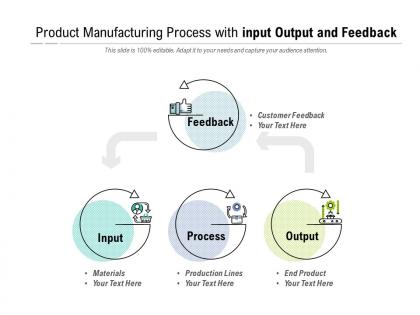
Product manufacturing process with input output and feedback




Try Before you Buy Download Free Sample Product
 Impress Your
Audience
 100%
Editable
 Save Hours
of Time


Focus on heroic deeds with our Product Manufacturing Process With Input Output And Feedback. Give folks the incentive to act courageously.
People who downloaded this PowerPoint presentation also viewed the following :
Product manufacturing process with input output and feedback with all 5 slides:
Give folks the incentive to act courageously with our Product Manufacturing Process With Input Output And Feedback. Focus on heroic deeds.


FAQs for Product manufacturing process with input
The key stages in product manufacturing include design and development, procurement and sourcing, production planning, actual manufacturing, quality control, and packaging and distribution. These stages work together to streamline operations by optimizing resource allocation, minimizing waste, and ensuring consistent output quality, with many manufacturing organizations finding that integrated stage management ultimately delivers faster time-to-market and enhanced competitive advantage.
Lean manufacturing enhances production efficiency by eliminating waste, streamlining workflows, and optimizing resource allocation through continuous improvement methodologies. By implementing just-in-time production, standardized processes, and employee empowerment, manufacturers in automotive, electronics, and consumer goods sectors reduce costs, accelerate delivery times, and improve quality control, ultimately delivering competitive advantage and operational excellence.
Quality control ensures products meet specifications and standards through systematic inspection, testing, and monitoring at every production stage, from raw materials to final assembly. This strategic approach minimizes defects, reduces waste, and enhances customer satisfaction, with manufacturers in automotive, electronics, and pharmaceuticals finding that robust quality systems ultimately deliver competitive advantage and operational efficiency.
Automation improves product manufacturing by reducing human error, accelerating production speeds, and enabling consistent quality control across assembly lines. Through robotics, AI-driven monitoring, and automated material handling, manufacturers streamline operations, minimize waste, and enhance precision, with automotive and electronics companies finding significantly lower costs and faster time-to-market delivery.
Common materials in product manufacturing include metals like steel and aluminum, polymers such as plastics and composites, ceramics, textiles, and specialized alloys. These materials significantly impact product durability, cost-effectiveness, and performance characteristics, with manufacturers in automotive, electronics, and consumer goods finding that strategic material selection enhances competitive advantage while optimizing production efficiency and end-user satisfaction.
The design phase fundamentally shapes manufacturing by determining material requirements, production methods, quality standards, and cost parameters. Strategic design decisions streamline assembly workflows, minimize waste, and optimize resource allocation, with automotive and electronics manufacturers finding that comprehensive design planning reduces production costs by 20-30% while accelerating time-to-market delivery.
Best practices for managing supply chain logistics include demand forecasting, supplier relationship management, inventory optimization, real-time tracking systems, and risk mitigation strategies. These approaches streamline operations by reducing lead times, minimizing costs, and enhancing visibility across the entire chain, with many manufacturing organizations finding that integrated logistics platforms ultimately deliver improved customer satisfaction and competitive advantage.
Manufacturers implement sustainability through renewable energy adoption, waste reduction programs, circular economy principles, water conservation systems, and sustainable material sourcing. These approaches streamline operations by minimizing environmental impact, reducing resource costs, and enhancing supply chain efficiency, with many organizations finding that sustainable practices ultimately deliver competitive advantages and improved stakeholder relationships.
Key technologies driving manufacturing innovation include artificial intelligence, Internet of Things sensors, robotics automation, additive manufacturing, and digital twin simulations. These technologies streamline production by enabling predictive maintenance, optimizing supply chains, and reducing waste, with automotive and electronics manufacturers finding that smart factories ultimately deliver faster time-to-market and enhanced competitive advantage.
Prototyping enables manufacturers to identify design flaws, test functionality, and refine products before full-scale production, significantly reducing costly errors and development time. Through rapid prototyping technologies, companies in automotive, electronics, and consumer goods sectors streamline product iterations, enhance quality control, and accelerate time-to-market, ultimately delivering competitive advantage and minimizing production risks.
Manufacturers reduce waste through lean manufacturing principles, predictive maintenance, quality control automation, material optimization systems, and real-time production monitoring. These approaches streamline operations by minimizing defects, optimizing resource allocation, and preventing equipment failures, with many manufacturing organizations finding that strategic waste reduction delivers significant cost savings while enhancing operational efficiency and sustainability.
Workforce management challenges include skills shortages, high turnover rates, scheduling complexities, training costs, and compliance requirements across multiple shifts and locations. These issues significantly impact production efficiency, quality control, and operational costs, with many manufacturers finding that strategic workforce planning, cross-training programs, and technology integration help streamline operations while reducing labor-related disruptions and enhancing competitive advantage.
Manufacturing strategy choice significantly impacts operational efficiency and cost through production volume flexibility, resource utilization, and quality control mechanisms. Batch processing enables customization and lower initial investment, while continuous manufacturing delivers higher throughput and reduced per-unit costs, with many organizations finding that hybrid approaches optimize both efficiency and adaptability in increasingly competitive markets.
Key production performance metrics include overall equipment effectiveness (OEE), cycle time, throughput rates, quality yield, and inventory turnover ratios. These measurements enable manufacturers to identify bottlenecks, optimize resource allocation, and enhance operational efficiency, with many organizations finding that tracking these metrics simultaneously delivers cost reductions, improved product quality, and competitive advantage in increasingly demanding markets.
Customer feedback influences product design and manufacturing through market research analysis, user experience testing, feature prioritization, and iterative design improvements. Companies like automotive manufacturers and consumer electronics firms increasingly integrate real-time feedback loops into their development cycles, enabling faster product iterations, reduced time-to-market, and enhanced customer satisfaction, ultimately delivering competitive advantage.
No Reviews