

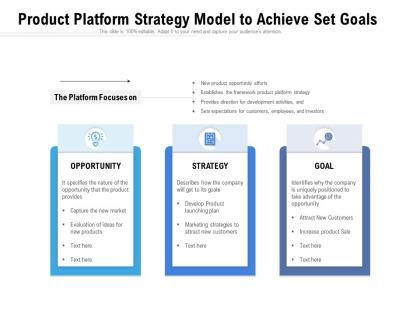
Product platform strategy model to achieve set goals




Try Before you Buy Download Free Sample Product
 Impress Your
 Audience
 100%
100% Editable
 Save Hours
 of Time


Our Product Platform Strategy Model To Achieve Set Goals are topically designed to provide an attractive backdrop to any subject. Use them to look like a presentation pro.
People who downloaded this PowerPoint presentation also viewed the following :
Product platform strategy model to achieve set goals with all 2 slides:
Use our Product Platform Strategy Model To Achieve Set Goals to effectively help you save your valuable time. They are readymade to fit into any presentation structure.
FAQs for Product platform strategy model to
**INPUT**: What are the key components of a successful product platform strategy? **OUTPUT**: Key components include shared technology architecture, standardized APIs, modular design frameworks, cross-product data integration, and scalable infrastructure foundations. These elements streamline development cycles, reduce operational costs, and enable faster market expansion, with many organizations finding that strategic platform approaches ultimately deliver competitive advantage through enhanced innovation speed and resource efficiency. **Word count: 54 words**
Companies determine this balance by analyzing customer needs, operational complexity, and cost implications, while considering market requirements, technical capabilities, and competitive positioning. Through strategic segmentation, organizations identify core standardized components and customizable features, with many finding that 70-80% standardization with targeted customization delivers optimal efficiency and customer satisfaction.
Customer feedback plays a crucial role in shaping product platform strategy by identifying unmet needs, validating feature priorities, guiding roadmap decisions, and revealing integration opportunities across different user segments. Through systematic feedback collection and analysis, companies can enhance platform scalability, optimize user experiences, and prioritize development resources more effectively, with many organizations finding that customer-driven insights ultimately deliver stronger market positioning and increased platform adoption rates.
Businesses leverage product platforms for scalability by standardizing core components, enabling rapid feature deployment, and facilitating seamless integrations across multiple markets. This strategic approach allows companies to reduce development costs, accelerate time-to-market, and customize offerings for different regions, with many technology firms finding that platform-based architectures deliver enhanced operational efficiency and competitive advantage.
Best practices for integrating new products into an existing platform include establishing unified APIs, maintaining consistent user experiences, implementing scalable data architectures, ensuring seamless authentication systems, and creating standardized documentation processes. These approaches streamline operations by reducing development complexity, accelerating time-to-market, and minimizing integration costs, with many technology companies finding that strategic platform integration ultimately delivers enhanced customer retention and significant competitive advantages.
Competitive dynamics influence product platform strategy by driving differentiation needs, innovation timing, and resource allocation priorities across multiple product lines. Companies must balance platform standardization with market responsiveness, often accelerating development cycles and feature integration to maintain competitive advantage, while monitoring competitor platform moves to identify strategic opportunities and defensive positioning requirements.
**INPUT**: What metrics should be used to evaluate the success of a product platform? **OUTPUT**: Product platform success metrics include user adoption rates, third-party developer engagement, revenue per user, ecosystem growth velocity, and time-to-market for new features. These indicators work together by measuring platform stickiness, network effects, and monetization effectiveness, with many organizations finding that cross-platform integration rates and developer retention ultimately deliver sustainable competitive advantage. [Word count: 56 words]
Organizations effectively manage product platform lifecycles through strategic roadmap planning, continuous customer feedback integration, modular architecture updates, and proactive technology refresh cycles. Through systematic performance monitoring and cross-functional collaboration, companies streamline platform evolution, minimize technical debt, and accelerate time-to-market, with many enterprises finding that structured lifecycle management ultimately delivers sustained competitive advantage and operational efficiency.
Companies face integration complexity, resource reallocation pressures, and cultural resistance when shifting from single-product to platform thinking. These transitions require significant upfront investment, cross-functional coordination, and architectural redesign, while many organizations find that aligning teams around shared platform components, managing technical debt, and maintaining product quality during the shift ultimately delivers greater scalability and competitive advantage.
A well-defined product platform strategy enhances collaboration by establishing shared objectives, standardized processes, and unified communication channels across departments like engineering, marketing, and sales. This strategic alignment streamlines decision-making, reduces silos, and accelerates product development cycles, with many organizations finding that integrated platform approaches ultimately deliver faster time-to-market and improved operational efficiency.
Current innovations shaping product platform strategies include AI-driven personalization engines, microservices architectures, API-first development, low-code/no-code tools, and ecosystem orchestration platforms. These technologies streamline platform scalability, enhance developer experiences, and accelerate time-to-market, with many organizations finding that strategic platform integration ultimately delivers competitive differentiation and operational efficiency.
Companies ensure platform compatibility through standardized APIs, common data formats, modular architecture design, comprehensive integration testing, and unified development frameworks. These approaches enable seamless component interaction across different systems and vendors, with many organizations finding that strategic standardization reduces development costs, accelerates time-to-market, and ultimately delivers enhanced scalability and competitive advantage.
Technology serves as the backbone of product platforms by enabling scalability, integration, and data-driven decision making through cloud infrastructure, APIs, analytics tools, and automation systems. These technologies streamline operations, enhance user experiences, and facilitate seamless third-party integrations, with companies like Amazon and Salesforce leveraging advanced platforms to deliver faster innovation cycles and competitive advantages.
Businesses protect intellectual property during platform development through comprehensive patent filings, strategic trade secret management, robust licensing agreements, and careful partnership contracts. These approaches enable organizations to secure core technologies while maintaining competitive advantage, with many tech companies finding that layered IP protection strategies ultimately deliver both innovation freedom and revenue opportunities through licensing.
Platform strategy risks include increased complexity in system integration, higher initial development costs, potential vendor lock-in scenarios, scalability challenges, and coordination difficulties across multiple product lines. While these challenges require careful planning and resource allocation, many organizations find that strategic risk mitigation through phased implementation and robust governance frameworks ultimately delivers greater operational efficiency and competitive advantage.
-
Very well designed and informative templates.