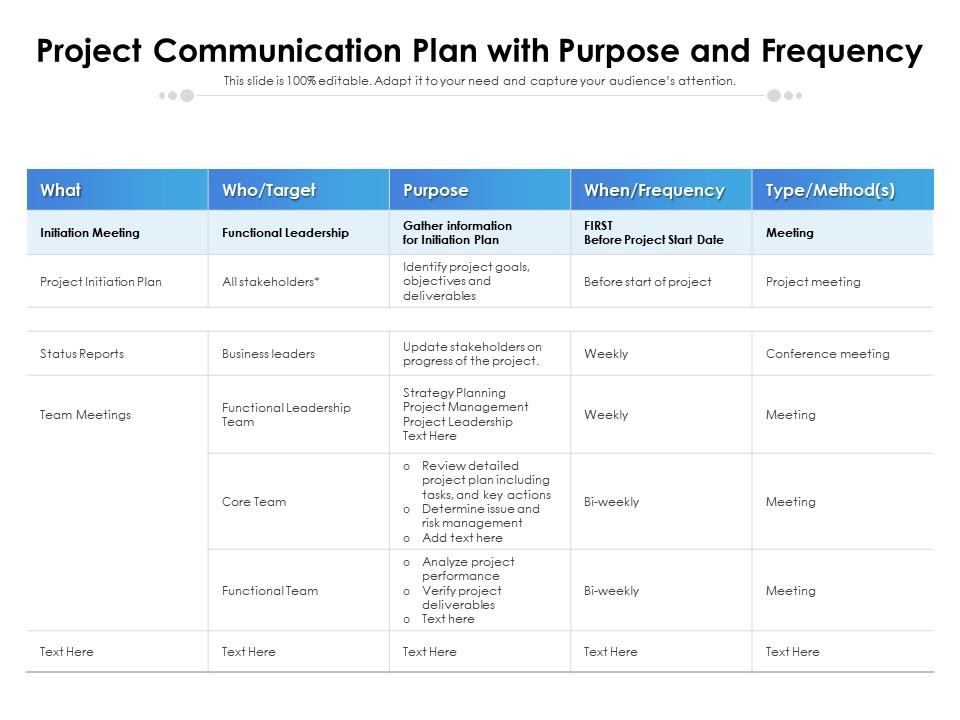
Project communication plan with purpose and frequency

Rating:
90%
Project communication plan with purpose and frequency
Slide 1 of 2
Favourites Favourites

Try Before you Buy Download Free Sample Product

Audience Impress Your
Audience
Editable 100%
Editable
Time Save Hours
of Time
The Biggest Sale is ending soon in
0
0
:
0
0
:
0
0
Rating:
90%
Introducing our Project Communication Plan With Purpose And Frequency set of slides. The topics discussed in these slides are Leadership, Project Meeting, Business Leaders. This is an immediately available PowerPoint presentation that can be conveniently customized. Download it and convince your audience.

People who downloaded this PowerPoint presentation also viewed the following :

FAQs for Project communication plan with

Key components of an effective project communication plan include stakeholder identification, communication objectives, message content guidelines, delivery methods and channels, frequency schedules, and feedback mechanisms. These elements work together by establishing clear expectations, streamlining information flow, and ensuring accountability, with many organizations finding that structured communication reduces project delays, enhances team alignment, and ultimately delivers improved outcomes and stakeholder satisfaction.

Project managers identify stakeholders through stakeholder analysis, organizational charts, project documentation reviews, team consultations, and impact assessments to determine who influences or is affected by the project. This systematic approach enables managers to map internal teams, external partners, clients, and decision-makers across departments, ensuring comprehensive communication coverage while prioritizing engagement based on influence and project impact.

Effective project communication tools include Slack for real-time messaging, Microsoft Teams for integrated collaboration, Asana for task tracking, Confluence for documentation, and Zoom for virtual meetings. These platforms streamline information flow by centralizing updates, automating notifications, and enabling seamless collaboration across teams, with many organizations finding that strategic tool combination ultimately delivers improved transparency and faster project delivery.

A communication plan should segment stakeholders by role, interest level, and preferred communication channels, tailoring frequency, detail depth, and delivery methods accordingly. For example, executives may require high-level dashboards and monthly summaries, while project teams need detailed daily updates and technical documentation, ultimately ensuring each group receives relevant information that enables informed decision-making and sustained engagement.

**INPUT**: What strategies can be used to ensure timely updates and communication flow in a project? **OUTPUT**: Effective project communication strategies include regular status meetings, automated reporting systems, centralized communication platforms, clear escalation protocols, and defined update schedules. These approaches streamline information flow by establishing consistent touchpoints, minimizing communication gaps, and enabling real-time visibility, with many organizations finding that structured communication frameworks ultimately deliver faster decision-making and enhanced project outcomes. [Word count: 58 words]

Feedback mechanisms can be incorporated through regular surveys, structured review meetings, communication audits, suggestion systems, and stakeholder interviews throughout project phases. These approaches enable teams to identify communication gaps, assess message clarity, and refine delivery methods, while many organizations finding that continuous feedback loops significantly enhance project transparency, stakeholder engagement, and ultimately deliver improved collaboration outcomes.

Formal documentation serves as the authoritative record of project decisions, requirements, changes, and progress, ensuring consistency and accountability across all stakeholders. It provides legal protection, enables knowledge transfer, and creates audit trails, with organizations finding that structured documentation reduces miscommunication by up to 40% while accelerating project delivery.

Visual aids enhance understanding in project communication plans by simplifying complex information, improving retention rates, and accommodating different learning styles through charts, diagrams, timelines, and infographics. These tools streamline stakeholder alignment by making project milestones, dependencies, and progress immediately clear, with many organizations finding that visual communication reduces misunderstandings and accelerates decision-making processes.

Communication effectiveness metrics include response rates, message clarity scores, stakeholder engagement levels, feedback quality assessments, and information retention rates. These measurements help project managers identify communication gaps, optimize delivery methods, and ensure critical information reaches intended audiences, with many organizations finding that regular metric reviews significantly improve project outcomes and team alignment.

Cultural considerations significantly impact international project communication through varying communication styles, hierarchy preferences, time orientations, and decision-making processes across different cultures. These differences influence meeting structures, feedback delivery, conflict resolution approaches, and relationship-building requirements, with many global organizations finding that adapting communication protocols, leveraging local liaisons, and establishing cultural awareness training ultimately enhances project collaboration and reduces misunderstandings.

Common pitfalls include overcomplicating messaging channels, failing to define clear stakeholder roles, neglecting feedback mechanisms, setting unrealistic communication frequencies, and lacking contingency protocols for urgent updates. These oversights often lead to information silos, stakeholder confusion, and project delays, with many organizations finding that streamlined, role-specific communication frameworks ultimately enhance project transparency and execution efficiency.

Technology automates project communication through AI-powered status updates, automated milestone notifications, real-time dashboard reporting, and intelligent task assignment systems. These solutions streamline workflows by reducing manual updates, accelerating decision-making, and minimizing communication gaps, with many organizations finding that automated systems deliver faster project delivery and enhanced team coordination.

Agile communication plans emphasize frequent, informal touchpoints like daily standups, sprint reviews, and retrospectives, while waterfall methodologies rely on structured milestone reports, formal status meetings, and phase-gate approvals. Agile environments require real-time collaboration tools and continuous stakeholder engagement, whereas waterfall projects benefit from detailed documentation and scheduled communications, with many organizations finding that hybrid approaches ultimately deliver enhanced flexibility while maintaining necessary oversight and accountability.

Tailoring communication styles for different project phases ensures stakeholders receive relevant information at appropriate levels of detail, frequency, and urgency throughout the project lifecycle. During initiation, communication focuses on high-level strategic alignment, while execution phases require detailed progress updates and issue resolution, with many project managers finding that phase-specific communication significantly improves stakeholder engagement and project success rates.

Lessons learned from previous projects inform communication plans by identifying effective channels, highlighting stakeholder engagement gaps, and revealing timing optimization opportunities. These insights enable project managers to refine messaging strategies, streamline information flow, and proactively address communication barriers, with many organizations finding that incorporating past experiences ultimately delivers more targeted stakeholder engagement and reduced project risks.

Ratings and Reviews

90% of 100
Review Form
Write a review
Most Relevant Reviews
  1. 80%

    by Cortez Graham

    Helpful product design for delivering presentation.
  2. 100%

    by William Martinez

    Use of icon with content is very relateable, informative and appealing.
  3. 80%

    by Miller Rogers

    Very unique, user-friendly presentation interface.
  4. 80%

    by Clair Gray

    Graphics are very appealing to eyes.
  5. 80%

    by Dusty Hoffman

    Commendable slides with attractive designs. Extremely pleased with the fact that they are easy to modify. Great work!
  6. 100%

    by Christoper Chavez

    Nice and innovative design.
  7. 100%

    by Colby Coleman

    Excellent Designs.
  8. 80%

    by Cyril Gibson

    Design layout is very impressive.
  9. 100%

    by Clement Patel

    Nice and innovative design.
  10. 100%

    by Thomas Garcia

    Easy to edit slides with easy to understand instructions.

Items 1 to 10 of 12 total

    Page:
  • You're currently reading page 1
  • Page 2
  • Next
per page: