


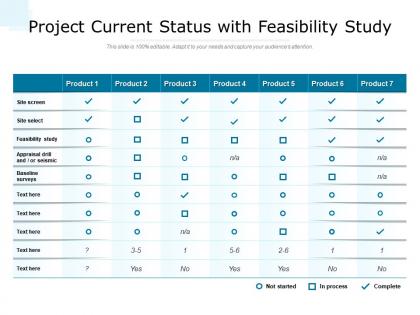
Project current status with feasibility study




Try Before you Buy Download Free Sample Product
 Impress Your
 Audience
 100%
100% Editable
 Save Hours
 of Time


Our Project Current Status With Feasibility Study are explicit and effective. They combine clarity and concise expression.
People who downloaded this PowerPoint presentation also viewed the following :
Project current status with feasibility study with all 2 slides:
Give your audience a fulfilling experience. They will find our Project Current Status With Feasibility Study elevating.

FAQs for Project current status
Key components of a feasibility analysis include technical feasibility, economic viability, legal compliance, operational requirements, and schedule assessment. These elements work together by evaluating resource availability, market conditions, and regulatory constraints, with many organizations finding that comprehensive analysis across all components significantly reduces project risks and enhances strategic decision-making capabilities.
Market research enhances feasibility study accuracy by providing validated customer demand data, competitive landscape insights, pricing benchmarks, and market size quantification. Through surveys, focus groups, and industry analysis, organizations can minimize assumptions while maximizing data-driven decision making, ultimately delivering more reliable financial projections and strategic recommendations for successful project implementation.
Financial modeling serves as the quantitative backbone of feasibility analysis, evaluating cash flows, ROI projections, break-even points, sensitivity scenarios, and risk assessments to determine project viability. These comprehensive models enable organizations to compare investment alternatives, secure stakeholder buy-in, and make data-driven decisions, with many companies finding that robust financial modeling significantly reduces project failure rates and enhances resource allocation efficiency.
Assessing technical feasibility involves evaluating resource availability, technology requirements, team capabilities, timeline constraints, and potential technical risks or limitations. Organizations typically conduct comprehensive audits examining existing infrastructure, skill gaps, and integration challenges, with many finding that early technical assessments prevent costly delays and enable more accurate project scoping and resource allocation.
Common pitfalls in feasibility analysis include overly optimistic assumptions, insufficient market research, underestimating costs and timelines, inadequate risk assessment, and ignoring competitive dynamics. These oversights can derail projects across industries, with many organizations finding that thorough stakeholder consultation, realistic financial modeling, and comprehensive scenario planning ultimately deliver more accurate assessments and strategic advantage.
Feasibility studies inform startup decision-making by evaluating market demand, financial viability, technical requirements, and competitive positioning through comprehensive research and analysis. These assessments enable entrepreneurs to identify potential risks, validate business assumptions, and allocate resources strategically, with many startups finding that thorough feasibility analysis significantly reduces failure rates while enhancing investor confidence.
Operational feasibility methodologies include workflow analysis, resource assessment, staff capability evaluation, system integration testing, and pilot program implementation. These approaches streamline evaluation by examining current processes, identifying bottlenecks, and measuring performance metrics, with many organizations finding that combining multiple methodologies delivers comprehensive insights and competitive operational advantage.
Regulatory compliance significantly impacts feasibility assessments by determining legal viability, influencing cost projections, and shaping implementation timelines across all project phases. These requirements affect resource allocation, operational procedures, and market entry strategies, with many organizations finding that early compliance integration streamlines approvals and reduces long-term risks, ultimately delivering competitive advantage.
Economic feasibility evaluates a project's broader societal impact, resource allocation efficiency, and overall value creation, while financial feasibility focuses specifically on cash flows, profitability, and return on investment for stakeholders. These complementary analyses enable organizations to assess both strategic worthiness and commercial viability, with many enterprises finding that projects passing both evaluations deliver sustainable competitive advantage and long-term success.
Stakeholder feedback significantly influences feasibility analyses by providing insights into market demand, operational requirements, resource constraints, regulatory considerations, and implementation challenges. Through surveys, interviews, and focus groups, organizations can identify potential risks, refine project scope, and validate assumptions, ultimately enhancing project viability and stakeholder buy-in across diverse industries.
Timeline feasibility is evaluated by analyzing project scope, resource availability, task dependencies, and critical path requirements against realistic delivery constraints. Organizations assess these factors through detailed work breakdown structures, resource capacity planning, and risk buffer allocation, with many finding that thorough timeline analysis prevents costly delays and enables more accurate stakeholder expectations.
Resource availability significantly impacts project feasibility by determining timeline viability, budget requirements, and execution capability across all project phases. Limited resources can delay milestones, increase costs, and compromise quality, while adequate resource allocation enables streamlined project delivery, optimal performance outcomes, and enhanced competitive positioning for organizations.
Feasibility study software includes project management platforms like Microsoft Project, financial modeling tools such as Excel and specialized applications, risk assessment software, market research platforms, and business planning solutions like LivePlan. These tools streamline analysis by automating calculations, generating comprehensive reports, and enabling scenario modeling, with many organizations finding that integrated software suites significantly reduce study timelines while enhancing accuracy.
A feasibility study mitigates project risks by identifying potential challenges, assessing resource requirements, evaluating market conditions, and analyzing financial viability before implementation begins. Through comprehensive risk assessment and scenario planning, organizations can adjust project scope, allocate resources more effectively, and develop contingency strategies, ultimately reducing costly surprises and improving project success rates.
Essential metrics for evaluating feasibility analysis success include financial ROI projections, market penetration potential, technical implementation timelines, resource allocation accuracy, and risk mitigation effectiveness. These indicators streamline decision-making by measuring projected versus actual outcomes, stakeholder alignment levels, and budget adherence, with many organizations finding that comprehensive metric frameworks ultimately deliver more informed strategic choices and reduced project failure rates.
No Reviews