

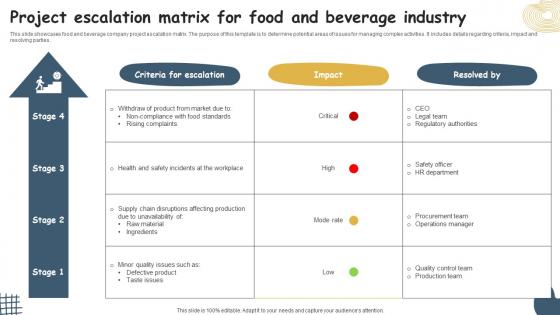
Project Escalation Matrix For Food And Beverage Industry




Try Before you Buy Download Free Sample Product
 Impress Your
 Audience
 100%
100% Editable
 Save Hours
 of Time


This slide showcases food and beverage company project escalation matrix. The purpose of this template is to determine potential areas of issues for managing complex activities. It includes details regarding criteria, impact and resolving parties.
People who downloaded this PowerPoint presentation also viewed the following :
Project Escalation Matrix For Food And Beverage Industry with all 9 slides:
Use our Project Escalation Matrix For Food And Beverage Industry to effectively help you save your valuable time. They are readymade to fit into any presentation structure.








FAQs for Project Escalation Matrix For Food
A project escalation matrix is a structured framework that defines when, how, and to whom project issues should be escalated based on severity, impact, and timeframes. It's essential because it streamlines decision-making processes, ensures accountability across organizational levels, and minimizes project delays, with many project managers finding that clear escalation pathways enhance stakeholder communication and ultimately deliver faster issue resolution.
Organizations effectively identify escalation-worthy issues by establishing clear trigger criteria including budget overruns exceeding defined thresholds, timeline delays affecting critical milestones, resource conflicts, and stakeholder disagreements impacting deliverables. Through systematic risk monitoring and regular status assessments, project teams can quickly recognize patterns that signal potential project derailment, ultimately enabling proactive intervention and maintaining strategic project outcomes.
A well-structured project escalation matrix includes defined escalation triggers, clear authority levels, specific timeframes for response, designated contact personnel, and established communication protocols. These components streamline decision-making by ensuring issues reach appropriate stakeholders quickly, minimizing project delays, and maintaining accountability, with many organizations finding that structured escalation processes ultimately deliver faster resolution times and improved project outcomes.
The escalation process varies significantly across project types, with IT projects emphasizing technical expertise and rapid response times, construction projects focusing on safety protocols and regulatory compliance, and marketing projects prioritizing brand reputation and campaign timing. While IT escalations often involve system architects and development teams, construction escalations engage safety officers and regulatory bodies, and marketing escalations include brand managers and legal teams, ultimately ensuring each sector's unique risks and stakeholder requirements are addressed effectively.
Project stakeholders serve as decision-makers, resource providers, and communication channels within escalation processes, with each level requiring different stakeholder involvement based on issue severity and impact. Senior stakeholders like executives handle strategic decisions and budget approvals, while project managers and team leads address operational issues, ultimately ensuring faster resolution times and maintaining project momentum through clear accountability structures.
Communication flow within an escalation matrix should follow a structured hierarchy, moving from immediate supervisors to senior management, with clear timelines, defined contact methods, and specific triggers for each level. This systematic approach ensures faster issue resolution, reduces miscommunication, and maintains accountability, with many organizations finding that structured escalation paths ultimately deliver better project outcomes and stakeholder confidence.
Common pitfalls include creating overly complex hierarchies, failing to define clear escalation criteria, bypassing immediate supervisors, and neglecting to communicate the matrix to all stakeholders. Many organizations find that unclear timelines, inadequate documentation requirements, and poor stakeholder buy-in ultimately undermine the matrix's effectiveness, leading to delayed resolutions and team frustration.
Technology tools support escalation matrices through automated workflow systems, real-time notification platforms, integrated project management software, and data analytics dashboards. These solutions streamline issue tracking by automatically routing problems to appropriate stakeholders, maintaining comprehensive audit trails, and providing instant status updates, with many organizations finding that automated escalation reduces response times significantly while ensuring consistent communication across all project levels.
An escalation matrix improves project collaboration by establishing clear communication pathways, defining role-specific responsibilities, setting transparent decision-making protocols, and creating structured conflict resolution processes. With defined escalation levels, team members understand exactly when and how to engage stakeholders, ultimately reducing delays and confusion while enhancing accountability through measurable response timeframes and designated ownership.
Escalation criteria should include project timeline delays exceeding predefined thresholds, budget overruns beyond approved variances, scope changes requiring additional resources, and quality issues impacting deliverables. These parameters enable project managers to systematically assess risk severity, resource constraints, and stakeholder impact, with many organizations finding that clear escalation triggers ultimately streamline decision-making and minimize project disruptions.
Organizations ensure effective escalation matrix training through comprehensive onboarding programs, regular workshops, scenario-based simulations, and clear documentation of escalation procedures and decision criteria. Through structured training modules, teams practice real-world escalation scenarios, understand their specific roles and responsibilities, and develop confidence in making escalation decisions, ultimately delivering faster issue resolution and improved project outcomes across departments.
Key metrics include escalation frequency rates, resolution time at each level, customer satisfaction scores, cost per escalated issue, and first-call resolution percentages. These indicators help organizations streamline their support processes by identifying bottlenecks, measuring team performance, and optimizing resource allocation, ultimately delivering faster resolution times and enhanced customer experiences across all service channels.
Feedback from past projects informs escalation matrix development by identifying recurring issues, communication gaps, and resolution bottlenecks that previously caused delays or failures. Organizations analyze patterns from completed projects to refine escalation triggers, adjust stakeholder notification protocols, and streamline decision-making pathways, with many finding that data-driven matrix improvements significantly reduce project risks and enhance delivery timelines.
**INPUT**: What are some real-world examples of successful escalation matrix implementations? **OUTPUT**: Successful escalation matrix implementations include IT service desks automatically routing critical system outages to senior engineers, healthcare facilities escalating patient safety issues through defined clinical hierarchies, and financial institutions streamlining fraud detection responses through tiered security teams. These frameworks enable organizations to reduce response times, minimize operational disruptions, and maintain service quality standards, with many finding that structured escalation paths ultimately deliver faster issue resolution and improved customer satisfaction across complex operational environments.
Cultural context significantly influences escalation matrix effectiveness by affecting communication styles, hierarchy respect, and conflict resolution approaches across different organizational environments. While direct cultures may embrace transparent escalation paths, relationship-focused cultures often prefer informal resolution methods, with many multinational organizations finding that culturally adapted matrices deliver better stakeholder engagement and ultimately more successful project outcomes.
-
It makes easy work of my work presentations. I’ve never had to be nervous about my presentations for meetings.
-
Love the template collection they have! I have prepared for my meetings much faster without worrying about designing a whole presentation from scratch.