

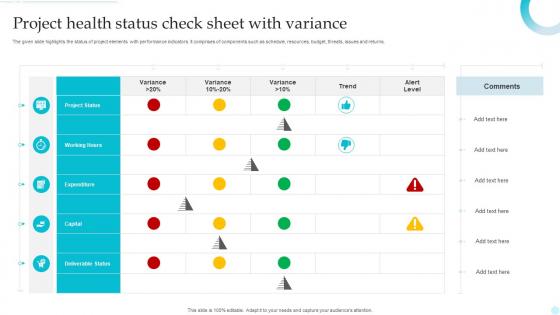
Project Health Status Check Sheet With Variance




Try Before you Buy Download Free Sample Product
 Impress Your
 Audience
 100%
100% Editable
 Save Hours
 of Time


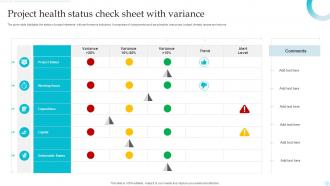
The given slide highlights the status of project elements with performance indicators. It comprises of components such as schedule, resources, budget, threats, issues and returns.
People who downloaded this PowerPoint presentation also viewed the following :
Project Health Status Check Sheet With Variance with all 6 slides:
Use our Project Health Status Check Sheet With Variance to effectively help you save your valuable time. They are readymade to fit into any presentation structure.





FAQs for Project Health Status Check
Key metrics for evaluating project health status include schedule performance index, budget variance, scope completion percentage, quality defect rates, and stakeholder satisfaction scores. These metrics work together by providing comprehensive visibility into timeline adherence, financial control, and deliverable quality, with many organizations finding that regular tracking of these indicators enables proactive risk management and ultimately delivers improved project success rates.
Project health assessments should be conducted weekly for active projects, monthly for stable initiatives, and at every major milestone or phase gate. The frequency depends on project complexity, risk level, and duration, with many organizations finding that regular assessments enable early issue identification, resource reallocation, and stakeholder alignment, ultimately delivering improved project outcomes.
Stakeholder feedback and engagement serve as critical indicators of project health by revealing alignment issues, resource concerns, satisfaction levels, and potential roadblocks early. Active stakeholder participation enables project managers to identify risks, adjust strategies, and maintain momentum, with many organizations finding that regular engagement sessions ultimately deliver higher success rates and stronger buy-in.
Project managers can effectively communicate health status findings through regular team meetings, visual dashboards, clear written reports, and one-on-one discussions tailored to each stakeholder's role. These communication methods streamline transparency by presenting data in accessible formats, addressing concerns proactively, and establishing consistent feedback loops, ultimately enabling faster issue resolution and enhanced team alignment.
Project management platforms include Microsoft Project, Asana, Jira, Trello, and Smartsheet, alongside specialized dashboard tools like Tableau and Power BI for advanced visualization. These solutions streamline tracking by automating status updates, centralizing team communications, and generating real-time reports, with many organizations finding that integrated platforms ultimately deliver enhanced visibility and faster decision-making capabilities.
Risk management strategies significantly influence project health by enabling early threat identification, resource protection, and timeline preservation through proactive planning and mitigation protocols. These strategies streamline project execution by minimizing disruptions, reducing cost overruns, and maintaining stakeholder confidence, with many organizations finding that systematic risk assessment ultimately delivers more predictable outcomes and competitive project delivery timelines.
Common signs of project distress include missed milestones, budget overruns, scope creep, declining team morale, and poor stakeholder communication. These warning indicators often compound quickly, with many project managers finding that early detection through regular health assessments, transparent reporting, and proactive risk management enables swift corrective action, ultimately preventing minor issues from escalating into project failures.
Project health assessments differentiate between minor issues and critical warnings through risk scoring matrices, impact analysis, timeline evaluation, and resource dependency mapping. These frameworks enable project managers to categorize concerns by severity, scope, and urgency, with many organizations finding that automated monitoring systems streamline identification processes, ultimately delivering faster response times and better resource allocation for critical interventions.
Teams can improve red flag areas through root cause analysis, resource reallocation, stakeholder communication enhancement, process optimization, and risk mitigation planning. These corrective techniques work by addressing underlying issues systematically, implementing targeted interventions, and establishing monitoring protocols, with many organizations finding that early intervention and transparent communication ultimately deliver faster project recovery and improved team performance.
Poor project health status significantly impacts team morale through increased stress, unclear priorities, and mounting pressure from delays or budget overruns. When teams face consistently red or yellow project indicators, productivity declines as members become demotivated, communication breaks down, and focus shifts from strategic execution to crisis management, ultimately creating cycles where declining morale further deteriorates project outcomes.
Scope changes significantly impact project health by altering timelines, resource allocation, budget requirements, and team dynamics, often creating cascading effects across all project metrics. While controlled scope adjustments can enhance project value and stakeholder satisfaction, they require immediate recalibration of health indicators, risk assessments, and performance benchmarks, with many project managers finding that proactive change management ultimately delivers stronger project outcomes.
**INPUT**: What are the best practices for documenting and reporting project health findings? **OUTPUT**: Best practices include establishing standardized metrics, creating visual dashboards, conducting regular health assessments, maintaining transparent communication channels, and documenting risk mitigation strategies. These approaches streamline project oversight by enabling real-time visibility, facilitating proactive decision-making, and ensuring stakeholder alignment, with many organizations finding that consistent reporting ultimately delivers improved project outcomes and enhanced operational efficiency. *[Word count: 58 words]*
Historical project data informs future health assessments by identifying recurring risk patterns, resource allocation trends, timeline deviations, and performance bottlenecks across completed initiatives. This data enables organizations to develop predictive models, refine estimation accuracy, and establish early warning indicators, with many companies finding that data-driven assessments reduce project failures by 40% while accelerating delivery timelines.
A project's health status directly influences resource allocation decisions, budget adjustments, timeline modifications, risk mitigation strategies, and stakeholder communication protocols. Projects showing green status typically maintain current resource levels, while yellow or red status projects often require additional funding, skilled personnel reassignment, or strategic pivots, with many organizations finding that proactive health monitoring ultimately delivers cost savings and improved project outcomes.
Project health status varies significantly across industries due to differing regulatory requirements, project complexity, stakeholder expectations, and risk tolerance levels. Healthcare and financial services typically demand stricter compliance monitoring and longer approval cycles, while technology and retail sectors often prioritize speed and adaptability, with many organizations finding that industry-specific metrics ultimately deliver more accurate performance insights.
-
The website is jam-packed with fantastic and creative templates for a variety of business concepts. They are easy to use and customize.
-
“The presentation template I got from you was a very useful one.My presentation went very well and the comments were positive.Thank you for the support. Kudos to the team!”