

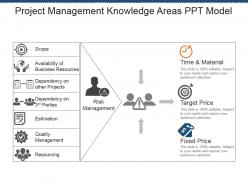
Project management knowledge areas ppt model





Try Before you Buy Download Free Sample Product
 Impress Your
Audience
 100%
Editable
 Save Hours
of Time


Generate capital with our Project Management Knowledge Areas Ppt Model. Folks will be happy to give financial assistance.
People who downloaded this PowerPoint presentation also viewed the following :
Project management knowledge areas ppt model with all 5 slides:
Highlight each ingredient with our Project Management Knowledge Areas Ppt Model. Get folks familiar with individual elements.


FAQs for Project management knowledge
Project Integration Management involves project charter development, project management plan creation, directing and managing project work, monitoring and controlling project work, performing integrated change control, and closing the project or phase. These processes ensure seamless coordination across all project elements by unifying activities, managing interdependencies, and maintaining alignment, with many organizations finding that effective integration delivers improved resource allocation, streamlined decision-making, and ultimately enhanced project success rates.
Risk Management integrates with all project management knowledge areas by influencing scope planning, schedule buffers, budget contingencies, quality standards, resource allocation, communication protocols, procurement contracts, and stakeholder expectations. Through systematic risk assessment, project managers enhance decision-making across cost estimation, timeline development, and resource planning, while delivering proactive mitigation strategies that ultimately strengthen project outcomes and organizational resilience.
Stakeholder Engagement drives successful project outcomes by ensuring clear communication, managing expectations, securing necessary resources, and maintaining project alignment with business objectives. Through systematic stakeholder identification and engagement strategies, project managers minimize resistance, accelerate decision-making, and enhance project acceptance, with many organizations finding that proactive stakeholder management significantly reduces project risks and delivers superior results.
Effective time management improves project efficiency by establishing realistic schedules, identifying critical paths, and minimizing delays through proactive planning and resource allocation. Through systematic scheduling and milestone tracking, organizations streamline workflows, reduce bottlenecks, and enhance team productivity, while ultimately delivering projects faster and more cost-effectively, with many finding improved client satisfaction and competitive advantage.
Strategies include implementing continuous quality audits, establishing clear quality metrics and KPIs, integrating quality checkpoints at each project phase, conducting regular stakeholder reviews, and utilizing quality management software tools. These approaches streamline quality assurance by preventing defects early, reducing rework costs, and maintaining consistent standards, with many organizations finding that proactive quality management ultimately delivers faster project completion and enhanced client satisfaction.
Cost Management contributes to project success by establishing realistic budgets, tracking expenditures against planned costs, and identifying variances early to prevent overruns. Through accurate cost forecasting and resource allocation, organizations can maintain profitability, secure stakeholder confidence, and deliver projects within financial constraints, with many companies finding that disciplined cost control ultimately enhances their competitive positioning and enables strategic growth.
Resource Management optimizes team performance by strategically allocating talent based on skills, availability, and project requirements, while preventing resource conflicts and bottlenecks. Through effective resource planning and monitoring, project managers enhance productivity, reduce costs, and minimize delivery timelines, with many organizations finding that optimized resource allocation ultimately delivers improved project success rates and competitive advantage.
Effective Communication Management techniques include stakeholder analysis matrices, communication planning frameworks, regular status reporting systems, collaborative digital platforms, and structured feedback mechanisms. These approaches streamline information flow by establishing clear channels, defining messaging frequency, and creating accountability structures, with many project teams finding that consistent, multi-channel communication ultimately delivers improved stakeholder engagement and project success rates.
Different project scopes significantly impact Project Scope Management through varying complexity levels, stakeholder requirements, resource allocation needs, and control mechanisms. Larger, complex projects in sectors like construction or software development require more rigorous scope definition, change control processes, and stakeholder alignment, while smaller projects enable streamlined approaches, ultimately delivering better project outcomes and strategic alignment.
Best practices for change management within project teams include establishing clear communication protocols, implementing structured approval processes, maintaining comprehensive documentation, conducting regular stakeholder assessments, and creating flexible project timelines. These approaches streamline adaptation by minimizing resistance, enhancing team buy-in, and ensuring seamless transitions, with many organizations finding that proactive change strategies ultimately deliver improved project outcomes and stronger team cohesion.
Project Procurement Management leverages strategic vendor selection, performance monitoring, contract optimization, and collaborative partnerships to strengthen supplier relationships. Through structured procurement processes, organizations enhance vendor accountability, negotiate favorable terms, and establish clear performance metrics, while fostering long-term partnerships that deliver cost savings, improved service quality, and competitive advantages across project portfolios.
Managing project constraints presents challenges including scope creep, resource limitations, timeline pressures, budget overruns, and quality compromises. These challenges can be addressed through strategic planning, regular stakeholder communication, agile methodologies, and robust risk management frameworks, with many organizations finding that proactive constraint monitoring and adaptive resource allocation ultimately deliver enhanced project outcomes and competitive advantage.
Agile methodology transforms traditional Project Management Knowledge Areas by emphasizing iterative planning, continuous stakeholder collaboration, and adaptive scope management rather than rigid documentation. While traditional approaches focus on comprehensive upfront planning, Agile integrates knowledge areas like risk, quality, and communications into daily workflows, with many organizations finding that this delivers faster project delivery, enhanced team flexibility, and improved customer satisfaction.
Project success indicators include schedule adherence, budget compliance, quality deliverables, stakeholder satisfaction, and risk mitigation effectiveness across the ten knowledge areas. These metrics work synergistically, with scope management ensuring deliverable completeness, communications fostering stakeholder engagement, and procurement optimizing resource allocation, ultimately delivering strategic value and competitive advantage for organizations.
Lessons learned enhance future project management by identifying successful strategies, common pitfalls, and resource optimization opportunities from previous initiatives. Through systematic documentation and analysis, organizations streamline planning processes, improve risk mitigation, and accelerate decision-making, with many companies finding that structured knowledge transfer reduces project timelines by 15-20% while significantly improving team performance.
-
Visually stunning presentation, love the content.
-
Unique research projects to present in meeting.