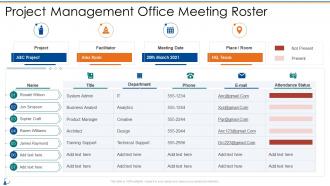
Project Management Office Meeting Roster Communication Management Bundle
Try Before you Buy Download Free Sample Product
Audience
Editable
of Time
Our Project Management Office Meeting Roster Communication Management Bundle are topically designed to provide an attractive backdrop to any subject. Use them to look like a presentation pro.
People who downloaded this PowerPoint presentation also viewed the following :
Project Management Office Meeting Roster Communication Management Bundle with all 6 slides:
Use our Project Management Office Meeting Roster Communication Management Bundle to effectively help you save your valuable time. They are readymade to fit into any presentation structure.
FAQs for Project Management Office Meeting Roster
So your PMO is like the coordination hub for all projects - they standardize processes and make sure everything ties back to business goals. They'll train project managers, track performance, and handle resource allocation. Documentation standards, governance committees for approvals, all that stuff too. Honestly think of them as helpful project cops rather than micromanagers (though some can get a bit intense lol). If your projects feel all over the place or you can't see what's happening across teams, definitely hit them up. They've got frameworks and tools that'll save you headaches down the road.
So a PMO is basically like air traffic control for all your company's projects - sounds boring but trust me, you need it. They standardize processes so you're not starting from scratch every time, track the metrics that actually matter, and catch scope creep before it kills your timeline. Without one, projects just turn into busy work instead of moving the business forward. They'll hook you up with templates and best practices too, which honestly saves so much time. My advice? Whatever framework your PMO uses, just go with it. Fighting their process never ends well.
So there are basically three types of PMOs you'll run into. Supportive ones are chill - they're like having a consultant around who gives you templates and training when you need it. Controlling PMOs are way more involved and make you follow their specific processes and reporting rules. Then directive PMOs actually run the projects themselves (honestly, they can be kind of intense). Which type you get depends on how much your leadership wants to micromanage everything. I'd try to figure out what yours is early on - makes it way easier to know what you're dealing with.
So PMOs track a bunch of stuff - mainly if projects finish on time, stay on budget, and hit their scope. They're obsessed with dashboards showing schedule variance and cost performance (honestly can be overwhelming). Stakeholder satisfaction scores matter too. The smart ones also measure benefits realization - like, did this thing actually deliver what we promised? Most create these scorecards that roll everything up across projects. Oh, and quality metrics are huge right now. Ask your PMO what they actually care about most so you're not spinning your wheels on random KPIs.
So basically a PMO sets up standard ways of doing projects - like whether you're using Agile, Waterfall, or some mix. They handle the boring but necessary stuff: how projects get approved, who gets what resources, regular reporting up the chain. Risk management, quality checks, governance frameworks - all that jazz. The smart PMOs actually help teams instead of drowning them in paperwork (though plenty still do that, unfortunately). They'll roll out project tools, templates, best practices. Plus they set up those steering committee meetings everyone loves to hate. Main thing is finding one that works with your culture instead of forcing some cookie-cutter corporate approach on everyone.
Honestly, just be super upfront from the start - people hate surprises way more than bad news. Set up weekly check-ins with the big bosses and maybe bi-weekly deeper dives with department heads. I always dump the bad stuff first, then jump into how you're gonna fix it. Trust me, they'd rather know early than get blindsided later. Oh, and make one of those RACI things so nobody's confused about who decides what. The real trick is staying ahead of problems instead of scrambling to catch up. Map out who you're dealing with first - some people want emails, others prefer quick calls. Build your whole rhythm around what works for them.
Honestly, just bake retrospectives into your regular routine - don't wait for disasters to strike. Get your teams trying new stuff and actually celebrating when experiments flop (yeah, I know your leadership probably hates hearing that). Build feedback loops so project teams can tell you when your PMO processes suck. Be real about what you're changing based on their input and what you're not. The whole thing falls apart if people don't feel safe speaking up about broken processes. Maybe start with one small pilot improvement each quarter? That way you're not overwhelming everyone while still making progress.
So basically a PMO stops all the chaos where different departments just grab whatever resources they want. You get actual criteria for ranking projects - ROI, strategic fit, that stuff - instead of whoever yells loudest winning. It creates visibility so you can see where everything's going and catch conflicts early. Way less political BS, more data-driven choices. Honestly, start by just writing down all your current projects and resources. I bet you'll find tons of overlap you didn't even know about. The whole thing makes resource allocation way more sane.
Start with Monday.com or Asana - they're solid for task tracking and keeping everyone on the same page. Microsoft Project is great if you need detailed Gantt charts, though honestly it can be overkill sometimes. For reporting to stakeholders, Power BI dashboards are incredible. Saved me so many headaches explaining project status to executives. You'll also want Slack for quick team communication and SharePoint for docs. My advice? Pick one main PM tool first and let your team get comfortable before adding more. Otherwise you'll just confuse everyone and nothing gets used properly.
So basically, PMOs set up consistent processes and training across all projects - templates, methodologies, the whole nine yards. Everyone starts speaking the same language instead of doing whatever they feel like. They run maturity assessments to spot gaps, then fix them through coaching and knowledge sharing. Performance tracking shows what's actually working vs what's not. Honestly, I'd say work WITH them on their initiatives rather than fighting it. I know PMOs can feel like red tape sometimes, but they're usually trying to help you succeed, not slow you down.
Ugh, the visibility thing is brutal when everyone's remote. You can't just peek over and see how things are going anymore. All those quick "hey, how's project X?" conversations in the kitchen? Gone. Now everything has to be super deliberate - which honestly means stuff slips through the cracks way more often. Time zones make it worse too since your nice standardized processes get all wonky when half the team's asleep during meetings. I'd say get some solid digital dashboards up and running, then do more check-ins but keep them short. Otherwise you'll drive everyone crazy with meetings.
Your PMO basically handles all the risk management grunt work for you. They've got standardized templates and processes so you don't have to build everything from zero. There's usually a master risk register with common issues and fixes that other teams already figured out. Regular risk reviews happen automatically, which is honestly a lifesaver when projects go sideways. They also share lessons learned between teams - super helpful for avoiding dumb mistakes. Oh, and definitely check if they have templates ready before you start making your own. Why reinvent the wheel, right?
Honestly? If you're drowning in multiple complex projects at once, that's your biggest red flag right there. Missing deadlines constantly? Budgets going haywire? Yeah, you probably need one. I'd also look at whether your project managers are all doing their own thing with zero consistency - that drives me nuts and wastes so much time. Oh, and if you keep having the same problems pop up over and over, that's another sign your processes are broken. Basically, if you're nodding along to most of this mess, it's time to start putting together a business case.
Your PMO can totally help develop your project managers. They're actually pretty good at setting up training programs that match different experience levels - think PMP prep or Agile certifications. What I've seen work well is when they do skills assessments first to figure out where everyone stands. Then they can create those mentorship programs and communities where PMs actually talk to each other about what's working (or not working, let's be honest). The standardized approach beats random training every time. I'd start by having them map out current competencies across your team, then build a development plan from there. Way more targeted than just throwing courses at people.
Start with portfolio governance - get clear criteria for evaluating projects based on strategy and ROI. Review your whole portfolio health regularly, not just individual projects (so many PMOs miss this). Standardize how projects get submitted so you can actually compare them fairly. Resource planning is huge - can't optimize what you don't track, right? Dashboards should show portfolio-level stuff, not just project stats. Oh, and audit your current projects against business goals this quarter. Trust me, that exercise alone will open your eyes to what's actually working.
-
I want to express my gratitude to SlideTeam’s presentation design services team for helping me create the best presentation of my life!
-
SlideTeam is very efficient when it comes to saving time. I am happy that I chose them for my presentation.