

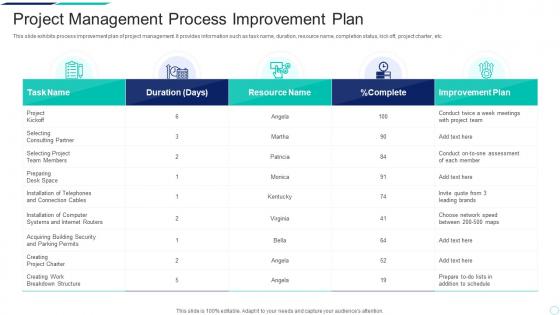
Project Management Process Improvement Plan




Try Before you Buy Download Free Sample Product
 Impress Your
 Audience
 100%
100% Editable
 Save Hours
 of Time


This slide exhibits process improvement plan of project management. It provides information such as task name, duration, resource name, completion status, kick off, project charter, etc.
People who downloaded this PowerPoint presentation also viewed the following :
Project Management Process Improvement Plan with all 6 slides:
Use our Project Management Process Improvement Plan to effectively help you save your valuable time. They are readymade to fit into any presentation structure.





FAQs for Project Management
The project management lifecycle includes initiation, planning, execution, monitoring and controlling, and closing stages. These phases streamline project delivery by defining objectives, allocating resources, coordinating tasks, tracking progress, and ensuring completion, with many organizations finding that structured lifecycle management enhances operational efficiency and delivers consistent outcomes.
Effectively defining project scope involves establishing clear deliverables, timelines, resource requirements, success metrics, and stakeholder responsibilities upfront. Through detailed documentation and stakeholder alignment sessions, organizations streamline communication, minimize scope creep, and enhance project outcomes, with many teams finding that comprehensive initial planning ultimately delivers faster execution and improved budget control.
Risk management techniques include risk identification workshops, probability and impact matrices, SWOT analysis, Monte Carlo simulations, and contingency planning. These methodologies streamline project delivery by enabling proactive threat assessment, resource allocation optimization, and stakeholder communication, with many organizations finding that systematic risk frameworks ultimately deliver enhanced project success rates and competitive advantage.
Project managers ensure effective communication by establishing clear channels, conducting regular check-ins, using collaborative tools, setting communication protocols, and creating transparent reporting structures. These approaches streamline coordination and minimize misunderstandings, with many organizations finding that structured communication frameworks enhance team productivity, accelerate project timelines, and ultimately deliver better outcomes across complex initiatives.
Essential project performance metrics include schedule variance, budget variance, scope completion, quality indicators, and resource utilization rates. These metrics enable project managers to track progress, identify potential risks, and make data-driven adjustments, with many organizations finding that consistent monitoring ultimately delivers improved project outcomes and enhanced stakeholder satisfaction.
Cultural differences significantly impact global project management through varying communication styles, decision-making processes, time orientations, and hierarchy expectations. Teams spanning regions like Asia, Europe, and the Americas often find that establishing clear protocols, leveraging cultural liaisons, and implementing flexible scheduling approaches streamlines collaboration, ultimately delivering enhanced project outcomes and stronger international partnerships.
Stakeholder engagement drives project success by ensuring alignment, securing resources, managing expectations, and facilitating smooth decision-making throughout the project lifecycle. Through regular communication and involvement, project managers build trust, minimize resistance, and leverage stakeholder expertise, with many organizations finding that engaged stakeholders ultimately deliver faster approvals and sustainable outcomes.
Project managers balance competing constraints by prioritizing requirements based on stakeholder needs, implementing agile methodologies for flexible resource allocation, and establishing clear trade-off frameworks that define acceptable compromises. Through strategic planning and continuous monitoring, organizations can optimize project outcomes while maintaining quality standards, with many finding that transparent communication and stakeholder alignment ultimately delivers successful projects within realistic parameters.
Agile emphasizes iterative development, continuous feedback, and adaptive planning, while Waterfall follows sequential phases with extensive upfront documentation and rigid timelines. Agile enables faster product launches and enhanced customer satisfaction through regular iterations, whereas Waterfall delivers predictable timelines and comprehensive documentation, with many organizations finding that hybrid approaches optimize both flexibility and structure.
Technology enhances project management through automated scheduling, real-time collaboration platforms, AI-powered risk assessment, cloud-based resource allocation, and integrated communication systems. These tools streamline workflows by eliminating manual tracking, enabling remote team coordination, and providing predictive analytics, with many organizations finding that digital project management delivers faster delivery times, reduced costs, and improved stakeholder visibility across complex initiatives.
Project managers should prioritize tasks using frameworks like MoSCoW method, critical path analysis, and stakeholder impact assessment, while allocating resources based on skill alignment, availability, and project dependencies. Effective managers balance competing demands by regularly reviewing priorities, maintaining resource flexibility, and leveraging project management tools, ultimately delivering projects on time and within budget while maximizing team productivity.
Preventing scope creep requires clear project boundaries through detailed requirements documentation, formal change control processes, regular stakeholder communication, and consistent progress monitoring. These strategies streamline project delivery by establishing approval workflows, maintaining timeline visibility, and ensuring resource allocation alignment, with many organizations finding that structured governance ultimately delivers projects on budget while enhancing client satisfaction and team productivity.
**INPUT**: How can lessons learned from previous projects improve future project outcomes? **OUTPUT**: Lessons learned improve future projects by identifying successful strategies, common pitfalls, resource optimization techniques, and stakeholder management approaches that can be systematically applied. Through structured knowledge repositories and post-project reviews, organizations streamline planning processes, reduce recurring risks, and enhance team performance, with many companies finding that documented insights significantly accelerate delivery timelines while improving overall project success rates.
Ethical considerations in project management include stakeholder transparency, resource allocation fairness, conflict of interest management, data privacy protection, and environmental responsibility. These principles streamline decision-making by establishing clear guidelines, enhancing team trust, and ensuring regulatory compliance, with many organizations finding that ethical frameworks ultimately deliver stronger stakeholder relationships and sustainable competitive advantage.
Team dynamics significantly influence project delivery through communication patterns, collaboration effectiveness, trust levels, and conflict resolution approaches. When teams demonstrate strong interpersonal relationships and clear role definitions, projects typically experience faster decision-making, reduced bottlenecks, and enhanced problem-solving capabilities, with many organizations finding that cohesive teams deliver projects 25% faster while maintaining higher quality standards.
-
Great designs, Easily Editable.
-
The templates are handy and I can personalize them as per my needs. Glad to be your subscriber!