

Project management professionals required documents powerpoint presentation slides




Try Before you Buy Download Free Sample Product
 Impress Your
 Audience
 100%
100% Editable
 Save Hours
 of Time


PMP focuses on the development of a plan outline how it can be managed. The purpose is to cater to PMP elements associated with IT projects. Here is a professionally designed template on PMP required documents that cater to integration and scope management details through project charter and work breakdown structure. It covers slides about time and quality management with project development timeline roadmap, time management in IT project schedule planning, quality assurance, essential elements associated with quality testing. The proposal displays key findings of human resource management in terms of key people involved in the project team, RACI for necessary tasks assigned, project manager facilitation development matrix, stakeholders assessment matrix, user persona for client understanding. It caters to slides about communication management with a stakeholder communication plan and a project communication plan for the target audience. The template will cover slides about documents required for risk and procurement management, such as risk management action plan, vendor evaluation scorecard, considerations for project contracts development. It will protect information regarding cost management through work breakdown structure budget for project, project budget assessment, and project budget plan. Book a free demo and download the proposal now. Talk to our expert team for all your queries and get access to the markets best template from us.
People who downloaded this PowerPoint presentation also viewed the following :
Content of this Powerpoint Presentation
Slide 1: This slide introduces Project Management Professionals Required Documents. State Your Company Name and begin.
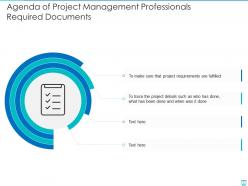
Slide 2: This is an Agenda slide. State your agendas here.
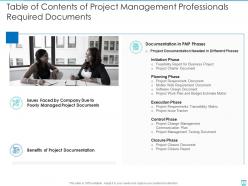
Slide 3: This slide shows Table of Contents for Project Management Professionals Required Documents.
Slide 4: This is another slide showing Table of Contents for Project Management Professionals Required Documents.
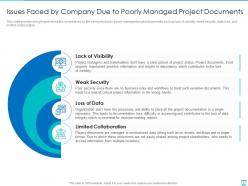
Slide 5: This slide provides the glimpse about the issues faced by the company due to poorly managed project documents such as lack of visibility, weak security, data loss, and limited collaboration.
Slide 6: This slide shows Table of Content highlighting Benefits of Project Documentation.
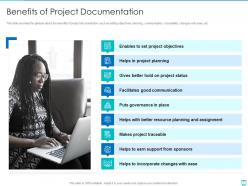
Slide 7: This slide displays the glimpse about the benefits of project documentation such as setting objectives, planning, communication, traceability, changes with ease, etc.
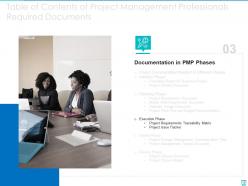
Slide 8: This slide shows Table of Contents for Project Management Professionals Required Documents.
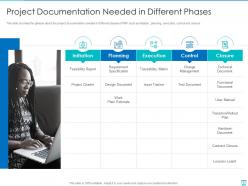
Slide 9: This slide presents the glimpse about the project documentation needed in different phases of PMP such as initiation, planning, execution, control and closure.
Slide 10: This slide displays Table of Contents for Project Management Professionals Required Documents.
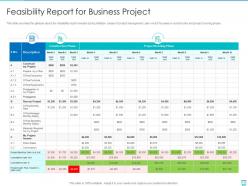
Slide 11: This slide provides the glimpse about the feasibility report needed during initiation phase of project management plan which focuses on construction and project running phase.
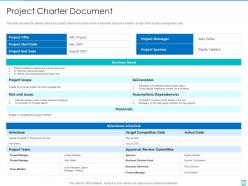
Slide 12: This slide represents the glimpse about the project charter document which is important during the initiation phase of the project management plan.
Slide 13: This slide shows Table of Contents for Project Management Professionals Required Documents.
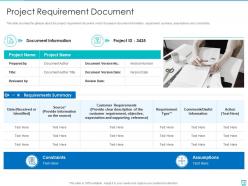
Slide 14: This slide presents the glimpse about the project requirement document which focuses on document information, requirement summary, assumptions and constraints.
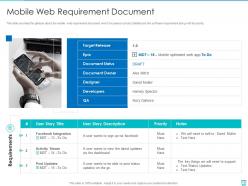
Slide 15: This slide displays the glimpse about the mobile web requirement document which focuses on product details and the software requirement along with its priority.
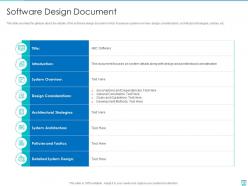
Slide 16: This slide provides the glimpse about the details of the software design document which focuses on system overview, design considerations, architectural strategies, policies, etc.
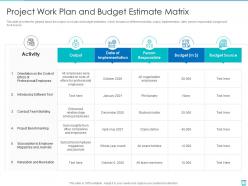
Slide 17: This slide represents the glimpse about the project work plan and budget estimation which focuses on different activities, output, implementation date, person responsible, budget and fund source.
Slide 18: This slide shows Table of Contents for Project Management Professionals Required Documents.
Slide 19: This slide displays the glimpse about the requirements traceability table which focuses on project description, requestor, department, business justification, test strategy, etc.
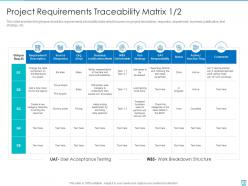
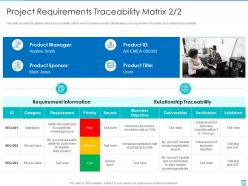
Slide 20: This slide provides the glimpse about the traceability matrix which focuses on project details along with requirement information and relationship traceability.
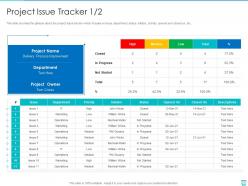
Slide 21: This slide represents the glimpse about the project issue tracker which focuses on issue, department, status, initiator, priority, opened and closed on, etc.
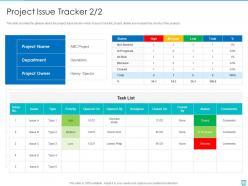
Slide 22: This slide provides the glimpse about the project issue tracker which focus on track list, project details and evaluate the priority of the projects.
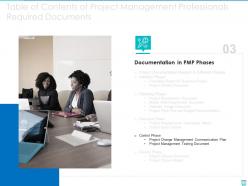
Slide 23: This slide shows Table of Contents for Project Management Professionals Required Documents.
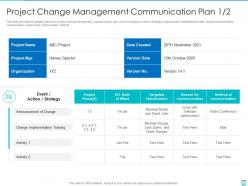
Slide 24: This slide presents the glimpse about the project change management communication plan which focuses on event or strategy, project phase, establishment date, targeted stakeholders, communication reason and communication method.
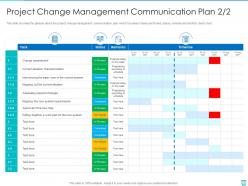
Slide 25: This slide displays the glimpse about the project change management communication plan which focuses on tasks performed, status, remarks and monthly Gantt chart.
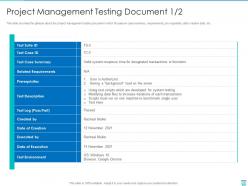
Slide 26: This slide provides the glimpse about the project management testing document which focuses on case summary, requirements, pre requisites, date creation date, etc.
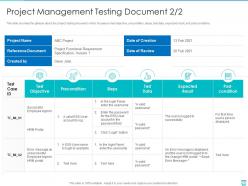
Slide 27: This slide represents the glimpse about the project testing document which focuses on test objective, precondition, steps, test data, expected result, and post conditions.
Slide 28: This slide shows Table of Contents for Project Management Professionals Required Documents.
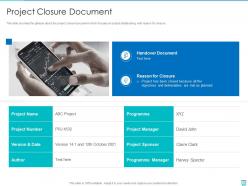
Slide 29: This slide presents the glimpse about the project closure document which focuses on project details along with reason for closure.
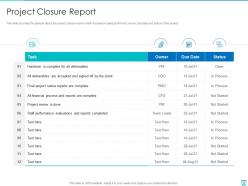
Slide 30: This slide displays the glimpse about the project closure report which focuses on tasks performed, owner, due date and status of the project.
Slide 31: This slide shows Project Management Professionals Required Documents for Icons.
Slide 32: This slide is titled as Additional Slides for moving forward.
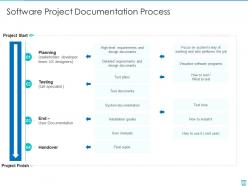
Slide 33: This slide shows Software Project Documentation Process.
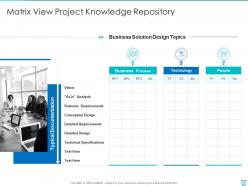
Slide 34: This slide presents Typical Documentation describing- Business Solution Design Topics and Matrix View Project Knowledge Repository.
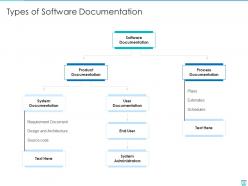
Slide 35: This slide shows Types of Software Documentation.
Slide 36: This is About Us slide to show company specifications etc.
Slide 37: This is Our Goal slide. State your firm's goals here.
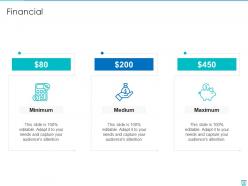
Slide 38: This is a Financial slide. Show your finance related stuff here.
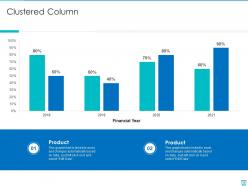
Slide 39: This slide shows Clustered Column with two products comparison.
Slide 40: This is Our Mission slide with related imagery and text.
Slide 41: This is an Idea Generation slide to state a new idea or highlight information, specifications etc.
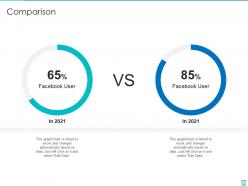
Slide 42: This is a Comparison slide to state comparison between commodities, entities etc.
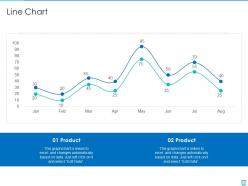
Slide 43: This slide shows Line Chart with two products comparison.
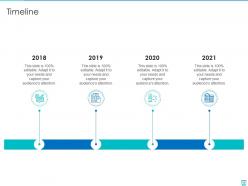
Slide 44: This is a Timeline slide. Show data related to time intervals here.
Slide 45: This slide shows 30 60 90 Days Plan with text boxes.
Slide 46: This is a Thank You slide with address, contact numbers and email address.
Project management professionals required documents powerpoint presentation slides with all 46 slides:
Use our Project Management Professionals Required Documents Powerpoint Presentation Slides to effectively help you save your valuable time. They are readymade to fit into any presentation structure.

FAQs for Project management professionals required documents
Key components include project scope, timeline with milestones, resource allocation, budget breakdown, risk management strategies, and stakeholder communication plans. These elements work together by establishing clear expectations, tracking progress systematically, and enabling proactive decision-making, with many organizations finding that comprehensive documentation streamlines coordination and ultimately delivers projects on time and within budget.
Project management documentation facilitates stakeholder communication by providing centralized information access, establishing clear reporting structures, and creating standardized communication protocols. Through comprehensive project dashboards, regular status reports, and documented decision trails, organizations streamline updates, reduce miscommunication, and ensure alignment, with many teams finding that structured documentation ultimately enhances transparency and accelerates project decision-making processes.
Documentation serves as the foundation for effective project risk management by creating risk registers, tracking mitigation strategies, maintaining audit trails, and establishing clear accountability frameworks. Through comprehensive documentation, project managers can identify potential issues early, monitor risk evolution throughout the project lifecycle, and ensure stakeholders remain informed, ultimately delivering better project outcomes and organizational learning.
Templates enhance project management efficiency by standardizing formats, reducing creation time, ensuring consistency across teams, and minimizing errors through pre-built structures. Organizations using document templates for project charters, status reports, and risk assessments find they can accelerate project kickoffs by 40-50%, while maintaining quality standards and enabling seamless collaboration across departments.
Best practices for maintaining current project documentation include establishing standardized templates, assigning documentation ownership, implementing regular review cycles, using collaborative digital platforms, and integrating updates into project workflows. These approaches streamline information management by centralizing access, automating version control, and embedding documentation tasks into daily operations, with many project teams finding that consistent documentation practices ultimately enhance team coordination, reduce miscommunication, and accelerate project delivery timelines.
**INPUT**: What types of project management documentation should be prioritized in agile methodologies? **OUTPUT**: Agile project management documentation should prioritize user stories, sprint backlogs, burndown charts, retrospective notes, and definition of done criteria. These streamlined documents enhance team collaboration, maintain project transparency, and support iterative delivery, with many technology and consulting organizations finding that focused documentation accelerates development cycles while ensuring stakeholder alignment. **Word count: 54 words**
Visual aids in documentation enhance understanding and engagement by simplifying complex information, reducing cognitive load, and catering to different learning styles among team members. Through infographics, flowcharts, and interactive dashboards, organizations streamline communication processes, accelerate decision-making, and minimize misunderstandings, with many teams finding that visual elements ultimately deliver improved collaboration and project outcomes.
Common pitfalls include creating overly complex documentation, inconsistent formatting across documents, failing to establish clear approval workflows, inadequate version control systems, and neglecting stakeholder input during drafts. These issues streamline by implementing standardized templates, centralized document repositories, and regular review cycles, with many organizations finding that simplified, accessible documentation enhances team collaboration and project outcomes.
Documentation contributes to project audits and evaluations by providing comprehensive evidence of decisions, processes, and outcomes, enabling auditors to verify compliance, assess performance, and identify improvement opportunities. Through detailed records of timelines, budgets, and deliverables, organizations streamline audit processes, enhance transparency, and demonstrate accountability, while ultimately delivering valuable insights for future project optimization and strategic planning.
Digital tools streamline project management documentation by automating status updates, centralizing document storage, enabling real-time collaboration, and providing standardized templates and workflows. These platforms enhance efficiency through automated reporting, version control, and seamless integration with other business systems, with many organizations finding that digital documentation reduces administrative overhead by 40% while improving project transparency and stakeholder communication.
Lessons learned documentation enhances future project success by capturing critical insights, identifying recurring challenges, standardizing best practices, and preserving institutional knowledge across teams. These comprehensive records enable organizations to avoid repeated mistakes, streamline project workflows, and accelerate decision-making processes, with many companies finding that systematic documentation reduces project risks by up to 30% while improving overall delivery timelines.
Documentation serves as a critical control mechanism for managing project changes and scope creep by establishing clear baselines, tracking all modification requests, and maintaining stakeholder alignment throughout project evolution. Through comprehensive change logs and scope documentation, project managers can evaluate impacts on timelines and budgets, communicate decisions transparently, and prevent unauthorized additions, ultimately delivering projects within defined parameters while maintaining client relationships.
Project documentation should be structured hierarchically with clear folder systems, standardized naming conventions, version control protocols, searchable metadata tags, and centralized digital repositories. This organizational approach enables project teams across industries like construction, software development, and consulting to quickly locate critical information, reduce time spent searching for documents, and maintain consistency throughout project lifecycles, ultimately delivering improved collaboration and streamlined project execution.
**INPUT**: What strategies can be used to ensure team members actively contribute to project documentation? **OUTPUT**: Effective strategies include establishing clear documentation responsibilities, integrating updates into regular workflows, providing user-friendly templates, and implementing collaborative platforms that streamline contributions. These approaches enhance team engagement by minimizing administrative burden, creating accountability through defined roles, and ultimately delivering improved project transparency and knowledge retention across organizations.
Project managers can effectively train teams by demonstrating documentation's direct impact on project success, conducting hands-on workshops with real scenarios, and establishing clear templates and standards. Through role-specific training sessions, managers help team members understand how proper documentation streamlines communication, reduces errors, and accelerates project delivery, with many organizations finding that structured documentation training significantly improves team collaboration and project outcomes.
-
Great quality product.
-
Editable templates with innovative design and color combination.
-
Designs have enough space to add content.
-
Great designs, Easily Editable.