

Project Management Skill Matrix Powerpoint Ppt Template Bundles





Try Before you Buy Download Free Sample Product
 Impress Your
Audience
 100%
Editable
 Save Hours
of Time


Our Project Management Skill Matrix Powerpoint Ppt Template Bundles are topically designed to provide an attractive backdrop to any subject. Use them to look like a presentation pro.
People who downloaded this PowerPoint presentation also viewed the following :
Project Management Skill Matrix Powerpoint Ppt Template Bundles with all 25 slides:
Use our Project Management Skill Matrix Powerpoint Ppt Template Bundles to effectively help you save your valuable time. They are readymade to fit into any presentation structure.







FAQs for Project Management Skill Matrix Powerpoint
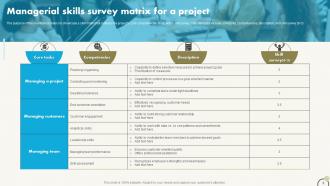
Essential project management skills include technical competencies like scheduling and budgeting, leadership abilities such as team management and stakeholder communication, analytical skills including risk assessment and resource allocation, and soft skills like problem-solving and negotiation. These competencies enable organizations to systematically evaluate project managers' capabilities, identify development gaps, and strategically align talent with project complexity, ultimately delivering more successful outcomes and enhanced team performance.
A project management skill matrix enhances team performance by identifying skill gaps, optimizing resource allocation, and enabling strategic task assignments based on individual competencies. Through clear visibility of team capabilities, project managers can streamline workflows, reduce bottlenecks, and accelerate project delivery, while simultaneously identifying training opportunities that strengthen overall team effectiveness and competitive advantage.
Project management skill matrices can integrate Agile, Scrum, Waterfall, Lean Six Sigma, and PRINCE2 methodologies alongside frameworks like PMI's competency model and Kanban. These methodologies enhance project outcomes by standardizing skill assessment, identifying development gaps, and aligning team capabilities with project requirements, with many organizations finding that this strategic combination ultimately delivers improved resource allocation and competitive advantage.
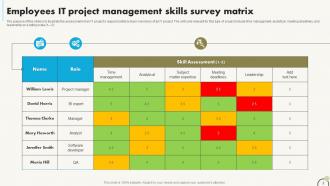
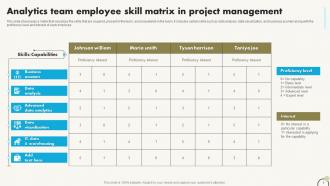
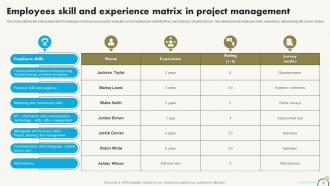
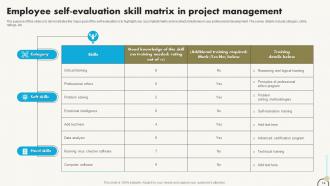
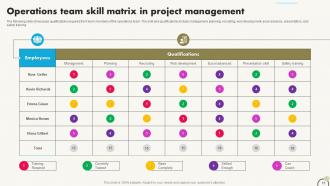
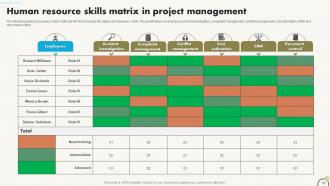
A skill matrix aids in identifying skill gaps by systematically mapping required project competencies against team members' current abilities, highlighting deficiencies in technical expertise, leadership capabilities, and domain knowledge. This visual assessment enables project managers to strategically address shortfalls through targeted training, strategic hiring, or resource reallocation, ultimately ensuring project success and enhanced team performance.
Communication serves as a foundational competency in project management skill matrices, encompassing stakeholder engagement, team coordination, conflict resolution, and progress reporting capabilities. Effective communication skills enable project managers to streamline collaboration across departments, enhance transparency with executives and clients, and ultimately deliver successful outcomes, with many organizations finding that strong communicators significantly reduce project delays and budget overruns.
A project management skill matrix should be updated quarterly or after major project milestones, with annual comprehensive reviews ensuring accuracy and relevance. Regular updates enable organizations to track skill development, identify emerging gaps, and align training initiatives with evolving project demands, ultimately delivering enhanced team performance and strategic workforce planning.
Visualizing skills through matrix formats enhances transparency, streamlines resource allocation, and enables strategic project assignments by clearly mapping individual capabilities against required competencies. This approach helps project managers identify skill gaps, optimize team compositions, and accelerate decision-making processes, with many organizations finding that visual skill matrices ultimately deliver improved project outcomes and enhanced workforce development planning.
A skill matrix facilitates resource allocation by providing comprehensive visibility into team member competencies, availability, and expertise levels across different project requirements. Through detailed skill mapping, project managers can strategically assign tasks based on individual strengths, identify skill gaps early, and optimize team performance, while ensuring projects receive the right talent at the right time, ultimately delivering improved efficiency and successful project outcomes.
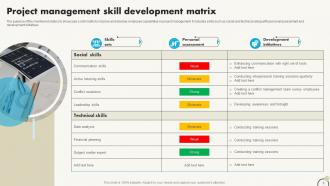
A skill matrix supports project manager professional development by identifying competency gaps, creating targeted learning pathways, and establishing clear advancement criteria for career progression. Through structured skill assessments and benchmarking, project managers can strategically focus their development efforts on high-impact areas like stakeholder management and risk mitigation, ultimately enhancing their leadership capabilities and market value.
Organizations leverage skill matrices to optimize project outcomes by accurately matching team members' competencies with specific project requirements, identifying skill gaps before they impact deadlines, and strategically allocating resources across multiple initiatives. This systematic approach enables project managers to assemble high-performing teams, reduce training costs, and accelerate project delivery, with many companies finding that skill-based assignments ultimately deliver improved quality and enhanced competitive advantage.
Agile project management skill matrices typically prioritize facilitation, stakeholder communication, risk management, team collaboration, and adaptive planning capabilities. These competencies enable project managers to navigate iterative workflows, manage cross-functional teams effectively, and respond to changing requirements, with many organizations finding that strong facilitation and communication skills ultimately deliver faster project cycles and improved team performance.
A project management skill matrix improves stakeholder engagement by clearly mapping team capabilities, identifying skill gaps, and aligning expertise with stakeholder expectations and project requirements. This transparency enables more informed conversations with stakeholders about resource allocation, timeline feasibility, and deliverable quality, while demonstrating professional competency and strategic planning, ultimately building stakeholder confidence and trust.
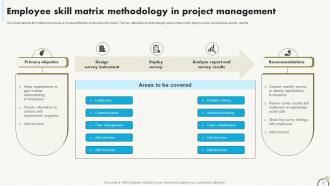
Tools for creating project management skill matrices include Excel, Google Sheets, Smartsheet, Monday.com, and specialized HR platforms like BambooHR and SuccessFactors. These solutions streamline skill assessment by automating data collection, enabling real-time updates, and generating visual dashboards, with many organizations finding that integrated platforms ultimately deliver better resource allocation and strategic workforce planning.
Virtual skill matrices adapt through cloud-based platforms, real-time collaboration tools, digital assessment features, and remote communication integrations. These technologies streamline skill tracking by enabling continuous updates, facilitating virtual skill-sharing sessions, and providing accessible dashboards for distributed team members, ultimately delivering enhanced transparency and coordination across geographically dispersed project teams.
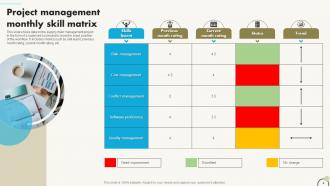
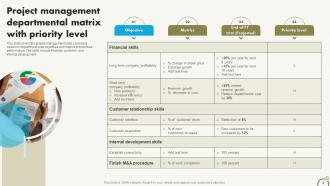
Key metrics include skill proficiency ratings, competency gap analysis, training completion rates, project performance correlations, and skill utilization frequency across different project types. These measurements enable organizations to track skill development progress, identify areas requiring additional training, and optimize team assignments, ultimately delivering improved project outcomes and enhanced resource allocation efficiency.
-
I have been using SlideTeam for the past six months. Very happy and satisfied!
-
“Immediate response, professional support, and effective solutions that were customized and immediately provided. Well done- Thank you!”