


Project management triangle integration procurement communications




Try Before you Buy Download Free Sample Product
 Impress Your
 Audience
 100%
100% Editable
 Save Hours
 of Time


Investigate the issue with our Project Management Triangle Integration Procurement Communications. Delve into all the facts involved.
People who downloaded this PowerPoint presentation also viewed the following :
Content of this Powerpoint Presentation
Description:
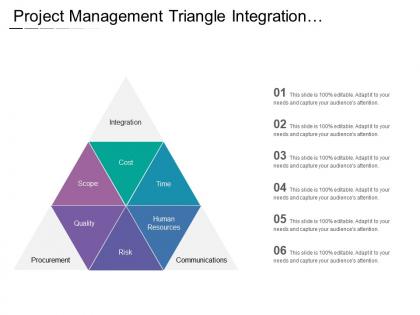
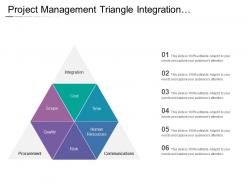
The image depicts a PowerPoint slide titled "Project Management Triangle Integration," which illustrates the interconnection between various elements critical to project management. The triangle is a well-known model known as the Triple Constraint or Iron Triangle in project management, which traditionally included Scope, Time, and Cost. However, this diagram expands on the classic model to include other key project aspects:
1. Integration: The core element that combines all aspects of the project, ensuring they work in harmony.
2. Scope: Defines the project's boundaries and deliverables.
3. Cost: The budgetary constraints of the project.
4. Time: The schedule and deadlines for the project.
5. Quality: The standards and criteria that the project's deliverables must meet.
6. Human Resources: The people and skills needed to complete the project.
7. Risk: Potential issues that could impact the project negatively.
8. Procurement: The process of acquiring goods and services necessary for the project.
9. Communications: The methods and frequency with which information is shared among stakeholders.
Use Cases:
This comprehensive approach to project management is beneficial across multiple sectors:
1. Construction:
Use: Managing complex building projects.
Presenter: Construction Manager.
Audience: Project Team, Investors.
2. Information Technology:
Use: Software development lifecycle management.
Presenter: IT Project Manager.
Audience: Developers, Stakeholders.
3. Healthcare:
Use: Coordinating healthcare system implementations.
Presenter: Healthcare Administrator.
Audience: Medical Professionals, IT Specialists.
4. Manufacturing:
Use: Overseeing new product development.
Presenter: Operations Manager.
Audience: Engineers, Production Staff.
5. Education:
Use: Implementing new educational programs or curricula.
Presenter: Academic Project Lead.
Audience: Educators, Administrators.
6. Finance:
Use: Launching new financial products or services.
Presenter: Financial Project Manager.
Audience: Finance Team, Regulatory Agencies.
7. Marketing:
Use: Rollout of marketing campaigns or initiatives.
Presenter: Marketing Director.
Audience: Marketing Team, Agency Partners.
Project management triangle integration procurement communications with all 5 slides:
Access the entire gamut with our Project Management Triangle Integration Procurement Communications. They assure no end of choices.

FAQs for Project management triangle
The three key constraints in the Project Management Triangle are scope, time, and cost, which form an interdependent relationship where changes to one constraint directly impact the others. These constraints enable project managers to balance deliverable requirements, timeline expectations, and budget limitations, with many organizations finding that understanding these trade-offs ultimately delivers more realistic planning and successful project outcomes.
The three constraints create an interconnected balance where changes to one directly impact the others, requiring strategic trade-offs throughout project execution. When scope expands, organizations typically face increased costs or extended timelines, while accelerated delivery often demands budget increases or scope reduction, with successful project managers finding that transparent stakeholder communication about these relationships ultimately delivers realistic expectations and strategic project outcomes.
Changes in one triangle constraint create cascading effects, as reducing project scope typically accelerates timelines and lowers costs, while expanding timelines can enhance quality within budget parameters. These interdependencies require strategic resource allocation, with many project managers finding that early constraint adjustments enable better stakeholder alignment and ultimately deliver more predictable outcomes.
Project managers can effectively communicate triangle adjustments by using visual representations, presenting clear trade-off scenarios, and quantifying impacts with specific metrics like timeline changes or budget reallocations. Through structured stakeholder meetings and comprehensive impact assessments, managers enable informed decision-making while maintaining transparency, ultimately delivering alignment on project priorities and ensuring stakeholder buy-in across organizational levels.
Project management methodologies like Agile, Waterfall, and Lean Six Sigma provide frameworks for assessing triangle balance, alongside tools such as Gantt charts, resource allocation software, risk assessment matrices, and earned value management systems. These approaches enable organizations to monitor scope creep, optimize resource distribution, and adjust timelines dynamically, with many project managers finding that integrated dashboard solutions ultimately deliver enhanced visibility and competitive advantage.
Quality in the Project Management Triangle represents the deliverable's standards and requirements, directly influenced by scope, time, and cost constraints. When project managers reduce budget or timeline, quality often suffers, while increased investment in resources and extended schedules typically enhance deliverable quality, with many organizations finding that balancing these elements strategically ensures optimal outcomes.
Yes, the Project Management Triangle applies to agile paradigms through adaptive scope management, iterative time-boxing, and flexible resource allocation across sprints. Agile methodologies like Scrum and Kanban leverage this framework by treating scope as variable while maintaining fixed sprint durations and team capacity, ultimately enabling organizations to deliver incremental value while managing traditional constraints in an increasingly dynamic project environment.
Common pitfalls include overcommitting to unrealistic timelines, underestimating resource requirements, ignoring stakeholder expectations, failing to communicate trade-offs clearly, and attempting to optimize all three constraints simultaneously. These challenges often occur when project managers lack experience with scope creep or face pressure from executives, with many organizations finding that proactive constraint management and transparent communication ultimately deliver better project outcomes and stakeholder satisfaction.
Stakeholder expectations significantly influence the Project Management Triangle by creating pressure to adjust scope, timeline, or budget constraints based on their priorities and requirements. When stakeholders demand enhanced features, accelerated delivery, or cost reductions, project managers must rebalance these three elements, often requiring strategic trade-offs and clear communication to maintain project viability while meeting evolving expectations.
Project managers typically prioritize scope when delivering critical features for product launches, time when facing regulatory deadlines or competitive pressures, and cost when operating under strict budget constraints or economic downturns. These decisions depend on stakeholder priorities, market conditions, and strategic objectives, with many organizations finding that clear constraint prioritization early in planning phases ultimately delivers better project outcomes and stakeholder satisfaction.
Team resources directly influence the project management triangle by determining execution capacity, skill availability, and workflow efficiency across all three constraints. With adequate skilled resources, organizations can expand scope without extending timelines, accelerate delivery through parallel workflows, and optimize costs through strategic resource allocation, while resource limitations force trade-offs between quality, speed, and budget, ultimately requiring project managers to balance competing priorities for successful outcomes.
Risk management serves as a protective mechanism for the Project Management Triangle by identifying potential threats to scope, time, and budget, enabling proactive mitigation strategies, contingency planning, and resource reallocation. Through systematic risk assessment and monitoring, project managers can maintain equilibrium by preventing scope creep, schedule delays, and cost overruns, ultimately delivering successful outcomes while preserving stakeholder confidence and organizational objectives.
Project managers leverage the triangle framework by using it to establish clear trade-offs between scope, time, and budget during initial planning, ensuring stakeholders understand that adjusting one constraint impacts the others. This approach enables realistic goal-setting through data-driven negotiations, with many organizations finding that transparent triangle discussions reduce scope creep, improve deadline accuracy, and enhance client satisfaction by setting achievable expectations upfront.
Stakeholder engagement significantly impacts Project Management Triangle success by ensuring realistic scope definition, securing adequate resources, and establishing achievable timelines through continuous communication and feedback. Organizations with strong stakeholder involvement experience fewer scope changes, better resource allocation, and improved schedule adherence, ultimately delivering projects that meet expectations while maintaining quality standards.
Lessons learned enable project managers to make more informed trade-offs between scope, time, and cost by identifying recurring patterns, risk factors, and successful strategies from previous initiatives. Historical data helps teams anticipate constraint conflicts, optimize resource allocation, and develop contingency plans, with many organizations finding that systematic knowledge capture ultimately delivers faster project timelines, reduced budget overruns, and enhanced stakeholder satisfaction.
-
Informative design.
-
The Designed Graphic are very professional and classic.