

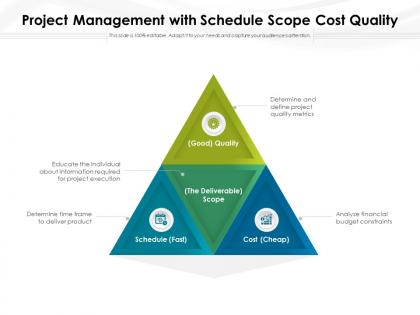
Project management with schedule scope cost quality




Try Before you Buy Download Free Sample Product
 Impress Your
Audience
 100%
Editable
 Save Hours
of Time


Our Project Management With Schedule Scope Cost Quality are topically designed to provide an attractive backdrop to any subject. Use them to look like a presentation pro.
People who downloaded this PowerPoint presentation also viewed the following :
Project management with schedule scope cost quality with all 2 slides:
Use our Project Management With Schedule Scope Cost Quality to effectively help you save your valuable time. They are readymade to fit into any presentation structure.


FAQs for Project management with schedule
Agile emphasizes iterative development, continuous feedback, and adaptive planning, while Waterfall follows sequential phases with extensive upfront planning and documentation. Agile enables faster product releases and responsive changes throughout development, whereas Waterfall delivers predictable timelines and comprehensive documentation, with many organizations finding that hybrid approaches optimize both flexibility and structure for complex projects.
Effective communication enhances project success rates by establishing clear expectations, facilitating timely decision-making, and preventing costly misunderstandings throughout project lifecycles. Through regular stakeholder updates, transparent progress reporting, and structured feedback loops, organizations streamline workflows, reduce delays, and maintain alignment, with many finding that consistent communication practices ultimately deliver higher completion rates and improved resource allocation.
Essential project management skills include leadership, communication, risk management, time management, and stakeholder engagement. These competencies enable project managers to coordinate cross-functional teams, navigate complex timelines, and deliver successful outcomes across industries like construction, IT, and healthcare, ultimately ensuring projects meet scope, budget, and quality requirements while driving organizational growth.
Project managers can effectively manage remote teams by establishing clear communication protocols, utilizing collaborative project management tools, setting defined expectations and deadlines, and conducting regular virtual check-ins. These approaches streamline coordination by enhancing transparency, maintaining team accountability, and ensuring consistent progress tracking, with many organizations finding that structured digital workflows ultimately deliver improved productivity and stronger team cohesion across distributed workforces.
Risk management serves as a critical foundation in project planning and execution by identifying potential threats, assessing their impact, developing mitigation strategies, and establishing contingency plans throughout the project lifecycle. This proactive approach enables project managers to minimize disruptions, control costs, and maintain timelines, with many organizations finding that systematic risk assessment ultimately delivers more predictable outcomes and competitive advantage.
Effective stakeholder engagement involves regular communication through structured meetings, progress dashboards, and feedback sessions, while clearly defining roles, expectations, and decision-making authority from project initiation. This strategic approach enables organizations to minimize scope creep, accelerate approvals, and maintain alignment, with many companies finding that proactive stakeholder involvement significantly reduces project risks and enhances delivery outcomes.
Essential project management tools include task management platforms like Asana and Trello, collaboration software such as Slack and Microsoft Teams, scheduling applications like Monday.com, and comprehensive suites including Jira and Basecamp. These technologies streamline workflows by centralizing communication, automating progress tracking, and enhancing resource allocation, with many organizations finding that integrated platforms ultimately deliver faster project completion and improved team productivity.
Project success extends beyond schedule and budget to encompass stakeholder satisfaction, quality deliverables, strategic alignment with business objectives, and long-term value creation. These comprehensive metrics enable organizations to evaluate whether projects truly enhance operational efficiency, drive competitive advantage, and deliver sustainable outcomes, with many companies finding that measuring customer satisfaction, team performance, and strategic impact provides deeper insights into overall project effectiveness.
Common project management pitfalls include unclear scope definition, inadequate resource planning, poor communication protocols, unrealistic timelines, and insufficient risk assessment. These challenges can be avoided by establishing detailed project charters, implementing regular stakeholder check-ins, utilizing collaborative management platforms, and conducting thorough feasibility analyses, ultimately delivering projects on time and within budget constraints.
AI and automation integration streamlines project management by automating task scheduling, enhancing resource allocation, and providing predictive analytics for risk assessment. These technologies enable project managers to minimize manual coordination, accelerate decision-making through real-time insights, and optimize workflows, with many organizations finding significantly improved delivery timelines and cost efficiency.
Managing project scope creep requires clear change control processes, regular stakeholder communication, detailed project documentation, and defined approval workflows for modifications. These strategies work by establishing baseline requirements, implementing formal change requests, and maintaining transparent cost-impact assessments, with many project managers finding that proactive scope monitoring and stakeholder education ultimately deliver better budget control and timeline adherence.
Cultural differences impact project management through varying communication styles, decision-making approaches, time orientations, and authority structures across international teams. While these differences present coordination challenges, they also deliver strategic advantages through diverse perspectives, enhanced creativity, and broader market insights, with many global organizations finding that culturally inclusive project frameworks ultimately strengthen innovation and competitive positioning.
Project timeline and budget estimation methodologies include parametric estimation, analogous estimation, three-point estimation, bottom-up estimation, and Monte Carlo simulation. These approaches streamline planning by leveraging historical data, statistical analysis, and detailed work breakdown structures, with many organizations finding that combining multiple methodologies delivers greater accuracy and ultimately enhances project success rates.
Project managers foster continuous improvement by establishing regular retrospectives, encouraging open feedback, implementing lessons learned processes, and recognizing innovative solutions from team members. Through structured review cycles and collaborative problem-solving sessions, teams identify inefficiencies, streamline workflows, and enhance delivery methods, with many organizations finding that this approach significantly reduces project timelines while improving quality outcomes.
Project management retrospectives include thorough documentation review, stakeholder feedback collection, timeline analysis, budget variance assessment, and lessons learned compilation. These evaluations enhance future project outcomes by identifying process improvements, resource optimization strategies, and risk mitigation approaches, with many organizations finding that structured retrospectives ultimately deliver increased team efficiency and strategic project success rates.
-
Good research work and creative work done on every template.
-
Out of the box and creative design.
-
Visually stunning presentation, love the content.
-
Unique and attractive product design.