

Project Portfolio Highlights Building Construction Company Profile





Try Before you Buy Download Free Sample Product
 Impress Your
Audience
 100%
Editable
 Save Hours
of Time


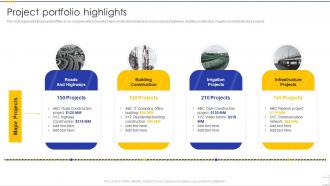
This slide represents the project portfolio of our company which includes major construction projects such as roads and highways, building construction, irrigation and infrastructure projects.
People who downloaded this PowerPoint presentation also viewed the following :
Project Portfolio Highlights Building Construction Company Profile with all 6 slides:
Use our Project Portfolio Highlights Building Construction Company Profile to effectively help you save your valuable time. They are readymade to fit into any presentation structure.





FAQs for Project Portfolio Highlights Building
Okay so first thing - does it actually match what you're trying to accomplish as a business? Then look at whether you've got the resources and bandwidth to pull it off. ROI matters obviously, but don't forget some projects have to happen in a certain order. Like, project A might need to finish before B can even start. The stakeholder thing is honestly make-or-break territory - I've seen great projects die because leadership wasn't really behind them. Risk tolerance is another big one. Map all this stuff out against your potential projects and see what rises to the top naturally.
Honestly, having your portfolio organized makes stakeholder meetings so much smoother. You can just pull up those visual dashboards showing project status and timelines instead of frantically searching through random files. Executives eat this up - they get the overview without getting buried in details. Way less time spent explaining background stuff since it's all laid out clearly. And when they ask questions, you look like a rockstar answering with real data right there. I always tell people to start with one master view of all projects. Trust me, it's huge for those exec check-ins.
Look, you'll want to mix financial stuff with operational metrics to really see what's happening. ROI and budget variance are non-negotiables. Then track schedule adherence, scope creep, and quality - that's your execution health check right there. Customer satisfaction is actually massive though. I've seen projects nail every target but bomb with stakeholders, which honestly feels like failure to me. Team performance matters too - resource utilization, engagement levels, all that. Pick maybe 4-6 metrics that match your goals instead of getting buried in spreadsheets. Track them consistently so patterns emerge.
So PPM is basically like having a GPS for all your projects - you can actually see which ones are heading toward your goals and which are just wasting money. Instead of teams running around doing random stuff, you align everything with what matters most to your business. The whole point is making smart decisions about what to fund or kill based on real strategic value, not just whoever yells loudest in meetings (we've all been there, right?). I'd start by taking your current projects and seeing how they stack up against your top 3 business objectives. Makes the whole mess way clearer.
Think of risk assessment as your safety net for projects. You'll want different types - some safe bets mixed with riskier ones that could really pay off. I usually check each project's risk level pretty regularly to see if I'm going too conservative or getting way too aggressive (honestly, I lean too risky sometimes). The goal is finding that balance where you're growing but not setting yourself up for disaster. Start by sorting your current stuff into high/medium/low risk categories. You'll probably spot some obvious gaps right away that need fixing.
Templates are honestly a game-changer for portfolio reviews. You'll save so much time not building everything from scratch each time. Plus stakeholders can actually find what they're looking for since everything's in the same spot - status here, risks there, you know? Way better than those awful text-heavy reports that put everyone to sleep. Charts and color-coding help people spot issues fast. I'd stick with maybe 2-3 formats max though, or you'll confuse people. Once your team gets used to where everything lives, reviews become way smoother.
You gotta speak their language, basically. Investors want hard numbers - ROI, revenue growth, market stuff. Your dev team? They care about cool tech solutions and whether you're finally fixing that messy codebase. It's honestly just telling the same story differently depending on who's in the room. Figure out your main groups first - maybe investors, your team, finance people. Then prep different talking points for each. Finance wants budget updates, developers want to hear about innovative fixes. I learned this the hard way when I pitched technical details to executives once... total disaster.
Honestly, I'd go with a weighted scoring matrix first - rate each project on things like strategic fit, ROI, and how many resources you'll need. MoSCoW method is solid too (Must have, Should have, Could have, Won't have). Risk-adjusted NPV works when you're comparing totally different project types. Map everything to your strategic goals and watch out for project dependencies - that stuff will bite you later. Pick maybe 3-4 criteria that actually matter to your company and stick with them. Don't overthink it.
Quarterly reviews are your sweet spot - gives you enough time to actually see what's working without drowning in meetings. Do lighter monthly check-ins too, just to catch any big shifts or new priorities that pop up. Honestly, the timing matters more than people think. Schedule those quarterly ones about two weeks before budget season hits. That way you can actually do something with what you find instead of just... talking about it. Oh, and don't wait around if something major happens between reviews. Sometimes the business throws curveballs and you've gotta adjust on the fly.
Don't dump every single project you've ever touched on there - seriously, it's tempting but nobody wants to scroll through 15 different things. Pick your best 5-7 that actually show off what they're looking for. Here's the thing though: skip just listing what you built. Talk about what happened because of it instead. Got numbers? Use them! Keep each one super short, like 2-3 sentences tops. I always tell people to think about what story you're telling overall with your projects together. Oh, and please don't write like a robot - those corporate-y descriptions make everyone's eyes glaze over immediately.
Honestly, get yourself a good portfolio management tool - it's a total game changer. No more drowning in those nightmare spreadsheets we all know and hate. You'll see everything in one place: budgets, timelines, who's working on what. Conflicts become obvious before they blow up, and you can actually move people around when needed. The best part? It handles all the tedious tracking stuff automatically. I'd start with something that plays nice with whatever systems you're already using. Seriously though, once you have that real-time view of everything, deciding which projects to prioritize (or axe) becomes so much easier.
First thing - map out how this new project fits with what you're already doing and whether you actually have the bandwidth. Dependencies analysis is super important here (I learned this the hard way). Check for any resource conflicts or timeline messiness with your current stuff. You'll need to update your governance framework too - boring but necessary for reporting and tracking success. Communication is huge, especially if priorities are gonna shift around. Oh, and if it's really complex? Maybe try a pilot run first to see how it goes before diving in completely.
Honestly, storytelling is what makes portfolios actually memorable instead of just another boring project dump. Like instead of "improved efficiency 30%" try something like "our team was literally spending half their day on tedious manual stuff, so I built this tool that gave everyone 12 hours back each week." Way more engaging, right? People's brains are just wired to remember stories better than random numbers. Structure each project around the problem you faced, how you tackled it, and what changed afterward. I'd start with your best project first to get the hang of it - once you nail that format, the rest gets easier.
Market trends basically control everything about your project portfolio. Tech disruptions, new regulations, economic mess - when any of that hits, you've gotta reassess fast. Some projects that seemed solid suddenly become risky or pointless. Honestly, it sucks when you're making progress on something and the market just destroys it overnight. But you can't be stubborn about it. Smart managers stay flexible and realign with where things are actually going, not where they were six months ago. Set up regular check-ins to review market changes - trust me, you don't want to be blindsided.
Honestly, feedback loops are a game-changer for portfolio management. Instead of waiting till the end to see what blew up, you get regular check-ins with teams about what's actually happening. They tell you what's working, what sucks, and where they're stuck. The real value? You start seeing patterns emerge. Like when three different teams keep complaining about the same bottleneck, or certain project types always go over budget. Monthly reviews work well to start - just don't let them turn into those painful status meetings everyone wants to skip. And actually do something with what you hear, obviously.
-
Unique design & color.
-
I want to express my gratitude to SlideTeam’s presentation design services team for helping me create the best presentation of my life!