


Project sample size for thesis research paper proposal ppt outline




Try Before you Buy Download Free Sample Product
 Impress Your
 Audience
 100%
100% Editable
 Save Hours
 of Time


Our Project Sample Size For Thesis Research Paper Proposal Ppt Outline are topically designed to provide an attractive backdrop to any subject. Use them to look like a presentation pro.
People who downloaded this PowerPoint presentation also viewed the following :
Content of this Powerpoint Presentation
Description:
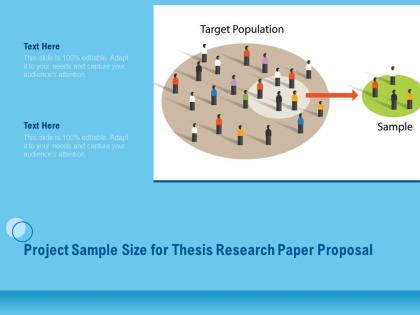
The image presents a PowerPoint slide titled "Project Sample Size for Thesis Research Paper Proposal." It illustrates the concept of selecting a sample from a target population for research purposes. The graphic shows a larger group of diverse figures, representing the target population, and a smaller group, representing the sample selected for the study. The arrow indicates the process of sampling.
The text placeholders marked "Text Here" suggest that specific details can be added, such as the criteria for selecting the sample or the number of participants. These elements are crucial for a research proposal as they define the scope and scale of the research methodology.
Use Cases:
Here are seven industries where this type of slide can be beneficial:
1. Academic Research:
Use: Explaining sampling methodology for academic studies.
Presenter: Research Student or Academician.
Audience: Thesis Committee, Academic Peers.
2. Market Research:
Use: Demonstrating how a market segment is chosen for research.
Presenter: Market Research Analyst.
Audience: Marketing Team, Business Stakeholders.
3. Public Health:
Use: Showcasing the selection process for a public health study sample.
Presenter: Public Health Researcher.
Audience: Health Policy Makers, Medical Community.
4. Social Sciences:
Use: Discussing participant selection for sociological or psychological studies.
Presenter: Social Scientist.
Audience: Academic Colleagues, Research Institutions.
5. Pharmaceuticals:
Use: Outlining patient selection for clinical trials.
Presenter: Clinical Research Coordinator.
Audience: Medical Professionals, Regulatory Bodies.
6. Education:
Use: Illustrating the sample selection for educational program effectiveness research.
Presenter: Education Specialist.
Audience: Educational Administrators, Policy Makers.
7. Government Policy Development:
Use: Describing the demographic sampling for policy impact research.
Presenter: Policy Analyst.
Audience: Government Officials, Public Sector Stakeholders.
Project sample size for thesis research paper proposal ppt outline with all 2 slides:
Use our Project Sample Size For Thesis Research Paper Proposal Ppt Outline to effectively help you save your valuable time. They are readymade to fit into any presentation structure.
FAQs for Project sample size for thesis research paper
Sample size determination for thesis research depends on research design, statistical power requirements, effect size expectations, population characteristics, and available resources including time and budget constraints. These considerations work together to balance methodological rigor with practical feasibility, with many researchers finding that pilot studies and power analyses help optimize sample sizes for meaningful results while maintaining academic standards.
Research design significantly influences sample size through study type, complexity, and statistical requirements, with experimental designs typically needing larger samples than descriptive studies. Quantitative research often requires hundreds of participants for statistical power, while qualitative studies may need only 15-30 participants, with mixed-methods approaches finding that strategic sample planning ultimately delivers more robust findings and stronger academic credibility.
Statistical methods for sample size calculation include power analysis, confidence interval approaches, effect size estimation, variance analysis, and population proportion formulas. These methods vary by research design, with experimental studies using power calculations for detecting treatment effects, survey research employing margin of error formulas, and qualitative studies using saturation principles, ultimately ensuring valid, reliable results while optimizing resource allocation.
Lower significance levels (like 0.01 versus 0.05) require larger sample sizes to maintain statistical power, as they demand stronger evidence to reject null hypotheses. This statistical relationship significantly impacts research planning and resource allocation, with many academic institutions and research organizations finding that balancing stringent significance requirements with practical sample size constraints ultimately delivers more robust findings while managing project feasibility and costs.
Population variability and expected effect size directly influence sample size requirements, with higher variability demanding larger samples while larger expected effects allow for smaller samples. Research across disciplines, from medical studies to social sciences, demonstrates that studies expecting subtle differences require substantially more participants to achieve statistical power, while those anticipating pronounced effects can maintain reliability with more modest sample sizes, ultimately enabling researchers to optimize resource allocation.
Power analysis determines the minimum sample size needed to detect meaningful effects in your research by calculating the probability of correctly identifying true relationships when they exist. It balances statistical requirements with practical constraints like time and resources, helping researchers avoid underpowered studies that waste effort or overpowered studies that waste resources, ultimately ensuring your thesis delivers reliable, defensible conclusions that contribute meaningful insights to your field.
Researchers can justify their chosen sample size through power analysis calculations, resource constraints assessment, population characteristics evaluation, and methodological requirements alignment. These justifications demonstrate statistical rigor by determining adequate sample sizes for detecting meaningful effects, while considering practical limitations like time and budget, ultimately ensuring their research delivers valid, reliable results that contribute meaningful insights to their field.
Yes, industry-specific guidelines exist across various fields, with medical research requiring larger samples for clinical trials, social sciences following APA recommendations, business research varying by market size, and engineering studies focusing on statistical power calculations. These guidelines help ensure methodological rigor and credibility within specific academic and professional communities, while acknowledging disciplinary standards ultimately enhances your proposal's acceptance and research validity.
Ethical considerations for research sample sizes include minimizing participant burden, ensuring adequate statistical power to avoid inconclusive results, obtaining proper informed consent, and balancing scientific validity with resource constraints. Researchers must consider vulnerable populations, data privacy protocols, and fair participant selection, while many institutions finding that smaller, well-designed studies often deliver meaningful insights without exposing unnecessary numbers of subjects to potential risks, ultimately protecting participant welfare while maintaining research integrity.
Qualitative research typically requires smaller, purposefully selected samples of 5-30 participants to achieve data saturation, while quantitative studies need larger, statistically representative samples of 100+ participants to ensure validity and generalizability. These differing approaches reflect their distinct methodologies, with qualitative designs focusing on depth and meaning through interviews and observations, while quantitative research emphasizes breadth and statistical power through surveys and experiments, ultimately delivering different but complementary insights for comprehensive academic research.
Researchers can employ stratified sampling, snowball sampling, multi-stage cluster sampling, online surveys, and partnerships with organizations to access broader populations despite initial limitations. These strategies enable researchers to expand their reach by leveraging existing networks, digital platforms, and institutional collaborations, while maintaining statistical validity through careful sampling design, ultimately delivering more robust findings and enhanced research credibility across diverse academic disciplines.
Pilot studies contribute to sample size determination by providing preliminary data on effect sizes, variance estimates, response rates, and feasibility constraints that inform power calculations for main studies. Through these smaller-scale investigations, researchers can refine their methodologies, identify potential dropout rates, and assess practical considerations like recruitment challenges, ultimately enabling more accurate sample size calculations that balance statistical power with resource limitations and timeline constraints.
When estimating sample size, researchers must account for sampling error, measurement error, non-response bias, selection bias, and coverage error. These sources can significantly impact data quality and statistical power, with many academic institutions finding that systematic consideration of these factors during the planning phase ultimately delivers more reliable results and stronger thesis conclusions.
Control groups significantly increase sample size requirements by necessitating separate participant allocation for experimental and control conditions, typically doubling the base sample needed for statistical power. This strategic combination enhances research validity and enables robust comparisons, with many academic institutions and research organizations finding that larger, well-controlled studies ultimately deliver more credible findings and stronger publication outcomes.
**INPUT**: What resources or tools are available for researchers to assist in calculating sample size effectively? **OUTPUT**: Sample size calculation resources include statistical software like G*Power, R, and SPSS, online calculators, research methodology textbooks, and professional consultation services. These tools streamline the complex statistical requirements by automating power analysis, effect size calculations, and confidence interval determinations, with many academic institutions and research organizations finding that combining multiple resources ultimately delivers more robust and defensible sample size justifications for thesis proposals. [Word count: 60]
-
It saves your time and decrease your efforts in half.
-
Good research work and creative work done on every template.