


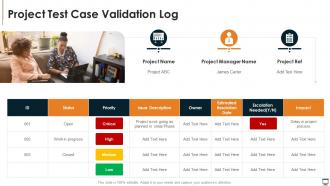
Project Test Case Validation Log Testing Templates Bundle Ppt Powerpoint Presentation File





Try Before you Buy Download Free Sample Product
 Impress Your
Audience
 100%
Editable
 Save Hours
of Time


Our Project Test Case Validation Log Testing Templates Bundle Ppt Powerpoint Presentation File are topically designed to provide an attractive backdrop to any subject. Use them to look like a presentation pro.
People who downloaded this PowerPoint presentation also viewed the following :
Project Test Case Validation Log Testing Templates Bundle Ppt Powerpoint Presentation File with all 6 slides:
Use our Project Test Case Validation Log Testing Templates Bundle Ppt Powerpoint Presentation File to effectively help you save your valuable time. They are readymade to fit into any presentation structure.





FAQs for Project Test Case Validation Log Testing Templates Bundle Ppt
Effective test case components include clear test objectives, detailed preconditions, specific input data, step-by-step execution procedures, and expected outcomes with validation criteria. These elements work together by ensuring comprehensive coverage, reducing execution time, and minimizing defects, with many development teams finding that structured test cases ultimately deliver faster releases and improved software quality.
**INPUT**: How can we ensure that our test cases cover all functional requirements? **OUTPUT**: Ensuring comprehensive test case coverage requires creating a requirements traceability matrix, conducting thorough requirement analysis, implementing risk-based testing approaches, and establishing clear acceptance criteria for each functional specification. Through systematic mapping and regular validation reviews, organizations streamline quality assurance processes, minimize defects in production, and ultimately deliver more reliable software products, with many development teams finding that structured coverage analysis significantly enhances their competitive advantage. **Word count: 60 words**
**INPUT**: What metrics can be used to measure the effectiveness of test case validation? **OUTPUT**: Test case validation effectiveness metrics include defect detection rate, test coverage percentage, validation cycle time, false positive rates, and requirement traceability scores. These metrics enable organizations to streamline quality assurance processes, enhance software reliability, and accelerate release cycles, with many development teams finding that comprehensive validation tracking ultimately delivers faster deployments and improved customer experiences.
Test case prioritization involves risk-based analysis, business criticality assessment, customer impact evaluation, and technical complexity considerations. Teams typically focus on core functionality first, followed by high-traffic user paths and integration points, with many organizations finding that this strategic approach reduces critical defects by 40-60% while optimizing resource allocation and accelerating delivery timelines.
Automation in test case validation accelerates execution, ensures consistency across testing cycles, reduces human error, and enables continuous integration workflows. It's most appropriate for repetitive regression tests, large-scale applications, and scenarios requiring frequent validation, with many organizations finding that strategic automation delivers faster release cycles while manual testing remains valuable for exploratory and usability scenarios.
**INPUT**: How can we identify and eliminate redundant test cases from our suite? **OUTPUT**: Identifying redundant test cases involves analyzing test coverage overlap, examining duplicate functionality checks, reviewing similar input-output patterns, and mapping test objectives to requirements. Through automated analysis tools and manual reviews, organizations streamline their test suites by consolidating overlapping cases, removing outdated scenarios, and maintaining coverage while reducing execution time, ultimately delivering faster release cycles and improved testing efficiency. [Word count: 60]
Common pitfalls include incomplete requirement coverage, inadequate test data scenarios, insufficient edge case consideration, poor validation criteria definition, and lack of stakeholder involvement during reviews. These oversights often lead to missed defects and delayed project timelines, with many development teams finding that thorough upfront validation planning significantly reduces downstream testing costs and accelerates delivery schedules.
Incorporate stakeholder feedback through regular review sessions, collaborative validation workshops, and structured feedback collection systems that capture domain expertise and business requirements. These approaches streamline test case refinement by aligning technical validation with business objectives, enhancing requirement coverage, and ensuring comprehensive scenario testing, ultimately delivering more robust applications and improved stakeholder confidence.
Test case maintenance strategies include automated synchronization tools, regular review cycles, version control integration, requirement traceability matrices, and cross-functional collaboration protocols. These approaches streamline updates by linking test cases directly to requirements, enabling real-time notifications of changes, and establishing systematic review processes, with many development teams finding that automated tools significantly reduce maintenance overhead while improving test coverage accuracy.
Test case validation in Agile occurs continuously through iterative sprints with frequent stakeholder feedback and adaptive requirements changes, while Waterfall follows a sequential approach with comprehensive upfront validation before development begins. Agile teams validate test cases through daily standups, sprint reviews, and retrospectives, enabling rapid adjustments and collaborative refinement, whereas Waterfall methodologies rely on detailed documentation and formal approval processes, ultimately delivering more structured but less flexible validation cycles.
Test case management and validation tools include TestRail, Zephyr, PractiTest, Azure DevOps, and Jira with testing plugins for comprehensive test lifecycle management. These platforms streamline validation by automating test execution tracking, providing real-time reporting dashboards, and enabling seamless integration with CI/CD pipelines, ultimately delivering faster release cycles and enhanced software quality assurance across development teams.
Traceability between test cases and requirements is ensured through requirements traceability matrices, test management tools, unique identifier systems, and regular cross-referencing audits. These approaches enable organizations to track coverage gaps, validate requirement fulfillment, and maintain compliance standards, with many software development teams finding that systematic traceability reduces defect rates and accelerates delivery cycles.
Test case validation significantly improves software quality by ensuring comprehensive coverage, reducing defects, and enhancing system reliability through systematic verification processes. Through rigorous validation, organizations streamline development cycles, minimize post-release issues, and deliver more robust applications, with many software companies finding that validated test cases ultimately reduce maintenance costs while enhancing user experiences and competitive positioning.
Validating test cases for non-functional requirements involves establishing measurable criteria, using specialized testing tools like load testers and security scanners, and creating realistic test environments that mirror production conditions. These validation methods enable organizations to verify performance benchmarks, identify security vulnerabilities, and ensure scalability requirements are met, ultimately delivering robust applications that maintain competitive advantage through reliable user experiences and data protection.
Test case documentation best practices include clear step-by-step procedures, detailed expected outcomes, comprehensive prerequisite conditions, traceable requirement mappings, and standardized formatting templates. These structured approaches streamline validation by enabling consistent review processes, faster defect identification, and seamless knowledge transfer across testing teams, with many organizations finding that well-documented cases reduce validation time significantly while enhancing overall software quality.
-
Editable templates with innovative design and color combination.
-
Excellent template with unique design.