

Project Timeline For Job Safety Analysis




Try Before you Buy Download Free Sample Product
 Impress Your
Audience
 100%
Editable
 Save Hours
of Time


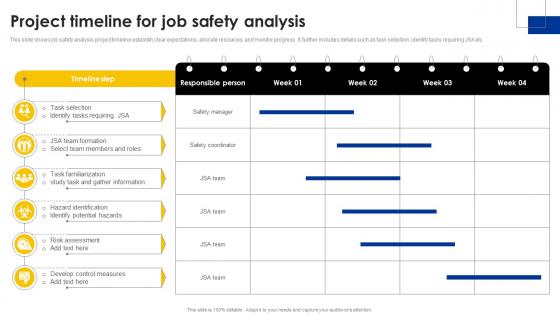
This slide shows job safety analysis project timeline establish clear expectations, allocate resources, and monitor progress . It further includes details such as task selection ,identify tasks requiring JSA etc.
People who downloaded this PowerPoint presentation also viewed the following :
Project Timeline For Job Safety Analysis with all 9 slides:
Use our Project Timeline For Job Safety Analysis to effectively help you save your valuable time. They are readymade to fit into any presentation structure.








FAQs for Project Timeline For
The key components of a Job Safety Analysis include job step identification, hazard assessment, risk evaluation, control measures, and employee training requirements. These elements work together by systematically breaking down tasks, identifying potential dangers, and implementing preventive measures, with many manufacturing and construction companies finding that comprehensive JSAs significantly reduce workplace incidents and enhance operational safety compliance.
Businesses can effectively implement JSA timelines by establishing clear phases including hazard identification, risk assessment, control measures development, and regular review schedules. Through systematic integration with existing safety protocols, organizations streamline compliance tracking, enhance worker protection, and reduce incident rates, with many manufacturing and construction companies finding that structured JSA timelines ultimately deliver improved operational efficiency and regulatory adherence.
A comprehensive Job Safety Analysis typically takes 2-4 hours per job task, depending on complexity, with simple tasks requiring 1-2 hours and complex industrial processes needing 4-6 hours. Organizations in manufacturing, construction, and healthcare often find that investing this time upfront significantly reduces workplace incidents, streamlines safety compliance, and ultimately delivers faster project completion with enhanced worker protection.
JSAs should be reviewed annually at minimum, with immediate updates required after incidents, equipment changes, regulatory updates, or process modifications. Many organizations implement quarterly reviews for high-risk activities, finding that regular assessment cycles enhance workplace safety protocols, reduce accident rates, and ensure compliance with evolving industry standards, ultimately delivering sustained operational safety and regulatory adherence.
Employees play crucial roles in JSA development by identifying workplace hazards, sharing firsthand knowledge of job procedures, and contributing insights from daily task experience. Their participation ensures comprehensive hazard identification, enhances safety measure effectiveness, and promotes ownership of safety protocols, ultimately delivering more accurate risk assessments and stronger safety compliance across organizations.
Industries with high-risk operations, including construction, manufacturing, oil and gas, mining, and healthcare, benefit most from structured JSA timelines. These sectors leverage systematic risk assessment schedules to reduce workplace incidents, ensure regulatory compliance, and streamline safety protocols, with many organizations finding that consistent JSA implementation delivers enhanced worker protection and operational efficiency.
Technology enhances Job Safety Analysis effectiveness by enabling real-time hazard detection, automated risk assessments, and digital documentation systems. Through mobile apps, wearable sensors, and AI-powered analytics, organizations streamline safety protocols, reduce human error, and accelerate incident reporting, with manufacturing and construction companies finding that these digital tools ultimately deliver faster compliance and improved worker protection.
**INPUT**: What are common challenges faced when creating a JSA timeline? **OUTPUT**: Common JSA timeline challenges include inadequate hazard identification, insufficient worker input, unrealistic time estimates, poor task sequencing, and incomplete risk assessment documentation. These obstacles can be overcome through comprehensive site assessments, cross-functional team collaboration, and phased implementation approaches, with many manufacturing and construction organizations finding that structured planning processes ultimately deliver enhanced safety compliance and reduced incident rates. [Word count: 58 words]
Management should communicate JSA importance through regular safety meetings, hands-on training sessions, visual workplace reminders, and clear policy documentation that emphasizes personal protection and operational efficiency. By demonstrating how JSAs prevent workplace incidents, reduce insurance costs, and create safer working environments, organizations across manufacturing, construction, and industrial sectors find that employees increasingly embrace these protocols, ultimately delivering enhanced safety culture and reduced liability risks.
JSA training should include hazard identification techniques, risk assessment methodologies, control measure development, and documentation standards, along with industry-specific safety regulations and communication skills. Through comprehensive programs covering observation techniques, incident analysis, and collaborative problem-solving, organizations enhance workplace safety, reduce accidents, and ensure regulatory compliance, with many finding that well-trained JSA teams deliver significantly improved safety outcomes.
Yes, a JSA timeline significantly reduces workplace accidents by establishing systematic hazard identification schedules, mandatory safety reviews before high-risk tasks, and regular equipment inspections throughout project phases. Through structured timing protocols, organizations streamline safety compliance, enhance worker preparedness, and minimize incident rates, with many construction and manufacturing companies finding that timeline-driven safety approaches deliver measurable accident reduction and improved operational efficiency.
Companies measure Job Safety Analysis effectiveness by tracking incident rates, near-miss reports, employee compliance metrics, safety audit scores, and training completion rates over specific periods. Through comparative analysis, organizations identify trends, assess risk reduction progress, and adjust safety protocols accordingly, with many finding that regular measurement cycles enhance workplace safety outcomes and regulatory compliance while reducing operational costs.
JSAs serve as essential documentation demonstrating adherence to OSHA standards, industry regulations, and safety compliance requirements by systematically identifying and mitigating workplace hazards. Through comprehensive risk assessments and documented safety procedures, organizations streamline regulatory audits, reduce liability exposure, and enhance worker protection protocols, with many manufacturing and construction companies finding that well-executed JSAs significantly accelerate compliance verification processes.
Organizations can tailor JSA processes by adjusting frequency based on risk levels, customizing documentation formats for specific industries, integrating with existing safety management systems, and adapting step granularity to operational complexity. Manufacturing facilities, construction sites, and healthcare institutions increasingly modify JSA templates, approval workflows, and review cycles to match their operational pace, regulatory requirements, and workforce capabilities, ultimately enhancing safety compliance while streamlining implementation.
Post-JSA metrics include incident rates, near-miss reports, employee safety compliance scores, training completion rates, and hazard identification frequency. These measurements enable organizations to track operational improvements by monitoring accident reduction, enhanced safety behaviors, and proactive risk identification, with many manufacturing and construction companies finding that consistent tracking delivers measurable safety improvements and regulatory compliance.
-
The best collection of PPT templates!! Totally worth the money.
-
Delighted to see unique and eye-catching PowerPoint designs that are so easy to customize.