

Prominent B2B Customer Journey Pain Points





Try Before you Buy Download Free Sample Product
 Impress Your
Audience
 100%
Editable
 Save Hours
of Time


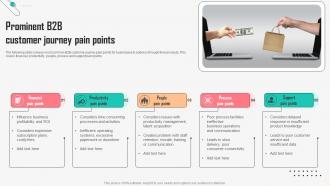
The following slide conveys most common B2B customer journey pain points for businesses to address through their products. This covers financial, productivity, people, process and support pain points.
People who downloaded this PowerPoint presentation also viewed the following :
Prominent B2B Customer Journey Pain Points with all 6 slides:
Use our Prominent B2B Customer Journey Pain Points to effectively help you save your valuable time. They are readymade to fit into any presentation structure.





FAQs for Prominent B2B Customer
The key stages in the B2B customer journey that often lead to pain points include awareness and research complexity, lengthy evaluation processes, procurement bottlenecks, implementation challenges, and ongoing support gaps. These stages create friction through information overload during research, extended decision-making cycles involving multiple stakeholders, and integration difficulties, with many organizations finding that streamlined communication and clear documentation significantly reduce customer frustration while accelerating deal closure.
Communication gaps between sales and marketing teams create inconsistent messaging, misaligned lead qualification, and fragmented customer experiences throughout the buyer journey. These disconnects result in prospects receiving conflicting information, delayed follow-ups, and poor handoff experiences, ultimately leading to reduced conversion rates, longer sales cycles, and damaged brand credibility in competitive B2B markets.
Customer onboarding plays a pivotal role in alleviating B2B pain points by establishing clear expectations, streamlining initial processes, and reducing time-to-value through structured guidance and support systems. Effective onboarding programs enable organizations to minimize confusion, accelerate product adoption, and build stronger client relationships, with many companies finding that comprehensive onboarding reduces churn while enhancing customer satisfaction and long-term retention.
Technology can streamline B2B customer journeys through CRM automation, AI-powered personalization, integrated communication platforms, predictive analytics, and self-service portals. These solutions enhance efficiency by eliminating manual touchpoints, providing real-time insights, and enabling seamless handoffs between sales and support teams, with many organizations finding that automated workflows reduce response times while delivering more consistent, personalized customer experiences.
Common objections during B2B decision-making include budget constraints, implementation complexity concerns, ROI uncertainty, vendor reliability questions, and internal resistance to change. These challenges often arise when stakeholders evaluate competing priorities and risk factors, with many organizations finding that addressing these concerns through detailed cost-benefit analysis, pilot programs, and comprehensive vendor demonstrations ultimately accelerates approval processes and builds stakeholder confidence.
Long sales cycles contribute to customer frustration by creating uncertainty, delaying decision-making processes, and consuming valuable resources through extended evaluation periods. These prolonged timelines often lead prospects to seek faster alternatives, with many B2B buyers finding that streamlined competitors deliver quicker responses, clearer timelines, and more efficient purchasing experiences, ultimately gaining competitive advantage.
Businesses can implement personalized email sequences, multi-channel touchpoints, behavioral trigger campaigns, content mapping to buyer stages, and automated follow-up systems to enhance lead nurturing. These strategies streamline engagement by delivering relevant content, maintaining consistent communication, and addressing specific prospect needs, with many organizations finding that targeted nurturing reduces drop-offs by 40% while accelerating conversion timelines.
Feedback loops can be established through customer surveys, regular check-ins, support ticket analysis, user behavior tracking, and cross-departmental collaboration between sales and service teams. These mechanisms enable organizations to identify friction points, measure satisfaction trends, and adapt strategies accordingly, with many B2B companies finding that systematic feedback collection ultimately delivers improved customer experiences and stronger retention rates.
Personalization significantly enhances the B2B customer journey by delivering targeted content, streamlining decision-making processes, and reducing sales cycles through relevant touchpoints. Through AI-driven insights and behavioral analytics, organizations across manufacturing, financial services, and healthcare accelerate buyer engagement, improve conversion rates, and ultimately deliver superior customer experiences while gaining competitive advantage in increasingly complex B2B markets.
Differing buyer personas within B2B create complex customer experiences by introducing varied priorities, decision-making timelines, and communication preferences across stakeholders like technical evaluators, financial gatekeepers, and end users. These diverse perspectives can fragment the journey, requiring businesses to deliver personalized content and touchpoints that address each persona's specific concerns while maintaining cohesive messaging that ultimately drives consensus.
Businesses should track metrics including customer satisfaction scores, conversion rates at each journey stage, time-to-resolution for support tickets, churn rates, and Net Promoter Score. These measurements enable organizations to pinpoint friction areas, optimize touchpoints, and enhance customer experiences, with many companies finding that systematic tracking reduces customer acquisition costs while improving retention rates.
Aligning customer support with the sales process enhances the journey by creating seamless handoffs, maintaining consistent messaging, and providing comprehensive prospect assistance throughout decision-making stages. This strategic integration enables faster issue resolution, reduces friction during evaluations, and builds trust through coordinated touchpoints, with many B2B organizations finding that unified teams deliver higher conversion rates and improved customer experiences.
Outdated marketing content creates disconnects between customer expectations and actual experiences, leading to confusion, reduced trust, and longer sales cycles. With many B2B buyers conducting independent research before engaging sales teams, inconsistent or stale content undermines credibility, ultimately resulting in lost opportunities and damaged brand perception in competitive markets.
Case studies and testimonials reduce customer uncertainty by providing social proof, demonstrating real-world results, addressing specific pain points, and showcasing measurable outcomes from similar organizations. Through detailed success stories, B2B prospects can visualize implementation processes, understand ROI potential, and gain confidence in purchasing decisions, with many finding that peer validation significantly accelerates their buying journey and reduces perceived risk.
Continuous education and training minimize client pain points by reducing onboarding confusion, accelerating feature adoption, and preventing user errors that lead to frustration. Through comprehensive training programs, organizations enable faster time-to-value, improved customer satisfaction, and reduced support ticket volumes, with many B2B companies finding that well-educated clients achieve significantly higher product utilization and retention rates.
-
Great product with effective design. Helped a lot in our corporate presentations. Easy to edit and stunning visuals.
-
I joined SlideTeam last month and there’s no doubt that I tend to find our bond only strengthening over time. Best place to find world-class themes, templates, and icons.