

Promotional Tactics To Boost Startup Sales Powerpoint Presentation Slides Strategy CD V





Try Before you Buy Download Free Sample Product
 Impress Your
Audience
 100%
Editable
 Save Hours
of Time


Every marketer needs a set of both digital and traditional strategies to promote their startup. A marketing plan is an advertising strategy used by startups to sell their products or services to a target audience. Check out our professionally designed Promotional Tactics to Boost Startup Sales template. Through it, businesses can increase brand awareness, boost web traffic, improve customer retention rate, and enhance sales. Our startup marketing agency deck initially shows an overview section covering vital components such as trends, statistics, challenges, and solutions. It then highlights the target market analysis section startups can successfully develop marketing communication strategies. Afterwards, our digital marketing for startups PPT caters to digital marketing, like influencer marketing, social media marketing, email marketing and search engine optimization SEO, etc. Following that, through the cost effective traditional marketing strategies section, new businesses can contact local communities and target specific customers. Lastly, through key performance indicators KPIs and analytics dashboards, startups can measure the impact of marketing strategies on business performance. Download our 100 percentage editable and customizable template, which is also compatible with Google Slides.
People who downloaded this PowerPoint presentation also viewed the following :
Content of this Powerpoint Presentation
Slide 1: This slide introduces Promotional Tactics to Boost Startup Sales. Commence by stating Your Company Name.
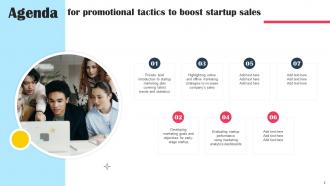
Slide 2: This slide depicts the Agenda of the presentation.
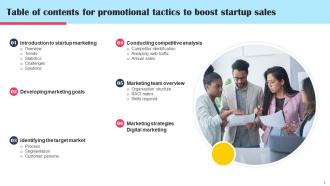
Slide 3: This slide includes the Table of contents.
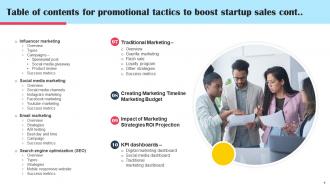
Slide 4: This is yet another slide continuing the Table of contents.
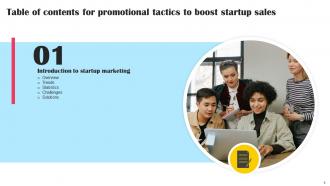
Slide 5: This slide highlights the Title for the Topics to be discussed further.
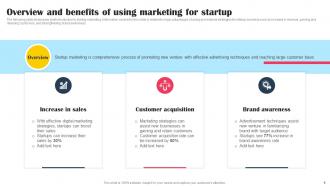
Slide 6: This slide portrays the Overview and benefits of using marketing for startup.
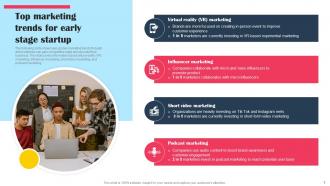
Slide 7: This slide showcases global marketing trends through which startups can gain competitive edge and upscale their business.
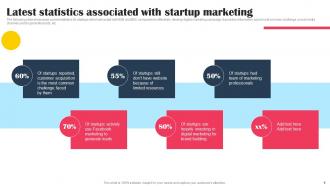
Slide 8: This slide displays the Latest statistics associated with startup marketing.
Slide 9: The following slide showcases various advertisement challenges faced by new ventures.
Slide 10: This slide reveals the multiple solutions to address different issues faced by early-stage startups.
Slide 11: This slide includes the Heading for the Contents to be covered in the forthcoming template.
Slide 12: This slide deals with Developing marketing objectives for early stage startup.
Slide 13: This slide contains the Title for the Ideas to be discussed in the upcoming template.
Slide 14: The following slide showcases five-step process to successfully create target market for early-stage startups.
Slide 15: This slide states the target market segmentation based on multiple factors.
Slide 16: This slide displays the Semi fictional representation of customer persona for startups.
Slide 17: This slide depicts the Heading for the Ideas to be covered in the following template.
Slide 18: The following slide showcases the most successful market leader in XYZ industry.
Slide 19: This slide focuses on Analyzing market leader website to understand web traffic.
Slide 20: The following slide showcases graphical representation of market leader yearly sales.
Slide 21: This slide reveals the Title for the Contents to be further discussed.
Slide 22: The following slide highlights the divisional structure of early-stage startup marketing team.
Slide 23: This slide showcases responsible, accountable, consulted, and informed (RACI) framework outlining major roles and responsibilities of marketing ream.
Slide 24: This slide displays the showcases soft and technical skills that are required by marketing team to successfully achieve business objectives.
Slide 25: This slide states the Heading for the Topics to be covered in the next template.
Slide 26: This slide portrays the Overview and key benefits of using influencer marketing.
Slide 27: The following slide showcases comparative analysis of various digital influencers such as nano, micro, macro, and mega.
Slide 28: This slide presents the Introduction to various influencer marketing campaigns.
Slide 29: The following slide showcases sponsored post-campaign through which marketers can increase customer engagement rate and boost conversions.
Slide 30: This slide covers social media giveaway campaign through which startups can build strong following on social media platforms.
Slide 31: This slide outlines the product review campaign that can assist new ventures to boost customer trust and strengthen brand credibility.
Slide 32: This slide shows the Success metrics to measure influencer marketing campaign performance.
Slide 33: This slide displays the Title for the Topics to be discussed in the following template.
Slide 34: This slide highlights the Overview and key benefits of using social media marketing.
Slide 35: This slide deals with Selecting the most popular social media channels for startups.
Slide 36: The following slide showcases social media marketing strategy through which startups can increase brand following.
Slide 37: This slide talks about the Facebook marketing strategy to drive web traffic.
Slide 38: The following slide states YouTube marketing techniques that can assist new firms in improving their digital presence.
Slide 39: This slide highlights the Success metrics to measure social media marketing strategies performance.
Slide 40: This slide exhibits the Heading for the Contents to be covered next.
Slide 41: The following slide showcases brief introduction to email marketing covering its most important statistics for startups.
Slide 42: This slide displays the Email marketing strategies for higher open rate.
Slide 43: This slide talks about A/B testing strategy to effectively run email marketing campaign.
Slide 44: The following slide showcases ideal day and time to successfully run email marketing campaign to generate higher return on investment (ROI).
Slide 45: This slide reveals the Email marketing campaign to maximize leads.
Slide 46: This slide exhibits the Success metrics to measure email marketing campaign performance.
Slide 47: This slide highlights the Title for the Ideas to be discussed in the upcoming template.
Slide 48: This slide portrays the Overview and key benefits of using search engine optimization.
Slide 49: This slide states the Major types of search engine optimization.
Slide 50: This slide depicts the SEO strategies for startups to boost web traffic.
Slide 51: This slide presents the Strategies to make company website mobile responsive.
Slide 52: This slide displays the Success metrics to measure SEO marketing strategies performance.
Slide 53: This slide incorporates the Heading for the Ideas to be covered next.
Slide 54: This slide shows the Overview and key benefits of using traditional marketing strategies.
Slide 55: This slide talks about the Guerilla marketing campaign for startup growth.
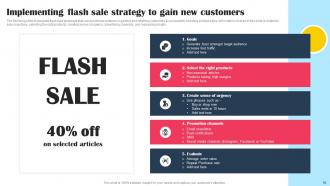
Slide 56: This slide deals with Implementing flash sale strategy to gain new customers.
Slide 57: This slide depicts the Loyalty program to improve customer engagement.
Slide 58: This slide states the Other offline marketing techniques for startups to boost sales.
Slide 59: This slide exhibits the Success metrics to measure offline marketing strategies performance.
Slide 60: This slide includes the Title for the Contents to be discussed in the following template.
Slide 61: The following slide showcases monthly roadmap to successfully develop online and offline marketing strategies for new businesses.
Slide 62: This slide focuses on Developing marketing budget for early-stage startup.
Slide 63: This slide exhibits the Heading for the Topics to be covered in the following template.
Slide 64: This slide highlights the Impact of marketing strategies on startup performance.
Slide 65: The following slide showcases return on investment (ROI) of new established business for five years.
Slide 66: This slide indicates the Title for the Topics to be discussed next.
Slide 67: This slide shows the Digital marketing dashboard with customer acquisition cost.
Slide 68: This slide displays the Marketing analytics dashboard to evaluate social media campaign performance.
Slide 69: This slide exhibits the impact of offline marketing strategies on store performance.
Slide 70: This is the Icons slide containing all the Icons used in the plan.
Slide 71: This slide is used for depicting some Additional information.
Slide 72: This slide elucidates information related to the Financial topic.
Slide 73: This is the Quote slide for motivation.
Slide 74: This is the Idea generation slide for encouraging fresh ideas.
Slide 75: This is the 30,60,90 days plan slide for effective planning.
Slide 76: This is the Magnifying glass for minute details.
Slide 77: This slide represents the organization's Roadmap.
Slide 78: This is the Venn diagram slide.
Slide 79: This slide portrays the firm's mission, Vision, and Goal.
Slide 80: This is the Thank You slide for acknowledgement.
Promotional Tactics To Boost Startup Sales Powerpoint Presentation Slides Strategy CD V with all 87 slides:
Use our Promotional Tactics To Boost Startup Sales Powerpoint Presentation Slides Strategy CD V to effectively help you save your valuable time. They are readymade to fit into any presentation structure.
















FAQs for Promotional Tactics To Boost Startup Sales Powerpoint Presentation Slides
Honestly, SEO and social proof are your best bets here. Go after specific stuff like "modern pitch deck template" instead of just "templates" - way easier to rank for. Getting users to post their finished presentations with your hashtag is gold, though it takes time to build up. Most people totally sleep on email marketing to existing users, which is crazy because those people already trust you. Oh, and definitely check where you're actually ranking right now first. That'll show you the low-hanging fruit you can grab quickly. Short sentences work better than I used to think they would.
Instagram and Pinterest are no-brainers since your templates are so visual - just post your best designs. TikTok's great for those quick before/after videos or design tips that people love. Don't sleep on LinkedIn either, especially for business templates. Honestly, professionals eat that stuff up for presentations. Try carousel posts with template previews and sprinkle in some design advice to show you know your stuff. Always link back to your site though - that part's crucial. The whole thing works better when you just let the templates speak for themselves through killer visuals rather than explaining everything.
Email marketing works really well for template promotion, honestly. I'd segment by industry first - like sending finance templates to accountants, that kind of thing. Visuals are your friend here since you can drop preview images right in the email. People eat that stuff up. Build your list with free templates as bait (works every time), then nurture them with design tips and new releases. Oh, and limited-time offers create urgency. The whole lead nurturing thing happens naturally when you're consistently sharing useful content. Start small but stay consistent with it.
Honestly, working with influencers is probably one of the smartest moves you can make for template promotion. When they actually use your designs in their own content, it feels way more genuine than regular ads. I'd start with micro-influencers in your space - like business coaches if you're selling professional templates. Their followers trust them, so when they show off a before/after using your template, people pay attention. Plus micro-influencers won't cost you a fortune like the big names do. The engagement rates are usually better too, which is weird but true.
You gotta do before/after shots - seriously, just put a boring slide next to your nice template and people instantly understand. Those quick video demos work amazing too, like 30 seconds showing how simple the customization is. Case studies with real numbers hit different though - "cut presentation prep by 75%" sounds way more convincing than just saying it's faster. Screenshots from actual presentations beat those fake mockups every day. Honestly, most people care more about saving time than having pretty slides. Focus on the transformation aspect and test different approaches to see what clicks with your crowd.
Testimonials are honestly your best friend for selling templates. Real customers saying your stuff saved them hours or helped land a big client? That's gold. I'd scatter them everywhere - sales pages, emails, social posts. People trust other buyers way more than they'll ever trust you (harsh but true). The trick is matching testimonials to who you're targeting. Selling to consultants? Show quotes from other consultants raving about client reactions. Oh, and start collecting these now - just reach out to customers you know are happy. You'll wish you'd started sooner.
Conversion rates are your main focus - shows how many people actually buy or download after seeing your stuff. Click-through rates matter too since they tell you if your messaging works. Revenue per campaign and customer acquisition cost give you the money picture. Oh, and don't sleep on engagement stuff like social shares and email opens - honestly those can be pretty telling about whether people actually care about what you're putting out there. But yeah, start with conversions since that's what pays the bills. The other metrics are nice but conversions are everything.
Dude, seasonal promos are honestly a game changer - I've seen 40-60% sales jumps during peak times. Back-to-school season is huge, plus Q4 when everyone's scrambling to plan for next year. New Year works too since people love fresh starts. Here's the thing though - timing matters way more than you'd think. Don't wait until everyone's already busy. Run your back-to-school stuff in late July, Q4 planning sales in early September. Black Friday's kinda oversaturated now but still worth it. The sweet spot is catching people right when they're starting to think about projects, not when they're drowning in them.
Honestly, I'd hit up Etsy and Creative Market first - they're perfect for presentation templates. Gumroad's pretty sweet too because the fees are way lower and you actually own your customer list. If your stuff has any educational vibe, Teachers Pay Teachers is clutch. Amazon? Skip it for now, you'll just disappear into the void with everyone else. Pinterest is killer for free traffic though, so definitely use that to funnel people wherever you're selling. Oh, and don't go crazy trying to be everywhere at once - pick like 2-3 platforms and actually do them right.
Here's what I'd do - start with 3-4 solid base templates, then create slide libraries for different industries you can swap in. Tech companies love sleek designs packed with data, but retail clients want product visuals everywhere. Healthcare's totally different though - they need that trustworthy vibe and all the compliance stuff. Entertainment? Way more flashy and fun. Color schemes matter too - what works for finance definitely won't fly for a startup pitch. I usually break my templates into modular sections so I can mix and match based on who I'm presenting to. It's honestly saved me tons of time once I got the system down.
So SEO is basically how people find your templates without you having to pay for ads. Research what keywords your audience actually types in - stuff like "business pitch deck template" or "modern PowerPoint design." Then work those into your titles, descriptions, and tags naturally. Don't just spam keywords everywhere though, Google hates that now. I'd also write some blog posts about presentation tips or design trends - it helps with ranking. Oh, and make sure your URLs and meta descriptions are clean too. Honestly, it's more about being genuinely helpful than gaming the system these days.
Yeah, free trials are gold for template sales - people really need to see the quality first. Give them a few from each category or do watermarked versions. Once someone uses a solid template and gets compliments on their presentation, they're basically sold. Just don't cheap out and give away your worst stuff (I've seen people do this, it's so dumb). Use your best work for samples. Set up an email capture when they download, then hit them with targeted offers based on what they grabbed. Works like a charm.
Honestly, just email department heads directly - they're the ones making these decisions anyway. August and January are money months when budgets reset. LinkedIn's actually clutch for finding educators, way more than people think. Don't pitch features though, talk about how it saves them prep time and gets students engaged. Budget's always an issue so definitely offer educator discounts or free trials. I'd probably start with like 2-3 departments and really personalize each message. Oh and email templates showing education examples work really well too.
Get your customers to post their actual presentations on social media! Make a branded hashtag and throw in some incentives - honestly, people eat that stuff up when they get to show off their work. Then take the best ones and use them in your marketing or as testimonials on your site. It's way more convincing than anything you'd make yourself. Oh, and definitely start with customers you already have - just ask if they're cool with sharing what they created. Social proof like this is gold because it feels real.
Honestly, discounts and bundles are a total game-changer for template sales. People can't resist feeling like they're scoring a deal - it's just human nature. When you bundle stuff together, customers see way more value and you're making more per sale too. I'd say start with maybe 20-30% off when someone buys 3+ templates. The urgency factor alone will push those fence-sitters to actually buy. Plus your conversion rates should jump pretty noticeably compared to selling individual templates. Worth tracking the numbers though - I'm curious how much of a difference you'll see!
-
Wide collection of templates available. SlideTeam has made it easier to create presentations in just a few minutes.
-
Use of different colors is good. It's simple and attractive.