


Puppet Solution For Configuration Management Powerpoint Presentation Slides




Try Before you Buy Download Free Sample Product
 Impress Your
 Audience
 100%
100% Editable
 Save Hours
 of Time


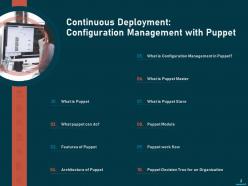
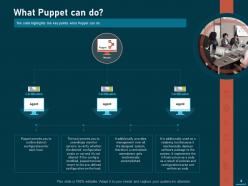
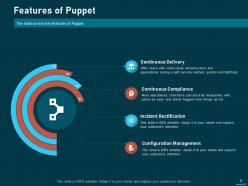
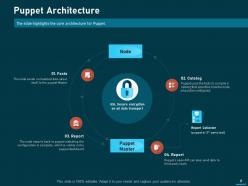
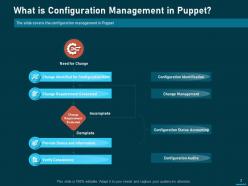
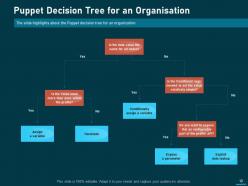
Give a brief description of puppet management with the help of Puppet Solution For Configuration Management PowerPoint Presentation Slides. Highlight the key points on usages of puppets with the use of readily available PowerPoint themes. Discuss the key features of a tool such as continuous delivery, compliance, incident rectification, and configuration management by utilizing this slide design. Take the assistance of a content-ready software configuration management PPT slideshow to demonstrate the core architecture of puppet. Cover the configuration management of puppets with the help of system configuration PPT presentation. Provide a brief introduction of puppet master using this model-driven solution PPT slide design. Describe the working of the puppet by employing this content-ready PowerPoint slide deck. You can also highlight the workflow of means with the help of ready-to-use PPT themes. The presentation also demonstrates the puppet decision tree for an organization. Create an impressive and meaningful display by downloading this ready-to-use PPT slide design.
People who downloaded this PowerPoint presentation also viewed the following :
Puppet Solution For Configuration Management Powerpoint Presentation Slides with all 26 slides:
Use our Puppet Solution For Configuration Management Powerpoint Presentation Slides to effectively help you save your valuable time. They are readymade to fit into any presentation structure.




FAQs for Puppet Solution For Configuration Management
Puppet is an automation platform that manages infrastructure configuration through declarative code, ensuring systems maintain desired states across environments. Unlike imperative tools like Ansible that define step-by-step procedures, Puppet uses a model-driven approach with agent-based architecture, enabling organizations to achieve greater consistency and compliance at scale, while tools like Chef require more procedural programming knowledge for implementation.
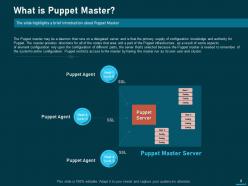
Puppet architecture includes the Puppet Master server, Puppet agents, catalogs, manifests, modules, and Facter for system discovery. These components work together by centralizing configuration management, automating deployments across servers, and ensuring consistency, with many enterprises finding that this architecture streamlines IT operations while reducing manual errors and operational overhead.
Puppet manifests work as declarative code files that define desired system states through resources, classes, and modules, specifying configurations like packages, services, and file permissions. These manifests enable IT teams to automate infrastructure management across servers, networks, and applications, ultimately delivering consistent deployments, reduced manual errors, and streamlined operations for scalable enterprise environments.
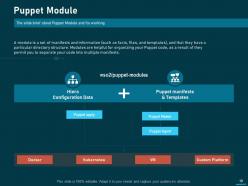
Puppet modules are self-contained packages that organize configuration code, manifests, templates, and files into reusable components for specific services or applications. They enhance reusability by enabling administrators to share standardized configurations across multiple environments, streamline deployment processes, and maintain consistent infrastructure management, with many organizations finding that modular approaches significantly reduce configuration errors while accelerating system provisioning.
Puppet facilitates infrastructure as code by enabling declarative configuration management through code-based definitions, version control integration, automated deployment pipelines, and reproducible infrastructure states. Organizations leverage Puppet's manifest files and modules to standardize server configurations, streamline compliance across environments, and reduce manual errors, ultimately delivering consistent infrastructure scaling and faster deployment cycles.
Best practices for large-scale Puppet deployments include modular design with reusable components, role-based classification systems, environment-specific configurations, comprehensive testing frameworks, and version control integration. These approaches streamline infrastructure management by enabling consistent deployments, reducing configuration drift, and facilitating collaboration across teams, with many enterprises finding that structured code hierarchies ultimately deliver faster provisioning and enhanced operational reliability.
**INPUT**: How can you manage dependencies between different Puppet modules effectively? **OUTPUT**: Effective Puppet module dependency management involves using metadata.json files, implementing proper module versioning, defining clear resource ordering with require and before parameters, and utilizing dependency resolution tools like r10k. These approaches streamline configuration deployment by ensuring correct module load sequences, preventing conflicts, and maintaining environment consistency, with many DevOps teams finding that structured dependency management significantly reduces deployment failures and accelerates infrastructure automation.
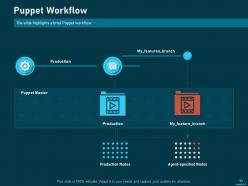
Puppet code version control strategies include Git branching workflows, environment-specific repositories, automated testing pipelines, code review processes, and semantic versioning for modules. Through GitOps practices, organizations streamline deployments across development, staging, and production environments, while implementing continuous integration validates configurations before deployment, ultimately delivering consistent infrastructure management and reducing configuration drift across enterprise systems.
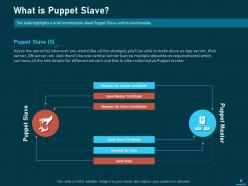
Puppet's agent/master architecture enhances configuration management by centralizing policy definition, automating configuration distribution, and ensuring consistent system states across distributed environments. This model enables organizations to manage thousands of servers efficiently, with agents automatically pulling configurations from masters, reporting compliance status, and maintaining desired states, ultimately delivering scalable infrastructure management and reduced operational overhead.
PuppetDB serves as Puppet's centralized database for storing node facts, catalogs, and reports, enabling comprehensive inventory management and historical tracking across infrastructure. It streamlines operations by providing real-time queries, resource compliance monitoring, and detailed analytics, with many organizations finding that this centralized approach significantly enhances visibility, troubleshooting capabilities, and automated decision-making processes.
Puppet integrates with cloud providers through APIs, cloud-specific modules, and orchestration tools like Terraform, enabling dynamic resource provisioning and automated configuration updates. Through AWS EC2, Azure Resource Manager, and Google Cloud Platform integrations, organizations streamline infrastructure deployment, automatically scale configurations based on demand, and maintain consistent environments across hybrid cloud architectures, ultimately delivering faster deployment cycles and reduced operational overhead.
Common implementation challenges include resource conflicts, complex dependency management, inadequate testing procedures, scaling configuration complexity, and insufficient team training on Puppet's declarative syntax. Organizations often struggle with maintaining consistency across diverse environments, managing sensitive data securely, and establishing proper version control workflows, though strategic planning and phased rollouts enable teams to minimize disruptions while delivering streamlined infrastructure automation.
Puppet ensures idempotency by continuously checking system states against defined configurations and only making changes when current states differ from desired ones. This approach prevents configuration drift, reduces system downtime, and maintains consistency across infrastructure, with many enterprises finding that idempotent operations streamline deployments while minimizing risks associated with repeated configuration changes.
Security considerations for Puppet managing sensitive data include encrypted communication channels, role-based access controls, secret management integration, certificate-based authentication, and audit logging capabilities. Through these mechanisms, organizations in banking, healthcare, and financial services can automate infrastructure provisioning while maintaining compliance standards, ultimately delivering enhanced operational security and streamlined resource management across distributed environments.
Puppet integrates with Kubernetes through configuration management of host systems, automated provisioning of cluster nodes, and management of underlying infrastructure components. While Kubernetes handles container orchestration, Puppet ensures consistent server configurations, security policies, and compliance standards across the infrastructure, with many organizations finding that this strategic combination delivers enhanced operational efficiency and streamlined deployment processes.
-
Editable templates with innovative design and color combination.
-
Much better than the original! Thanks for the quick turnaround.
-
Great quality product.
-
Wonderful templates design to use in business meetings.
-
Visually stunning presentation, love the content.