

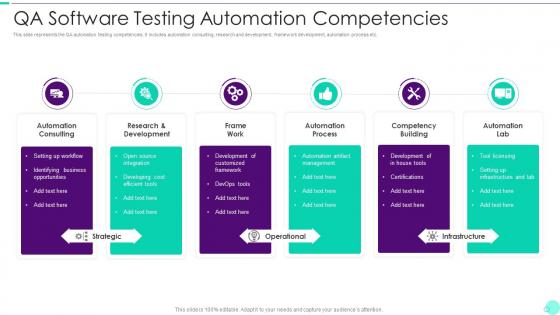
QA Software Testing Automation Competencies




Try Before you Buy Download Free Sample Product
 Impress Your
 Audience
 100%
100% Editable
 Save Hours
 of Time


This slide represents the QA automation testing competencies. It includes automation consulting, research and development, framework development, automation process etc.
People who downloaded this PowerPoint presentation also viewed the following :
QA Software Testing Automation Competencies with all 6 slides:
Use our QA Software Testing Automation Competencies to effectively help you save your valuable time. They are readymade to fit into any presentation structure.





FAQs for QA Software
Honestly, start with Python or JavaScript - they're everywhere in QA. Pick up Selenium first, then maybe Cypress or Playwright later. The tools change constantly (kinda annoying tbh) but the core ideas don't. Git's a must for version control, and you'll want some basic database stuff for managing test data. API testing is massive right now since everything talks to everything else. Oh, and CI/CD pipelines - can't escape those. My advice? Master one language and framework really well before jumping around. Way better than being mediocre at five different things.
Your programming skills basically make or break how good your automation gets. Strong coding lets you build solid frameworks and tackle weird edge cases without losing your mind. I've watched people burn entire afternoons debugging simple loops - it's painful to see. Page object models, data-driven tests, all that fancy stuff becomes way easier when you actually know what you're doing. But honestly? Pick one language first and get decent at it. Don't jump around trying to learn everything at once, you'll just confuse yourself. The debugging skills alone are worth it.
Frameworks are pretty much essential for testing - you don't want to be building everything from scratch. JUnit, TestNG, Pytest, whatever fits your stack... they handle all the boring setup stuff, assertions, parallel runs, reporting. Otherwise you're just writing sloppy code that'll annoy you later. Honestly, I'd rather spend time writing actual tests than figuring out how to organize them. Pick one that works with your tech and get really good at it first. Don't jump around between different ones right away - that's just confusing yourself.
So CI/CD is basically where the magic happens with QA automation. Your tests can run automatically every time someone pushes code - no more manual test runs after every little change. Bugs get caught super early, which honestly saves everyone's sanity. Developers get instant feedback too, so they're not waiting around wondering if they broke something. You can set up different test types at different stages - like unit tests first, then integration, then the full end-to-end stuff. Oh and the feedback loop thing? Total game changer. Just start by connecting your current test framework to whatever CI tool your team uses.
Honestly, just focus each test on one thing - don't try to cram everything together. Give your test methods names that actually make sense so you're not deciphering cryptic code later. Page Object Model will save your sanity when the UI inevitably changes (trust me on this one). Whatever you do, don't hardcode test data everywhere - use files or factories instead. Oh, and get your waits right or you'll have flaky tests driving everyone crazy. Basically write it like someone else has to fix your mess tomorrow, because let's be real, they probably will.
Honestly, you gotta stop waiting on the sidelines until they're "done" with features - that's where most QA people mess up. Jump into their standups and sprint planning so you actually know what's coming. I'd start writing automation scripts while they're coding, not after. Code reviews together are gold too. Your test environments should match what they're building (seems obvious but you'd be surprised). The whole point is thinking about quality from the start instead of just being the person who says "nope, broken" at the end. Makes everyone's life easier.
Track your execution times, pass/fail rates, and code coverage - those are the big ones. Flaky tests are the worst, so definitely measure that percentage. Nothing kills productivity like randomly failing tests that worked fine yesterday. Monitor how many bugs you're actually catching before they hit production too. Oh, and keep an eye on maintenance effort since broken tests can eat up your whole day. I set up a weekly dashboard for all this stuff - makes it way easier to catch problems early instead of wondering why everything's suddenly broken.
Look, QA automation changes so ridiculously fast that you'll get left behind if you don't stay current. New frameworks pop up constantly. AI testing tools are everywhere now. What worked two years ago? Probably useless today. I spend maybe 30 minutes each week just browsing QA blogs or messing around with new tools - nothing crazy structured. Reddit's automation communities are actually pretty solid for picking up trends. Trust me, you don't want to be that person frantically trying to learn everything during your next job hunt. Been there, it's rough.
Honestly, the hardest part is just how long everything takes - way longer than your boss will want to hear. Your team's gonna need serious time to learn the frameworks and scripting because those old record-and-playback tools are pretty much useless now. Then you get stuck choosing between like 50 different automation tools, which is its own nightmare. Start with your most boring, repetitive tests first. Those flaky tests that break constantly? Yeah, you'll spend half your time fixing those instead of writing new ones. Management always expects results immediately but the setup phase is brutal. Definitely invest in training upfront though - it's the only way this actually works.
Honestly, just compare your time savings to what you spent setting everything up. Say your team used to burn 40 hours on regression testing each release - now automation cuts that to 5 hours. That's massive. Don't forget the hidden costs though: tool licenses, setup time, maintaining the scripts (which is more work than people think). Bug fixes are cheaper when caught early, but that's harder to put exact numbers on. Track everything from day one so you've got real data when your boss asks if it was worth it.
API testing is seriously a game changer - you catch integration problems way before they mess up your UI. It's much faster than running those massive end-to-end tests too. Basically you're making sure all your services actually talk to each other properly, which saves you from those awful moments where the frontend looks perfect but your data's totally screwed up behind the scenes. APIs don't change as much as UIs either, so tests won't randomly break when someone tweaks a button color or whatever. Start building your test suite early and you'll catch breaking changes right away. Trust me on this one.
Dude, totally worth learning multiple languages as a QA automation engineer. You won't be stuck when teams use different tech stacks. Python's perfect for quick scripts and data stuff, while Java works great with enterprise frameworks like Selenium. JavaScript? That covers both frontend and backend testing. Honestly, interviewers eat that stuff up too. But here's the thing - you actually get programming concepts way better once you've seen them work across different languages. Oh, and don't try learning everything at once lol. Get solid with one first, then add others when projects need them. Makes the whole process less overwhelming.
Okay so test data management - three things that'll save your sanity. Build reusable datasets for your main scenarios first, trust me on this one. Data factories are clutch for generating fresh stuff instead of those crusty static files that break everything. Oh and clean up between runs! Shared data between tests is where everything goes to hell. I'd start by looking at what you've got now and figure out which tests are stepping on each other. Boring topic but your future self will thank you when things actually work.
Honestly, you really need cloud knowledge for QA automation these days. Most apps run across multiple services now, so understanding containerization and distributed systems is pretty much required. Docker should be your starting point - I'd pick up at least one major cloud provider's testing tools too. The parallel testing capabilities are insane though, like running thousands of tests at once. Without this stuff, you'll hit walls with environment management and scaling your automation. Oh, and deployment pipelines become way easier once you get the hang of it.
Honestly, the worst thing you can do is try automating everything at once. I've watched entire teams crash and burn doing that. Pick the boring, stable stuff first - not those flaky UI tests that'll drive you insane. Make sure you actually plan this out though. Choose tools that make sense and verify your team can handle the coding side before jumping in. Oh, and skip anything that changes constantly - total waste of time. Stick with regression tests for your main features first. You'll get some quick wins, then expand from there once you've got momentum.
-
The PPTs are extremely simple to modify. Thank you for providing the slides that are ready to be used. They assist me in saving a lot of time.
-
“One of the best experiences with SlideTeam for my presentation.Everything on time, communication is efficient and price is reasonable. All good in one place.”