

QA Software Testing Services Comparative Analysis





Try Before you Buy Download Free Sample Product
 Impress Your
Audience
 100%
Editable
 Save Hours
of Time


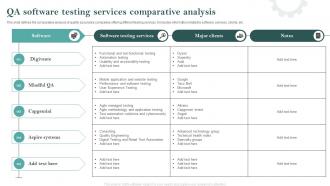
This slide defines the comparative analysis of quality assurance companies offering different testing services. It includes information related to software, services, clients, etc.
People who downloaded this PowerPoint presentation also viewed the following :
QA Software Testing Services Comparative Analysis with all 6 slides:
Use our QA Software Testing Services Comparative Analysis to effectively help you save your valuable time. They are readymade to fit into any presentation structure.





FAQs for QA Software Testing
QA software testing services aim to identify defects early, ensure functionality meets requirements, validate performance under various conditions, verify security protocols, and maintain code quality throughout development cycles. These comprehensive testing approaches streamline deployment processes, reduce post-launch issues, and enhance user satisfaction, with many organizations finding that systematic quality assurance significantly minimizes costly fixes while accelerating reliable product delivery.
Automated testing delivers significantly higher efficiency through faster execution, continuous integration, and 24/7 capability, while manual testing excels in exploratory scenarios, user experience validation, and complex edge cases. Organizations increasingly adopt a strategic combination, with automated testing handling repetitive regression suites and manual testing focusing on usability insights, ultimately achieving comprehensive coverage while reducing time-to-market and testing costs.
QA testing services ensure compliance by validating software against industry-specific regulations, conducting security audits, and implementing standardized testing protocols that meet regulatory requirements. These services help organizations in healthcare, finance, and manufacturing maintain GDPR, HIPAA, and FDA compliance while streamlining certification processes, ultimately reducing regulatory risks and accelerating market entry.
QA teams can effectively measure software quality through comprehensive metrics including defect density, test coverage, customer satisfaction scores, performance benchmarks, and mean time to resolution. These measurement frameworks enable organizations to track product reliability, identify improvement areas, and optimize release cycles, with many financial services and healthcare companies finding that systematic quality metrics ultimately deliver faster deployments and enhanced user experiences.
Common QA software testing tools include Selenium for automation, JIRA for defect tracking, TestRail for test management, Postman for API testing, and LoadRunner for performance testing. These technologies streamline testing workflows by automating repetitive tasks, enhancing defect visibility, and accelerating release cycles, with many development teams finding that strategic tool combinations ultimately deliver faster deployment and improved software quality.
QA software testing services enhance user experience by identifying usability issues, performance bottlenecks, and functionality gaps before product launch. Through comprehensive testing across devices and user scenarios, these services streamline navigation, minimize load times, and ensure intuitive interfaces, with many organizations finding that rigorous QA testing significantly reduces user complaints and increases customer satisfaction rates.
Agile methodologies revolutionize QA testing processes by enabling continuous integration, shorter feedback loops, collaborative cross-functional teams, and iterative testing cycles throughout development phases. This approach streamlines quality assurance through automated testing frameworks, real-time defect resolution, and enhanced communication between developers and testers, ultimately delivering faster releases and improved product quality.
Organizations can balance thorough testing with tight deadlines by implementing risk-based testing approaches, parallel testing phases, and automated regression suites that prioritize critical functionalities over comprehensive coverage. Through strategic test planning and continuous integration practices, companies in sectors like fintech and healthcare streamline quality assurance while maintaining essential standards, ultimately delivering reliable products faster without compromising core user experiences.
Functional testing validates what the software does by verifying features, user interactions, and business logic against requirements, while non-functional testing examines how the software performs through load testing, security assessments, and usability evaluations. These complementary approaches enable organizations to deliver robust applications that meet user expectations and perform reliably under real-world conditions, ultimately ensuring competitive advantage.
QA software testing services adapt to AI and machine learning by implementing intelligent test automation, predictive defect analysis, and AI-driven test case generation. These technologies enable testing teams to automatically identify high-risk areas, optimize test coverage, and accelerate release cycles, with many organizations finding that AI-enhanced testing delivers faster deployment and improved software quality.
QA teams testing mobile applications face device fragmentation across different operating systems, screen sizes, and hardware configurations, network connectivity variations, performance optimization requirements, and security vulnerability assessments. These challenges are amplified by the need for continuous testing cycles, battery consumption monitoring, and user experience validation across platforms, with many organizations finding that automated testing frameworks and cloud-based device labs streamline these complex processes.
Performance testing evaluates overall system responsiveness, stability, and resource usage under various conditions, while load testing specifically measures behavior under expected user volumes and peak traffic scenarios. Both are critical because performance testing identifies bottlenecks in speed, memory, and processing across different environments, while load testing ensures applications can handle real-world user demands without crashes, ultimately delivering reliable user experiences and preventing costly system failures.
QA teams can enhance communication through daily stand-ups, shared testing documentation, integrated bug tracking systems, collaborative test planning sessions, and cross-functional code reviews. These strategies streamline feedback loops by fostering real-time dialogue, establishing clear defect resolution processes, and creating mutual understanding of requirements, ultimately delivering faster release cycles and higher software quality across development teams.
Continuous testing is critical in DevOps environments as it enables rapid feedback cycles, reduces deployment risks, and maintains software quality throughout accelerated development processes. Through automated test integration, real-time monitoring, and seamless CI/CD pipeline incorporation, organizations streamline release cycles, minimize production defects, and enhance customer experiences, with many development teams finding that continuous testing ultimately delivers faster time-to-market and competitive advantage.
Security testing best practices include threat modeling, vulnerability assessments, penetration testing, authentication validation, and data encryption verification. These methodologies enhance system resilience by identifying potential breaches, validating access controls, and ensuring compliance standards, with many financial services and healthcare organizations finding that comprehensive security testing ultimately delivers reduced risk exposure and stronger customer trust.
-
A fantastic collection of templates. I'll likely use this as my go-to resource for future templates and support.
-
They guys always go the extra mile to meet the expectations of their customers. Almost a year has been associated with them.