

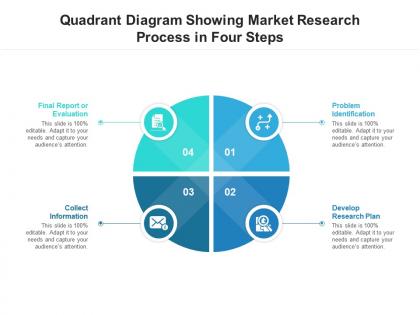
Quadrant diagram showing market research process in four steps




Try Before you Buy Download Free Sample Product
 Impress Your
 Audience
 100%
100% Editable
 Save Hours
 of Time


Our Quadrant Diagram Showing Market Research Process In Four Steps are topically designed to provide an attractive backdrop to any subject. Use them to look like a presentation pro.
People who downloaded this PowerPoint presentation also viewed the following :
Quadrant diagram showing market research process in four steps with all 2 slides:
Use our Quadrant Diagram Showing Market Research Process In Four Steps to effectively help you save your valuable time. They are readymade to fit into any presentation structure.

FAQs for Quadrant diagram showing market research process
The key stages of the market research process include problem definition, research design development, data collection methodology selection, fieldwork execution, and analysis with reporting. These stages work systematically to guide organizations through comprehensive market analysis, with companies in sectors like retail, healthcare, and financial services finding that following this structured approach delivers actionable insights, reduces decision-making risks, and ultimately enhances competitive positioning.
Businesses effectively define research objectives by identifying specific information gaps, establishing measurable goals, aligning research with strategic priorities, and determining actionable outcomes they need to achieve. Through clear objective-setting frameworks, companies streamline resource allocation, focus data collection efforts, and ensure research delivers actionable insights that drive informed decision-making, ultimately enhancing competitive advantage.
Primary data collection methods include surveys, interviews, focus groups, observations, and experiments. These approaches enable researchers to gather firsthand insights by directly engaging target audiences, conducting in-depth discussions, and analyzing consumer behavior patterns, ultimately delivering customized data that addresses specific research objectives and enhances strategic decision-making capabilities.
Secondary data enhances market research by providing foundational insights, reducing costs, accelerating timelines, and offering broader market context that primary research alone cannot deliver. Through existing industry reports, competitor analyses, and demographic studies, organizations streamline their research approach while identifying key trends and gaps, ultimately enabling more targeted primary research and strategic decision-making.
Data analysis transforms raw market research data into actionable business insights by identifying patterns, trends, correlations, and statistical relationships within customer feedback, survey responses, and behavioral data. Through advanced analytics techniques, organizations can segment audiences, predict market opportunities, and validate strategic assumptions, ultimately enabling data-driven decision making that enhances competitive positioning and minimizes investment risks.
Qualitative research explores consumer motivations, attitudes, and behaviors through interviews, focus groups, and observations, while quantitative research measures data through surveys, statistics, and numerical analysis. While qualitative methods help companies understand the "why" behind consumer decisions, quantitative approaches provide measurable insights for strategic planning, with many organizations combining both methods to enhance market understanding and competitive positioning.
**INPUT**: What are some best practices for designing a survey for market research? **OUTPUT**: Best practices for market research surveys include clear objective definition, targeted question design, logical flow structure, appropriate response scales, and thorough pre-testing with sample groups. These approaches streamline data collection by minimizing bias, maximizing response rates, and ensuring actionable insights, with many organizations finding that well-designed surveys deliver more accurate customer understanding and competitive advantage. [Word count: 54 words]
Market segmentation enhances research effectiveness by creating targeted consumer groups based on demographics, behavior, psychographics, and geographic factors, enabling more precise data collection and analysis. This strategic approach allows businesses to develop tailored marketing strategies, optimize resource allocation, and deliver personalized customer experiences, with many retailers and financial services finding significantly improved campaign performance and competitive advantage.
Survey platforms like Qualtrics and SurveyMonkey, social media analytics tools, web scraping software, mobile data collection apps, and automated interview transcription services significantly streamline market research data gathering. These technologies enhance efficiency by reducing manual data entry, enabling real-time responses, and providing integrated analytics, with many research teams finding faster project completion and improved data accuracy.
Businesses should choose target audiences by analyzing demographics, purchasing behaviors, geographic location, psychographic profiles, and engagement patterns relevant to their objectives. Through customer segmentation analysis and market data evaluation, companies can identify high-value prospects, understand consumer motivations, and refine messaging strategies, ultimately delivering more effective campaigns and improved ROI across diverse market segments.
**INPUT**: What ethical considerations should be taken into account during market research? **OUTPUT**: Ethical market research considerations include informed consent, data privacy protection, transparent methodology disclosure, unbiased questioning techniques, and secure data storage practices. These principles streamline trust-building with participants, ensure regulatory compliance, and enhance research credibility, with many organizations finding that ethical approaches ultimately deliver more reliable insights and stronger stakeholder relationships. --- **Word count**: 52 words ✓
Businesses can measure market research ROI by comparing research costs against revenue increases from improved decision-making, reduced product failure rates, and enhanced customer targeting accuracy. Through tracking metrics like sales growth, market share gains, and cost savings from avoided mistakes, organizations quantify research value, with many finding that strategic research investments deliver measurable competitive advantages and operational efficiency.
International market research presents challenges including cultural differences, language barriers, regulatory variations, data accessibility limitations, and cost complexities across diverse markets. These obstacles can be addressed through strategic partnerships with local research firms, cultural adaptation methodologies, and technology-enabled data collection, with many multinational corporations finding that investing in region-specific expertise ultimately delivers more accurate insights and competitive advantage in global expansion efforts.
Market research informs product development by identifying unmet customer needs, validating concepts, understanding competitive landscapes, and revealing market gaps that drive innovation opportunities. Through consumer surveys, focus groups, and behavioral analytics, companies like Apple and Netflix continuously refine offerings, reduce development risks, and create products that resonate with target audiences, ultimately delivering higher success rates and competitive advantage.
AI and automation, real-time data analytics, mobile-first research platforms, social listening technologies, and behavioral tracking are revolutionizing market research methodologies. These innovations streamline data collection, enhance predictive accuracy, and deliver deeper consumer insights, with companies across retail, healthcare, and financial services finding that automated analysis reduces research timelines while improving strategic decision-making capabilities.
-
Great designs, Easily Editable.
-
Top Quality presentations that are easily editable.