


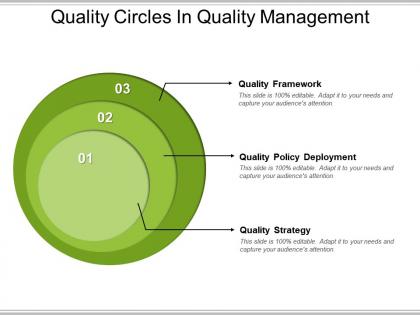
Quality circles in quality management




Try Before you Buy Download Free Sample Product
 Impress Your
 Audience
 100%
100% Editable
 Save Hours
 of Time


Ignite aspirations with our Quality Circles In Quality Management. Fan the fire in their bellies.
People who downloaded this PowerPoint presentation also viewed the following :
Quality circles in quality management with all 5 slides:
Folks find your ideas genuinely inspiring due to our Quality Circles In Quality Management. They become eager to join.

FAQs for Quality circles
Quality circles operate on principles of employee empowerment, continuous improvement, collaborative problem-solving, and voluntary participation, with teams systematically identifying and addressing workplace challenges. These groups function by bringing together employees from similar work areas to analyze processes, develop solutions, and present recommendations to management, ultimately delivering enhanced operational efficiency, reduced costs, and improved employee engagement across manufacturing, healthcare, and service organizations.
Quality circles contribute to employee engagement and morale by empowering workers to identify problems, propose solutions, and participate in decision-making processes that directly impact their work environment. Through regular collaborative meetings and problem-solving sessions, employees feel valued and heard, while organizations benefit from increased job satisfaction, reduced turnover, and enhanced productivity, ultimately delivering stronger workplace culture and competitive advantage.
Forming successful quality circles involves identifying volunteer participants from specific work areas, selecting relevant quality problems, providing structured problem-solving training, establishing regular meeting schedules, and implementing management support systems. These circles enhance workplace engagement by empowering employees to address operational challenges, reduce defects, and streamline processes, with many manufacturing and service organizations finding significant improvements in both quality metrics and employee satisfaction.
Quality circles enhance problem-solving and decision-making by bringing together frontline employees who possess intimate knowledge of operational challenges, enabling collaborative analysis, root cause identification, and practical solution development. These employee-driven teams streamline processes by leveraging diverse perspectives, reducing implementation resistance, and delivering faster problem resolution, with many manufacturing and service organizations finding that worker-generated solutions achieve higher success rates and sustainable improvements.
Leadership plays a crucial role in quality circle effectiveness by providing resources, setting clear expectations, demonstrating commitment to continuous improvement, and creating psychological safety for open dialogue. Strong leaders facilitate meaningful participation by removing barriers, recognizing achievements, and integrating circle recommendations into broader organizational strategies, with many manufacturing and service organizations finding that engaged leadership directly correlates with sustained quality improvements and employee engagement.
Quality circle success metrics include defect reduction rates, cost savings, employee participation levels, implementation rates of suggestions, and customer satisfaction scores. These measurements enable organizations to track both quantitative improvements, such as reduced waste and faster processes, and qualitative benefits like enhanced employee engagement, with many companies finding that comprehensive tracking ultimately delivers sustained operational efficiency and stronger competitive positioning.
Cultural differences significantly impact quality circle implementation through varying communication styles, hierarchical expectations, decision-making approaches, and teamwork preferences across regions. While Western cultures often emphasize individual contribution and direct feedback, Asian cultures prioritize group harmony and consensus-building, with many global companies finding that adapting circle structures to local cultural norms ultimately delivers better employee engagement and sustainable quality improvements.
Manufacturing, healthcare, automotive, and financial services have seen the most success with quality circles due to their complex processes, safety requirements, and customer-facing operations. These industries benefit from frontline worker insights into operational inefficiencies, quality defects, and service bottlenecks, with many organizations finding that employee-driven improvements deliver faster problem resolution, reduced costs, and enhanced customer satisfaction.
Technology enhances quality circles through digital collaboration platforms, data analytics tools, real-time feedback systems, and automated workflow management solutions. These technologies streamline problem identification, accelerate root cause analysis, and enable remote participation, with manufacturing and healthcare organizations finding that digital integration delivers faster issue resolution, improved employee engagement, and measurable quality improvements across operations.
Organizations face challenges including employee resistance to change, lack of management support, insufficient training on problem-solving methodologies, time constraints, and unclear communication channels. These obstacles can be overcome by securing leadership commitment, providing comprehensive training programs, establishing clear objectives and timelines, and creating structured communication processes, with many manufacturing and service companies finding that gradual implementation and continuous feedback ultimately deliver improved employee engagement and operational efficiency.
Quality circles emphasize employee-driven, grassroots problem-solving through small voluntary teams, while Six Sigma focuses on data-driven statistical analysis and Lean targets waste elimination and process flow optimization. These methodologies complement each other strategically, with many manufacturing and service organizations finding that quality circles enhance engagement and ownership, Six Sigma delivers measurable defect reduction, and Lean streamlines operations, ultimately creating comprehensive improvement frameworks.
Training resources for quality circle participants include problem-solving workshops, statistical analysis courses, team collaboration seminars, communication skills development, and quality management fundamentals. These programs enhance employee capabilities by building analytical thinking, fostering collaborative decision-making, and strengthening presentation skills, with many organizations finding that comprehensive training delivers improved problem resolution, higher engagement levels, and sustainable quality improvements.
Feedback from quality circles can be systematically integrated through structured reporting mechanisms, cross-functional implementation teams, regular management reviews, and formal tracking systems that monitor suggestion outcomes. Manufacturing companies and service organizations increasingly find that establishing clear communication channels, designated response timelines, and recognition programs ultimately enhances employee engagement while delivering measurable process improvements and operational efficiency.
Successful quality circle initiatives include Toyota's continuous improvement programs reducing defects by 50%, Motorola's Six Sigma circles achieving 99.99% quality standards, Honda's employee-driven circles cutting production costs by 30%, and Boeing's cross-functional teams enhancing aircraft safety protocols. These initiatives demonstrate how structured employee collaboration delivers measurable operational improvements, cost reductions, and competitive advantages across manufacturing and aerospace industries.
Quality circles support organizational change and innovation by fostering employee engagement, encouraging collaborative problem-solving, and creating structured channels for continuous improvement initiatives. These cross-functional teams enable organizations to identify operational inefficiencies, streamline processes, and implement creative solutions from frontline perspectives, with many manufacturing and service companies finding that employee-driven innovations significantly enhance productivity and competitive advantage.
-
Presentation Design is very nice, good work with the content as well.
-
It saves your time and decrease your efforts in half.