


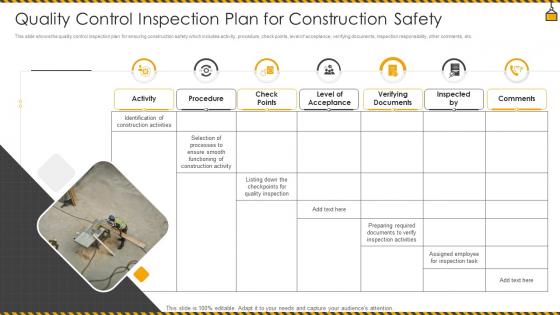
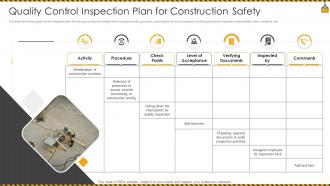
Quality Control Inspection Plan For Construction Safety




Try Before you Buy Download Free Sample Product
 Impress Your
 Audience
 100%
100% Editable
 Save Hours
 of Time


This slide shows the quality control inspection plan for ensuring construction safety which includes activity, procedure, check points, level of acceptance, verifying documents, inspection responsibility, other comments, etc.
People who downloaded this PowerPoint presentation also viewed the following :
Quality Control Inspection Plan For Construction Safety with all 6 slides:
Use our Quality Control Inspection Plan For Construction Safety to effectively help you save your valuable time. They are readymade to fit into any presentation structure.





FAQs for Quality Control Inspection Plan
You'll want clear quality standards first - that's your foundation. Regular inspections and documented procedures come next. Don't forget the feedback loop for improvements. Training your team properly is huge, and honestly? Good measurement tools matter way more than people think. I've seen companies buy cheap equipment and wonder why their quality sucks. Someone needs to own each piece or stuff just gets forgotten. Start with standards everyone can actually understand, then build monitoring around that. Oh, and tackle one thing at a time - trying to fix everything simultaneously never works out.
Dude, automation is a game changer for quality control. Vision systems catch tiny defects humans would totally miss, and sensors monitor everything in real-time without breaks. Honestly, the 24/7 testing alone makes it worth it - no more worrying about someone being off their game that day. The data you'll collect is insane too. You can actually spot patterns and fix problems before they spiral. I'd start with whatever inspection tasks are driving you crazy from repetition. Those boring, mind-numbing checks? Perfect candidates.
Honestly, data analysis is what saves your butt in quality control. All those test results and measurements? They're useless unless you turn them into something you can actually act on. You'll start seeing patterns - like when your process is slowly drifting off track or heading toward a problem. Those statistical control charts look intimidating at first, but they're gold once you figure them out. The data tells you everything: adjust the equipment, retrain someone, or call your supplier. I always tell people to pick your key metrics and track them religiously. Can't fix what you're not measuring, right?
Yeah, so every industry pretty much builds their QC around their worst-case scenarios. Pharma does crazy amounts of testing and paperwork - makes sense when people could die. Manufacturing uses statistical sampling to catch defects. Software teams can just push updates constantly, which honestly seems way easier than everyone else has it. Food companies have to juggle safety with taste and how long stuff lasts on shelves. The trick is figuring out what "failure" actually means for your business, then designing your whole process to stop those specific disasters from happening.
Honestly, the hardest part is getting people on board - everyone hates adding steps to what they're already doing. Costs hit you upfront too, whether it's new software or training time. Half your team will follow the new rules perfectly, the other half will just do whatever feels right. Production deadlines don't care about your quality checks, which creates this constant push-and-pull. If your current setup isn't documented well, you're screwed from the start. Pick one small process to fix first. Get a couple key people excited about it, then document like crazy as you figure it out.
Look, good quality control stops broken stuff from hitting your customers' doorsteps. People get what they expect, they stick around. One crappy product though? They'll bounce to competitors faster than you can say "oops" - and don't get me started on the reviews they'll leave behind. Fewer defects means way less drama with returns and angry support tickets. Here's what actually works: figure out what breaks most often in your process, then set up catch-points before anything ships. It's honestly not rocket science, just gotta be consistent about it.
Honestly, mix hands-on stuff with documentation. Interactive workshops work best - let people practice spotting defects on real products or mock setups. Pair newbies with your experienced QC folks for shadowing. Visual aids are clutch too, like those defect charts they can actually reference without hunting through manuals. Online modules handle the standard procedures fine, but real examples beat everything else. Oh, and don't forget refresher sessions since standards change. The tricky part is making it stick - test their knowledge regularly and jump on issues immediately when you see them happening on the floor.
So Six Sigma is basically about using data to fix quality problems instead of just putting out fires all the time. You follow this DMAIC thing - Define, Measure, Analyze, Improve, Control. Sounds boring but it actually works pretty well. The goal is 99.99966% defect-free, which is crazy precise but whatever. Start by mapping where your process screws up most often - that's where you'll get the biggest wins. My old manager was obsessed with it and honestly, once you get past all the fancy terminology, it's just being really systematic about improvements.
Start with defect rates - honestly this one's your golden metric for catching how many products bomb your quality checks. Customer complaints per thousand units is clutch too since it shows real-world damage. First-pass yield matters big time for keeping costs down (measures how often you nail it on the first try). Cost of quality tracks your spend on prevention and fixing screwups. Oh, and inspection turnaround times because bottlenecks suck. Throw these five on a basic dashboard and check weekly. Trust me on the weekly thing - monthly reviews let problems snowball.
Honestly, the trick with Agile QC is baking it right into your sprints instead of saving it for the end. Get automated tests running and make code reviews a regular thing - trust me, your Definition of Done will save your butt here. Daily standups are perfect for catching problems early. Don't dump everything on your testers though. Everyone owns quality, which sounds cheesy but actually works. Oh, and start with just one or two practices. You don't need to overhaul everything at once.
Honestly depends what industry you're in, but Minitab or JMP are solid for statistical stuff. MasterControl and Sparta Systems are pretty robust for quality management - though they're probably way more than you need starting out. Excel with decent templates works surprisingly well for basic tracking if budget's tight. My take? Go with whatever your team will actually stick with using. The fanciest tool doesn't mean much if nobody touches it after week one. I'd grab free trials of maybe 2-3 options and see what feels right for how you guys work.
So basically QC is your safety net for staying compliant with all those regulatory agencies - FDA, EPA, ISO, whatever applies to your industry. Every test you document and defect you catch before shipping creates the paper trail regulators love seeing during audits. Honestly, the work can be mind-numbing sometimes, but it keeps you out of serious trouble. You'll spot compliance issues early and maintain consistent standards across production. Plus if something does go wrong, you can show you did your due diligence. My old boss used to say treat your QC docs like gold because inspectors will definitely come looking for them eventually.
Look, continuous improvement is what stops your quality control from getting stuck in the past. You analyze data, spot bottlenecks, then tweak processes based on what's actually happening—not what you think should happen. My old supervisor used to say it's like that insanity quote, right? Same QC checks = same problems forever. Small changes work best. Pick one checkpoint and ask "how do we make this 5% better?" Real feedback from your metrics is everything. Otherwise you're just spinning your wheels doing the same stuff that didn't work last month.
Quality can't just be the QC team's problem - everyone needs to own it. Get your CEO using those metrics in actual meetings. People pay attention when leadership does. Train folks on the basics so they get WHY it matters, not just because some policy says so. Celebrate quality wins publicly (not just sales stuff). Make reporting issues super easy and blame-free, then actually do something with the feedback. Honestly, this part trips up most companies. Short sentences work. Connect quality performance to promotions and recognition. People prioritize whatever you measure and reward, period.
Yeah, upfront costs hurt - equipment, software, training, maybe hiring people. But honestly? Companies I know cut return rates in half within a year. The ROI usually hits around 12-18 months because you're avoiding so much waste and rework. Customer complaints drop like crazy too. First thing I'd do is figure out what bad quality costs you right now - missed deadlines, returns, angry clients. That's your number to beat. Those nightmare recall scenarios alone make it worth it. The math pretty much always works out if you're currently dealing with quality issues.
-
They helped us design the pamphlets for our church’s food drive! The people loved the design, and I’m happy to say it was successful. Thank you, SlideTeam!
-
I was mind-blown by the services that SlideTeam provided me. Thanks a ton!