

Quality Improvement Plan For Project Management




Try Before you Buy Download Free Sample Product
 Impress Your
 Audience
 100%
100% Editable
 Save Hours
 of Time


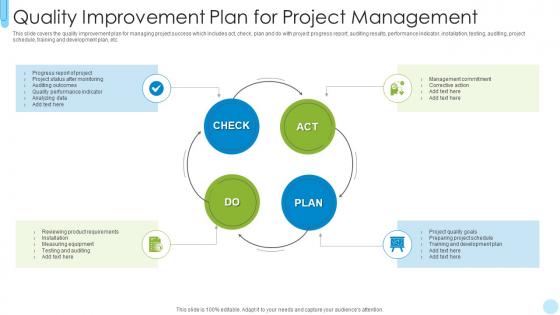
This slide covers the quality improvement plan for managing project success which includes act, check, plan and do with project progress report, auditing results, performance indicator, installation, testing, auditing, project schedule, training and development plan, etc.
People who downloaded this PowerPoint presentation also viewed the following :
Quality Improvement Plan For Project Management with all 6 slides:
Use our Quality Improvement Plan For Project Management to effectively help you save your valuable time. They are readymade to fit into any presentation structure.





FAQs for Quality Improvement Plan
So you need five main things for a solid QI plan. First, nail down exactly what problem you're solving and set measurable goals around it. Root cause analysis comes next - honestly, this is where most people mess up by just fixing surface stuff. Map out specific action steps with clear owners and deadlines. Oh, and don't forget regular check-ins to see if it's actually working. Keep the whole thing simple though. I've seen way too many elaborate plans that look impressive but nobody follows. Your team needs to actually use this thing, so make the timelines realistic and assign one person to each task.
Start with customer feedback - that's honestly where you'll find the real problems. Grab employee surveys too, plus any metrics you're already tracking. Complaint patterns and satisfaction scores are gold mines. Oh, and definitely talk to your frontline people - they catch stuff management totally misses. Process metrics like defect rates help round it out. Once you've got all that data (and yeah, it's a lot), map it against your main processes. The biggest gaps between what's happening and what should be happening will jump out at you pretty quickly.
Look, data analysis is literally everything when it comes to your Quality Improvement Plan. Can't fix what you haven't measured first, right? Grab at least 6 months of data to see what patterns emerge - that's where you'll spot the real problems and figure out root causes. It's like being a detective before you become the solution guy. Once you've got that baseline, you can actually set targets that make sense and pick strategies that'll work. I learned this the hard way on a project last year. Skip the analysis and you're basically throwing darts blindfolded.
Honestly, get people involved from the very beginning - like when you're still figuring out what the actual problem is. Don't just loop them in later for feedback, that's where most plans die. Figure out who's gonna be affected and set up regular touchpoints with each group. Could be quick check-ins, surveys, whatever fits their style. I've watched so many good ideas crash because people felt ambushed by changes they never had a say in. Be real about what you can actually change based on their input, but definitely show them how their suggestions shaped things. Oh, and celebrate the wins together - that part matters more than you'd think.
Here's what's worked for me - you've got to bake those improvements right into your daily processes, not treat them like some side project. Track maybe 2-3 key numbers religiously (dashboards are great for this). Document everything because honestly, when Bob quits next month, you don't want all that knowledge walking out the door with him. Set up regular check-ins so you'll catch problems before they spiral. Keep your team in the loop about wins - people need to see the improvements actually matter. Oh, and create ways for staff to flag issues or tweak things as needed.
Honestly, regs aren't something you tack on later - they're your starting point. Map out what Joint Commission or CMS expects first, then build everything around that. Your metrics and timelines have to match what they want to see anyway. I know it sounds backwards, but use those compliance requirements as your foundation for actual improvements. The guardrails are already there (kinda boring but whatever). Instead of just checking boxes, make the regulatory stuff work for you. Smart teams design their QIP to exceed compliance standards, not just meet them.
Pick 3-5 metrics that actually matter for what you're trying to fix. Defect rates, customer satisfaction, cycle times - stuff like that. Don't forget the process side either, like whether people are following new procedures or finishing training. Honestly, I've seen so many teams drown in data because they track everything. Get your baseline numbers first, then set realistic targets with deadlines. The trick is measuring consistently from the start so you can pivot if things aren't working. Oh, and make sure your targets are actually achievable - nothing kills momentum like impossible goals.
Set up different ways to get feedback - surveys, focus groups, suggestion boxes, whatever works for your setup. Exit interviews are honestly my favorite because people don't hold back when they're already leaving! But here's the thing - you've got to actually show patients what changed because of their feedback, otherwise they'll stop caring. Keep a simple log of complaints and group them by similar issues. That way you can tackle the biggest problems first in your improvement plan. Maybe just pick one method to try this month?
Honestly, the hardest part is just getting people to care. Everyone gets stuck in their routines even when they complain about how broken things are - it's wild. You'll hit walls with unclear goals, not enough budget, and departments that barely talk to each other. Here's what actually works though: get your boss's boss visibly excited about it first. Then bring in the people doing the actual work to help plan stuff. They need to feel like it's theirs, you know? Celebrate every tiny win and keep explaining why this change helps *them* personally, not just makes pretty reports for corporate.
Honestly, automation is a game-changer for tracking QI stuff. Set up dashboards in Tableau or even basic spreadsheet automation - you'll catch trends way faster than doing it manually. Your EHR can actually flag quality issues automatically too, which is pretty neat. Project management tools keep everyone on track with deadlines. The trick is finding something that plays nice with whatever systems you're already using. Don't create another headache, you know? I'd start with just one automated report or dashboard. You'll be shocked how much time it gives you back for the actual improvement work instead of just... collecting data forever.
Skip the boring handouts - do interactive workshops instead. People zone out with theoretical stuff, but they'll actually remember when you make it hands-on. Use real scenarios from their daily work so it doesn't feel pointless. I swear, half the training sessions I've been to are just people staring at PowerPoints! Give role-specific examples and let them ask questions. Check back in a few weeks to see how they're using it. The whole point is making QI feel like useful tools, not just another box to tick off.
Honestly, quarterly reviews are the bare minimum - monthly is way better if you can manage it. I learned this after letting things slide for too long and then scrambling to fix a mess that could've been avoided. Processes shift constantly, new problems come up, and something that worked great last year might be totally useless now. Set those calendar reminders or you'll definitely forget (speaking from experience here). The real trick is actually changing your plan based on what you discover, not just checking a box. Start quarterly and see how it feels.
Look, you need other departments involved or your QI plan will probably tank. Different teams spot problems you'd totally miss on your own. Marketing sees customer pain points, IT knows the tech limitations, operations has the real workflow data - that stuff matters. Honestly, I've watched so many initiatives crash because someone thought they could figure it out solo. Bad idea. When people help build the solution, they actually want it to succeed instead of just complying because they have to. Figure out who touches your process first, then bring them in early. Don't wait until you've already decided everything.
Map your QIP stuff directly to whatever your company's big priorities are this year. Customer satisfaction, revenue, efficiency - find where quality improvements actually move those needles. Honestly, I've watched so many quality projects die because nobody connected them to what leadership actually cares about. Use their language and metrics, not quality-speak. Your milestones should show progress on both fronts. Also random tip - if you haven't looked at your strategic plan recently, do that first. The connection points are usually pretty obvious once you dig in.
So manufacturing and healthcare are obsessed with Six Sigma - makes sense when you need defect rates under 3.4 per million. Lean's perfect for service, retail, and software where you're cutting waste and speeding things up. Tech and creative fields? Agile all the way since requirements change every five minutes. Healthcare's weird though, they actually use both Lean and Six Sigma pretty well. But honestly, don't stress too much about finding the "right" methodology for your industry. Figure out what's driving you crazy first, then pick whatever method actually fixes those problems. Way more effective than following some textbook approach.
-
Much better than the original! Thanks for the quick turnaround.
-
Unique research projects to present in meeting.