


Quality management journey for food processing firm complete deck




Try Before you Buy Download Free Sample Product
 Impress Your
 Audience
 100%
100% Editable
 Save Hours
 of Time


Quality management is a never-ending journey for any organization, but especially for food processing firms. There are always new ways to improve quality and ensure that products meet customer expectations. One way to ensure quality is to have a formal Quality Management System (QMS) in place. This provides a framework for continuous improvement and helps organizations track and address quality issues. SlideTeam’s technology quality assurance ppt templates can help your food processing firm document and track the progress of your quality management journey. Our templates are easy to use and customizable, so you can create a presentation that fits your specific needs. Plus, our team is always here to help if you have any questions. Download our technology quality assurance ppt templates now to get started on making your next presentation about quality management.
People who downloaded this PowerPoint presentation also viewed the following :
Content of this Powerpoint Presentation
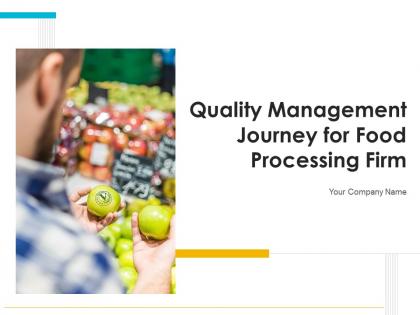
Slide 1: This is a template that illustrates the Quality Management Journey for Food Processing Firms.
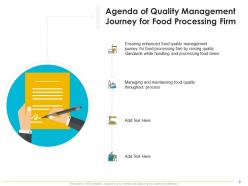
Slide 2: This is an Agenda slide that illustrates the Quality Management Journey for Food Processing Firms, how to manage and maintain the food quality throughout the process, and more.
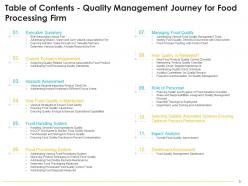
Slide 3: This is a Table of Contents slide that illustrates the executive summary, current scenario assessment, hazards assessment, and more.
Slide 4: This is a Table of Contents slide that illustrates the Executive Summary.
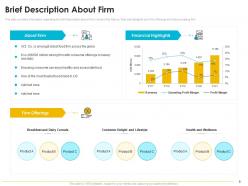
Slide 5: This slide provides information regarding the brief description of the firm in terms of its history, financial highlights, and firm offerings as a food processing firm.
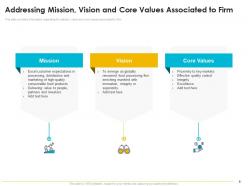
Slide 6: This slide provides information regarding the mission, vision, and core values associated with the firm.
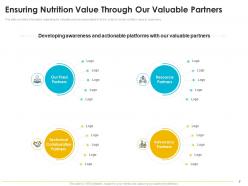
Slide 7: This slide provides information regarding the valuable partners associated with the firm in order to render nutrition value to customers.
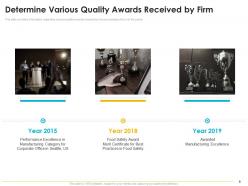
Slide 8: This slide provides information regarding various quality awards received by food processing firms over the years.
Slide 9: This is a Table of Contents slide that illustrates the Current Scenario Assessment.
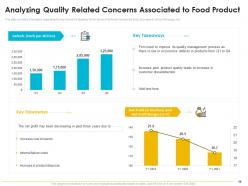
Slide 10: This slide provides information regarding the key concerns faced by firms in terms of defects in produced food, decrease in net profit margin, etc.
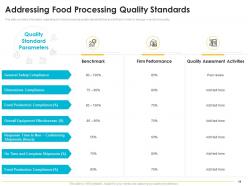
Slide 11: This slide provides information regarding the food processing quality standards that are defined in order to manage overall food quality.
Slide 12: This is a Table of Contents slide that illustrates the Hazards Assessment.
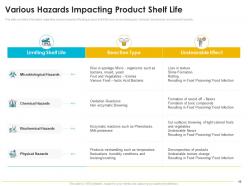
Slide 13: This slide provides information regarding various hazards affecting product shelf life such as microbiological, chemical, biochemical, and physical hazards.
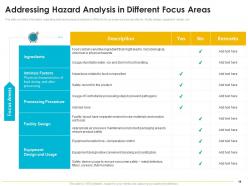
Slide 14: This slide provides information regarding addressing hazard analysis in different focus areas such as ingredients, facility design, equipment design, etc.
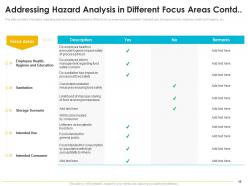
Slide 15: This slide provides information regarding addressing hazard analysis in different focus areas such as sanitation, intended use, storage scenario, employee health, and hygiene, etc.
Slide 16: This is a Table of Contents slide that illustrates How Food Quality is Maintained.
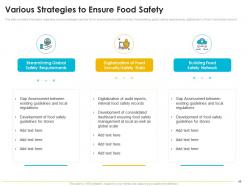
Slide 17: This slide provides information regarding various strategies used by firms in ensuring food safety in terms of streamlining global safety requirements, digitalization of food, and food safety networks.
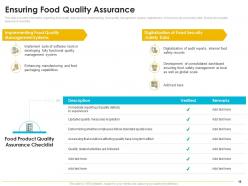
Slide 18: This slide provides information regarding food quality assurance by implementing a food quality management system, digitalization of food security and safety data, and food product quality assurance checklist.
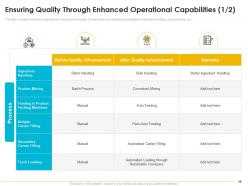
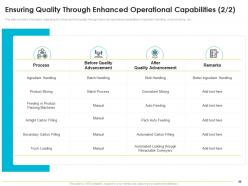
Slide 19: This slide provides information regarding the enhanced food quality through improved operational capabilities in ingredient handling, product mixing, etc.
Slide 20: This slide provides information regarding the enhanced food quality through improved operational capabilities in ingredient handling, product mixing, etc.
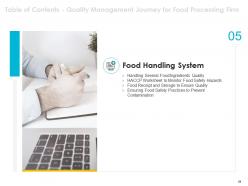
Slide 21: This is a Table of Contents slide that illustrates the Food Handling System.
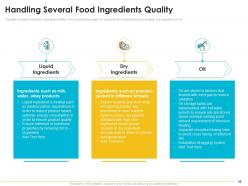
Slide 22: This slide provides information regarding the handling of food ingredients quality for various kinds of ingredients such as liquid, dry ingredient, and oil.
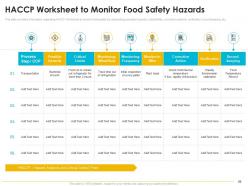
Slide 23: This slide provides information regarding HACCP Worksheet to ensure food quality by addressing possible hazards, critical limits, corrective actions, verification, record keeping, etc.
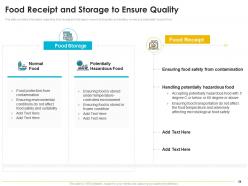
Slide 24: This slide provides information regarding food receipt and storage to ensure food quality by handling normal and potentially hazardous food.
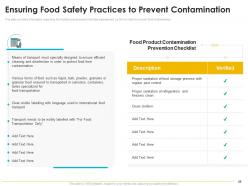
Slide 25: This slide provides information regarding food safety practices and checklists implemented by firms in order to prevent food contamination.
Slide 26: This is a Table of Contents slide that illustrates the Food Processing System.
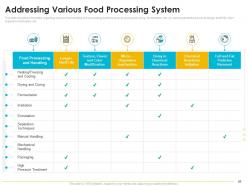
Slide 27: This slide provides information regarding various food handling and processing systems such as drying and curing, fermentation, etc.
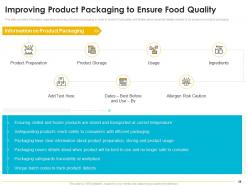
Slide 28: This slide provides information regarding the improvement of product packaging in order to ensure food quality and details about essential details needed to be present on product packaging.
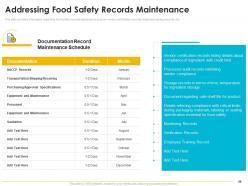
Slide 29: This slide provides information regarding food safety records maintenance, such as vendor certification records, employee training records, and more.
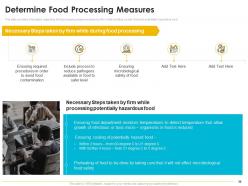
Slide 30: This slide provides information regarding food processing measures taken by firms while handling normal food and potentially hazardous food.
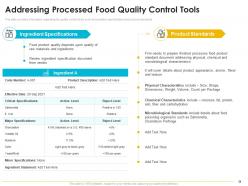
Slide 31: This slide provides information regarding the quality control tools such as ingredient specification and product standards.
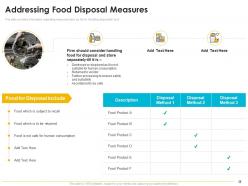
Slide 32: This slide provides information regarding measures taken by firms in handling disposable food.
Slide 33: This is a Table of Contents slide that illustrates how to Manage Food Quality.
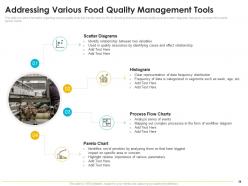
Slide 34: This is a Scatter Diagrams slide that can be used to identify the relationship between two variables.
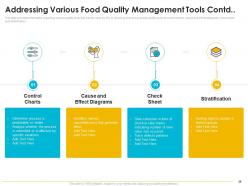
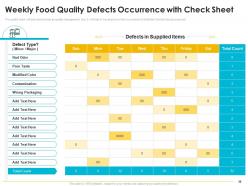
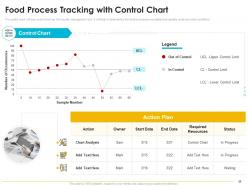
Slide 35: This slide provides information regarding various quality tools that can be used by firms in checking food and process quality such as control charts, cause and effect diagrams, check sheets, and stratification.
Slide 36: This is a slide that represents the Weekly Food Quality Defects Occurrence with Check Sheet.
Slide 37: This is a template that illustrates the Food Process Tracking with Control Chart.
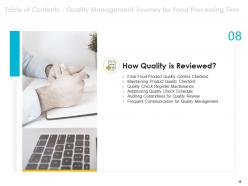
Slide 38: This is a Table of Contents slide on How Quality is Reviewed.
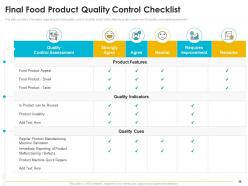
Slide 39: This slide provides information regarding the food quality control checklist which will be filled by the project supervisor for quality controllable assessment.
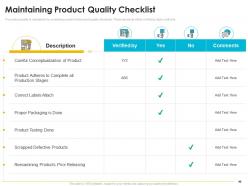
Slide 40: This is a slide that illustrates a method for Maintaining a Product Quality Checklist.
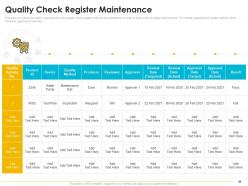
Slide 41: This slide provides information regarding the food quality check register that is to be maintained in order to keep track of quality improvement.
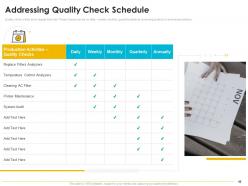
Slide 42: This is a 100% editable slide that represents the Addressing Quality Check Schedule.
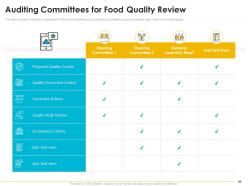
Slide 43: This slide provides information regarding the different committees such as steering committees, the general assembly meets, and will review overall quality.
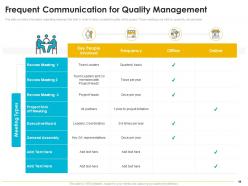
Slide 44: This slide provides information regarding meetings that were held in order to keep consistent quality throughout the project. These meetings are held on a quarterly, annual basis.
Slide 45: This is the Table of Contents slide that represents the Role of Personnel.
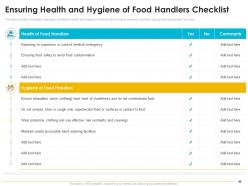
Slide 46: This slide provides information regarding the checklist for the health and hygiene of food handlers to ensure maximum sanitation during the food management process.
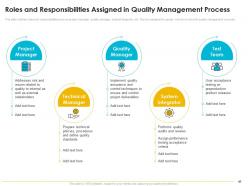
Slide 47: This slide outlines roles and responsibilities such as project manager, quality manager, system integrator, etc. that are assigned to people who are involved in the quality management process.
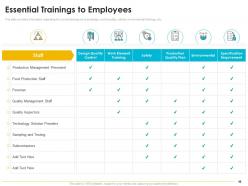
Slide 48: This slide provides information regarding the crucial training such as design control quality, safety, environmental training, etc.
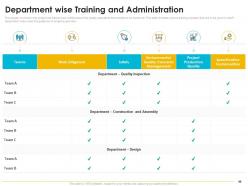
Slide 49: This slide includes various training modules that are to be given to staff department-wise under the guidance of the project supervisor.
Slide 50: This is a Table of Contents slide illustrating the Suitable Automated Systems Ensuring Optimum Process Performance.
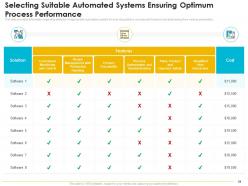
Slide 51: This slide provides information regarding the selection of an appropriate automated system for ensuring optimum process performance and addressing various parameters.
Slide 52: This is the Table of Contents slide illustrating the Overall Food Quality Improvement Impact Analysis.
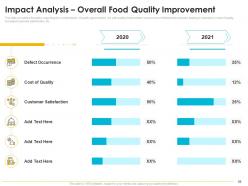
Slide 53: This slide provides information regarding the overall impact of quality improvement. As with quality enhancement, the occurrence of defects has been reduced, leading to a reduction in the cost of quality, increased customer satisfaction, etc.
Slide 54: This is a Table of Contents slide illustrating the Food Quality Management Dashboard.
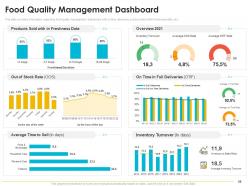
Slide 55: This slide provides information regarding the food quality management dashboard with on-time deliveries, products sold within freshness date, etc.
Slide 56: This is an Icons Slide illustrating the topic Quality Management Journey for Food Processing Firm.
Slide 57: This slide introduces the Additional Slides.
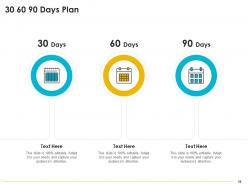
Slide 58: This is a 30-60-90 Day Plan Slide that can adapt to your needs and capture your audience's attention.
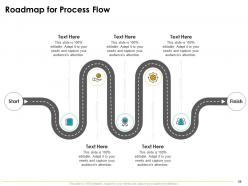
Slide 59: This is a 100% editable Roadmap template that can be used to illustrate the Process Flow.
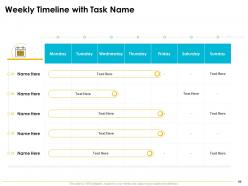
Slide 60: This is a 100% editable Weekly Timeline slide that includes critical task names.
Slide 61: This is a Company introduction template that can be used to illustrate the Mission, Vision, and Goals.
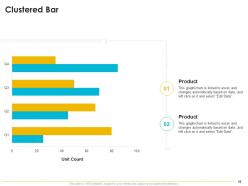
Slide 62: This is a Clustered Bar slide that is linked to excel and changes automatically based on data.
Slide 63: This is a Team introduction template that illustrates the Employee Names and Designation.
Slide 64: This is a 100% editable template that includes the information on Company Targets.
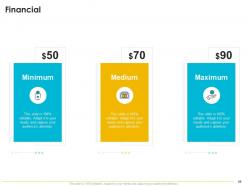
Slide 65: This slide presents the Financial data with the data’s numbers at minimum, medium, and maximum percentage.
Slide 66: This slide provides a Venn diagram that can be used to show interconnectedness and overlap between various departments, projects, etc.
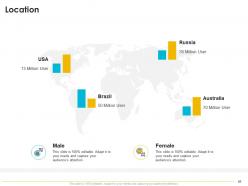
Slide 67: This is a 100% editable Location slide that can be used to display your company’s geographic presentation.
Slide 68: This slide contains Post-It Notes that can be used to express any brief thoughts or ideas.
Slide 69: This is an Idea Generation slide that can be used to represent a new idea.
Slide 70: This is a Thank You template that includes the company address, email, and more.
Quality management journey for food processing firm complete deck with all 70 slides:
Use our Quality Management Journey For Food Processing Firm Complete Deck to effectively help you save your valuable time. They are readymade to fit into any presentation structure.




FAQs for Quality management journey for food processing
Key principles of quality management in food processing include HACCP implementation, strict sanitation protocols, supplier verification, continuous monitoring, and regulatory compliance. These principles work together by preventing contamination, ensuring product consistency, and maintaining safety standards throughout production, with food manufacturers finding that systematic quality management reduces recalls, enhances consumer trust, and delivers sustainable competitive advantage.
Food safety standards fundamentally shape quality management practices by mandating rigorous traceability systems, comprehensive employee training protocols, and systematic monitoring procedures throughout production cycles. These regulatory frameworks enable food processors to streamline compliance documentation, enhance operational transparency, and minimize contamination risks, with many manufacturers finding that integrated safety-quality systems ultimately deliver reduced waste, faster audit processes, and stronger consumer trust.
HACCP serves as a systematic preventive approach that identifies physical, chemical, and biological hazards in food production processes, establishing critical control points to monitor and control these risks throughout manufacturing. This science-based system enables food processors to prevent contamination rather than detect it after occurrence, with companies in dairy, meat processing, and beverage industries finding that HACCP implementation significantly reduces recalls, ensures regulatory compliance, and ultimately delivers safer products while minimizing costly quality failures.
Traceability systems enhance quality management by enabling real-time monitoring, rapid contamination source identification, and comprehensive supply chain visibility throughout food processing operations. These technologies streamline recall processes, reduce waste through precise tracking, and strengthen compliance documentation, with many food manufacturers finding that enhanced traceability ultimately delivers improved consumer safety and competitive market advantage.
Common challenges in large-scale food production include maintaining consistent temperature controls, managing contamination risks across multiple processing lines, ensuring uniform ingredient quality from diverse suppliers, coordinating complex logistics, and meeting varying regulatory standards. These operational complexities require integrated quality systems that streamline monitoring processes, enhance traceability protocols, and deliver automated compliance reporting, with many food manufacturers finding that strategic technology investments ultimately reduce waste while maintaining consumer safety standards.
Sensory evaluation methods contribute to quality assessment by providing consumer-relevant insights through taste panels, aroma profiling, texture analysis, and visual inspection techniques. These approaches enable food manufacturers to validate product consistency, identify formulation improvements, and ensure consumer acceptance before market launch, with many processing facilities finding that systematic sensory testing significantly reduces product recalls while enhancing brand reputation.
Employee training significantly impacts food processing quality by ensuring proper handling techniques, contamination prevention protocols, equipment operation standards, and regulatory compliance procedures. Well-trained staff in food manufacturing facilities consistently deliver safer products, reduce waste through fewer processing errors, and maintain higher customer satisfaction rates, ultimately providing competitive advantage in an increasingly quality-conscious marketplace.
Automation technology enhances food quality management systems by enabling real-time monitoring, automated inspections, and precise control of critical parameters like temperature, pH, and contamination levels. Through AI-powered sensors and robotics, food manufacturers achieve consistent product standards, reduce human error, and ensure compliance with safety regulations, while delivering faster production cycles and minimizing waste across large-scale operations.
Essential metrics include microbial testing results, contamination rates, product consistency measurements, temperature control adherence, and regulatory compliance scores. These indicators enable food processing plants to maintain safety standards, reduce waste, and ensure product quality, with many facilities finding that comprehensive monitoring ultimately delivers enhanced consumer trust and operational efficiency.
Consumer feedback influences quality management strategies by identifying product defects, taste preferences, packaging issues, and safety concerns that internal testing might miss. Food manufacturers use customer reviews, social media monitoring, and direct surveys to refine recipes, enhance packaging durability, and strengthen safety protocols, with many companies finding that responsive quality adjustments based on consumer input significantly improve brand loyalty and market competitiveness.
Environmental considerations in quality management for sustainable food processing include waste reduction strategies, energy-efficient operations, water conservation protocols, sustainable packaging solutions, and carbon footprint monitoring systems. These approaches enable food manufacturers to streamline resource utilization while maintaining product quality, with many processing facilities finding that sustainable practices ultimately deliver operational cost savings, regulatory compliance, and enhanced brand reputation in an increasingly environmentally conscious marketplace.
Six Sigma methodologies enhance food quality management by reducing defects, optimizing processes, and minimizing variability through data-driven analysis and statistical process control. Food manufacturers leverage these approaches to streamline production workflows, improve contamination prevention protocols, and enhance regulatory compliance, with many processors finding that systematic DMAIC implementation ultimately delivers consistent product quality and operational efficiency.
Packaging serves as a critical barrier protecting food from contamination, moisture, oxygen, and temperature fluctuations while preserving nutritional value and extending shelf life. Through advanced materials like vacuum sealing and modified atmosphere packaging, manufacturers in dairy, meat, and produce industries maintain product integrity, reduce waste, and ensure consistent quality delivery to consumers, ultimately enhancing brand reputation.
International quality certifications significantly enhance marketability for food processors by building consumer trust, enabling global market access, and meeting regulatory requirements across different countries. These certifications, including ISO 22000, HACCP, and BRC standards, streamline export processes, reduce compliance barriers, and ultimately deliver competitive advantages, with many processors finding expanded distribution opportunities and premium pricing potential.
Emerging trends include AI-powered quality monitoring, blockchain traceability systems, predictive analytics for contamination prevention, IoT sensors for real-time monitoring, and automated compliance reporting. These technologies streamline operations by reducing manual inspections, enhancing supply chain transparency, and minimizing recall risks, with many food processors finding that integrated digital quality systems ultimately deliver faster compliance responses and stronger consumer trust.
-
Nice and innovative design.