

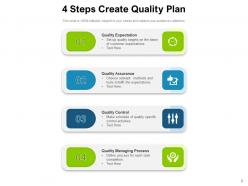
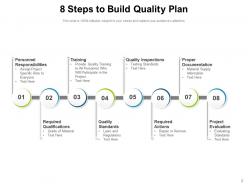
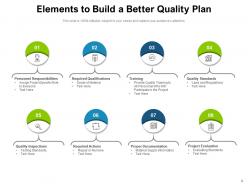
Quality Plan Managing Process Qualifications Evaluation Elements Manufacturing Management





Try Before you Buy Download Free Sample Product
 Impress Your
 Audience
 100%
100% Editable
 Save Hours
 of Time


Our Quality Plan Managing Process Qualifications Evaluation Elements Manufacturing Management are topically designed to provide an attractive backdrop to any subject. Use them to look like a presentation pro.
People who downloaded this PowerPoint presentation also viewed the following :
Quality Plan Managing Process Qualifications Evaluation Elements Manufacturing Management with all 12 slides:
Use our Quality Plan Managing Process Qualifications Evaluation Elements Manufacturing Management to effectively help you save your valuable time. They are readymade to fit into any presentation structure.



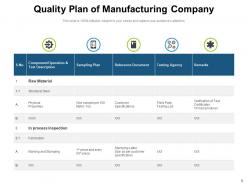
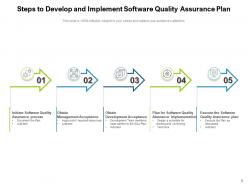
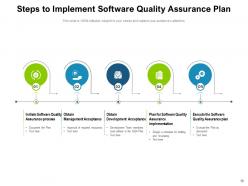
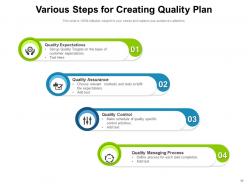

FAQs for Quality Plan Managing Process Qualifications Evaluation
Core quality management principles include customer focus, total employee involvement, process approach, integrated system thinking, strategic improvement, continuous enhancement, fact-based decisions, and mutually beneficial supplier relationships. These principles streamline operations across manufacturing, healthcare, financial services, and retail sectors by reducing defects, enhancing customer satisfaction, and improving operational efficiency, ultimately delivering competitive advantage and sustainable growth.
Organizations effectively implement a quality management system by establishing clear quality policies, mapping comprehensive processes, conducting thorough employee training, and implementing robust monitoring mechanisms. Through systematic documentation and continuous improvement cycles, companies streamline workflows, reduce operational waste, and enhance customer satisfaction, with many manufacturing and service organizations finding that structured QMS implementation delivers measurable cost reductions and competitive advantages.
Leadership plays a pivotal role by establishing quality vision, allocating resources for continuous improvement, modeling quality behaviors, and empowering employees to take ownership of standards. Through strategic communication and accountability systems, leaders in manufacturing, healthcare, and financial services create environments where quality becomes ingrained in daily operations, ultimately delivering enhanced customer satisfaction and sustainable competitive advantage.
Data analytics improves quality management processes by identifying patterns in defects, predicting potential failures before they occur, and optimizing production parameters through real-time monitoring. Manufacturing companies, healthcare institutions, and service organizations leverage predictive analytics to reduce waste, enhance customer satisfaction, and streamline operations, ultimately delivering significant cost savings and competitive advantage.
TQM is a comprehensive management philosophy emphasizing continuous improvement, customer focus, and organization-wide cultural transformation, while ISO 9001 is a specific certification standard providing structured quality management system requirements and documentation frameworks. While TQM delivers holistic cultural change through employee empowerment and process optimization, ISO 9001 enables systematic compliance and operational consistency, with many organizations finding that combining both approaches ultimately enhances competitive advantage and customer satisfaction.
Customer satisfaction metrics inform quality management strategies by identifying performance gaps, revealing process inefficiencies, and highlighting areas requiring immediate improvement across operations, service delivery, and product development. These insights enable organizations to prioritize resource allocation, streamline workflows, and enhance customer experiences, with many companies finding that data-driven quality improvements ultimately deliver higher retention rates and competitive advantage.
Employees can be engaged through cross-functional quality teams, continuous improvement training programs, suggestion systems, quality audits participation, and recognition incentives for process enhancements. These approaches streamline operations by empowering frontline workers, fostering ownership culture, and leveraging diverse perspectives, with manufacturing and healthcare organizations finding that employee-driven quality initiatives deliver measurable performance improvements and competitive advantage.
Organizations transitioning to digital quality management systems face challenges including employee resistance to change, data migration complexities, integration with existing systems, training requirements, and initial implementation costs. However, many manufacturing and healthcare organizations find that these short-term hurdles ultimately deliver streamlined compliance processes, enhanced data accuracy, and improved operational efficiency, providing significant competitive advantages in increasingly regulated industries.
Continuous improvement methodologies integrate into quality management through systematic implementation of PDCA cycles for iterative process refinement, Six Sigma's data-driven approach for defect reduction, and structured problem-solving frameworks. These methodologies enhance operational efficiency by standardizing procedures, minimizing variability, and fostering a culture of continuous enhancement, with manufacturing and healthcare organizations finding significantly improved quality outcomes and reduced costs.
Quality management significantly enhances supply chain performance by reducing defects, minimizing delays, improving supplier relationships, and ensuring consistent product standards throughout the entire network. Through systematic quality controls, organizations streamline operations, reduce costly rework and returns, while building stronger vendor partnerships, ultimately delivering faster fulfillment, lower operational costs, and enhanced customer satisfaction across increasingly complex global supply chains.
Risk management aligns with quality management through integrated planning, continuous monitoring, and preventive controls that identify potential quality failures before they occur. This strategic combination enables organizations to streamline compliance processes, reduce defect-related costs, and enhance customer satisfaction, with many manufacturing and healthcare institutions finding that proactive risk assessment ultimately delivers stronger operational efficiency and competitive advantage.
Best practices for conducting quality audits include establishing clear audit criteria, maintaining auditor independence, using systematic sampling methods, conducting thorough documentation reviews, and ensuring follow-up on corrective actions. These practices enhance operational efficiency by identifying process gaps, reducing compliance risks, and improving product consistency, with many organizations finding that regular audits ultimately deliver better customer satisfaction and competitive advantage.
Effective communication influences quality management success by ensuring clear quality standards, facilitating timely feedback loops, and aligning teams across departments toward common objectives. Through transparent communication channels, organizations streamline issue resolution, enhance employee engagement with quality initiatives, and accelerate continuous improvement processes, ultimately delivering consistent customer experiences and operational excellence.
Emerging quality management trends include AI-driven analytics, predictive quality control, digital twin technology, real-time monitoring systems, and integrated sustainability metrics. These approaches enable organizations to identify defects before production, streamline compliance processes, and enhance customer satisfaction through proactive quality assurance, with many manufacturing and healthcare organizations finding that predictive technologies significantly reduce costs while delivering competitive advantages.
Regulatory requirements fundamentally drive quality management practices in highly regulated industries by mandating strict documentation, standardized processes, continuous monitoring, and regular audits. Industries like pharmaceuticals, aerospace, and financial services must implement comprehensive quality systems that ensure compliance while streamlining operations, ultimately delivering enhanced safety, reduced risks, and competitive advantage through operational excellence.
-
I discovered this website through a google search, the services matched my needs perfectly and the pricing was very reasonable. I was thrilled with the product and the customer service. I will definitely use their slides again for my presentations and recommend them to other colleagues.
-
The content is very helpful from business point of view.